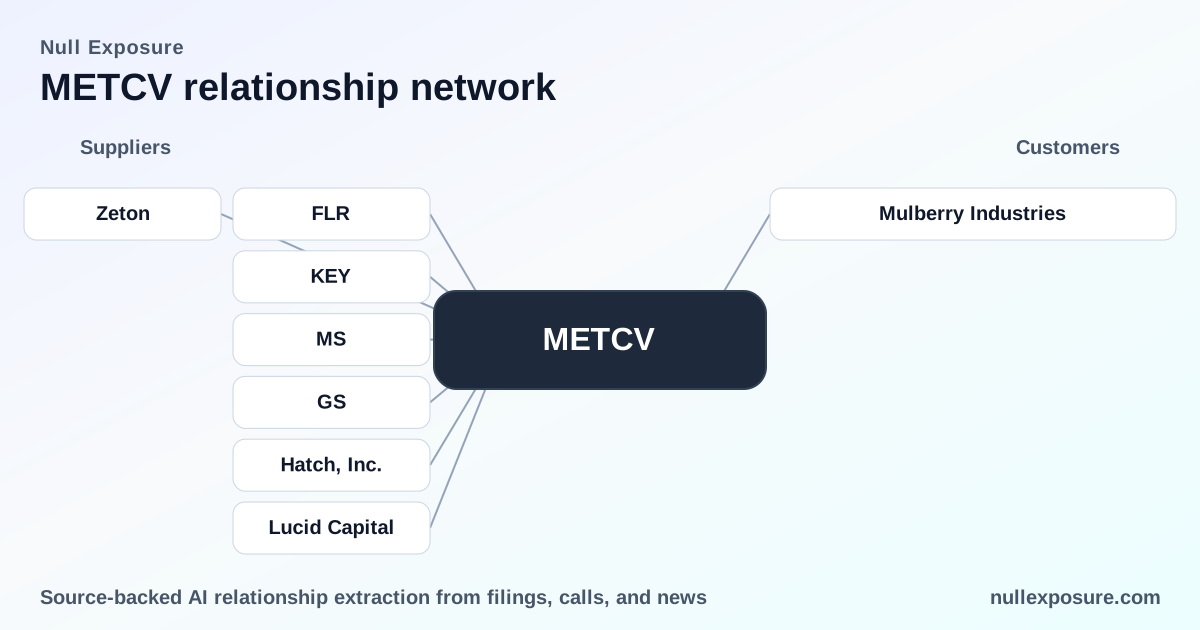
METCV (Ramaco Resources) — supplier relationship map and operating signals for investors
Ramaco Resources operates as a resource developer and miner that monetizes through project-level coal and critical-minerals production, strategic stockpiling/terminal logistics, and staged capital markets financings to underwrite pilot and development capital. The company outsources key engineering and pilot-fabrication work, runs diversified capital relationships across banks and investment houses, and relies on third-party partners to move from PEA-stage studies to pilot operations and commercial scale. For deeper supplier and counterparty background, visit https://nullexposure.com/.
What the relationship list reveals about how Ramaco gets things done
Ramaco is in a capital- and technical-intense phase: it is commissioning engineering studies and pilot facilities while simultaneously layering debt and equity to fund development. The operating model is partnership-driven — large engineering firms prepare economic assessments, specialized fabricators build pilot infrastructure, and banks and underwriters supply bridge and permanent capital. This mix signals a company that is not vertically integrated for critical non-mining capabilities and that uses market counterparties to de‑risk technical and financing execution.
For primary source detail on the company’s FY2026 activity, see the company press release disclosed via PR Newswire in March 2026 and related reporting on facility amendments and financings.
Supplier and financial counterparties: the complete list and what each does
Below I cover every relationship flagged in the available results, with a concise, plain-English description and the source for that description.
-
Fluor Corporation (FLR) — Fluor prepared a Preliminary Economic Assessment (PEA) in mid‑2025 that Ramaco references as part of its project evaluation process, indicating reliance on a major engineering firm for early-stage technical and economic modeling. According to Ramaco’s FY2026 press release on PR Newswire, the PEA was prepared by Fluor in mid‑2025.
-
KeyBank / KeyBank, N.A. (KEY) — KeyBank is the administrative agent and lead bank on a revolving credit facility that Ramaco expanded in December 2025 to $500 million (including a $150 million accordion), and extended the maturity to 2030; the enlarged facility supports working capital and near-term development cash needs. The amendment was disclosed in the Ramaco FY2026 results release and summarized in market reporting in March 2026.
-
Morgan Stanley (MS) — Morgan Stanley led (along with Goldman Sachs) an underwriting that raised $200 million of new equity for Ramaco, demonstrating the company’s use of major investment banks to access public equity capital. The equity raise appears in the FY2026 press release as an underwriting led by Morgan Stanley and Goldman Sachs.
-
Goldman Sachs (GS) — Goldman Sachs co-led the $200 million equity underwriting and is also named as a strategic partner in a critical mineral stockpile and terminal initiative at the Brook Mine, indicating dual roles as underwriter and commercial collaborator. Ramaco’s FY2026 press release describes the Brook Mine initiative and the underwriting activity in the same filing.
-
Hatch, Inc. — Hatch is preparing a revised PEA for Ramaco, with delivery expected by mid‑year, signaling that the company engages multiple engineering consultancies for iterative economic and process design work. Ramaco’s FY2026 announcement explicitly states a revised PEA is being prepared by Hatch.
-
Lucid Capital — Lucid Capital led a public issuance of unsecured notes that generated $65 million in gross proceeds, showing Ramaco’s use of non‑bank debt markets to supplement bank lines and equity. The $65 million unsecured note issuance led by Lucid Capital is disclosed in the FY2026 press release.
-
Zeton — Zeton is the fabrication partner for the interior pilot plant infrastructure in Canada; fabrication is scheduled to recommence at Zeton’s facility once Hatch delivers engineering plans, which makes Zeton a critical vendor for the pilot‑scale process demonstration. Ramaco’s press release references Zeton’s pilot plant role and the restart conditioned on receipt of Hatch plans.
How these relationships translate into investment signals
-
Contracting posture: Ramaco outsources key engineering and pilot fabrication rather than internalizing these capabilities, which reduces fixed engineering headcount but increases dependence on vendor delivery timetables and third‑party schedules. This is a company-level operating characteristic rather than a relationship-specific constraint.
-
Capital mix and concentration: The company spreads financing across a bank-led revolver (KeyBank), investment bank equity underwritings (Morgan Stanley, Goldman Sachs), and public note placements (Lucid Capital). This diversified capital approach lowers single-lender concentration risk and provides flexibility for project staging.
-
Criticality of suppliers: Fabrication by Zeton and PEA work by Fluor/Hatch are mission‑critical to move from study to pilot; supplier delays would translate directly into calendar risk for commercialization. This is a signal about operational dependency on these classes of suppliers.
-
Maturity and execution stage: Multiple PEAs, pilot plant fabrication and stockpile/terminal initiatives all indicate a company in late-predevelopment to pilot stage rather than full commercial maturity. Revenue and cash flows remain contingent on successful scale-up and market access.
Risk and upside distilled for operators and investors
-
Upside: Access to sizeable bank facilities and a $200M underwriting improve liquidity to fund pilots and early development; strategic collaboration with Goldman Sachs on a Brook Mine terminal initiative could open logistics and off‑take optionality. Capital availability and high-profile partners are clear positives for project advancement.
-
Risk: Reliance on external engineering and pilot fabricators concentrates execution risk outside the company; any slippage in Hatch or Zeton deliverables would push timelines. Debt and note issuance increase leverage and fixed obligations ahead of full commercial revenues. Operational progress is supplier-dependent and financing-intensive.
If you want a consolidated view of Ramaco’s supplier footprint and credit posture, explore our broader coverage at https://nullexposure.com/.
Bottom line and next steps for diligence
Ramaco is executing a classic capital-provider-plus-outsource engineering model: it leverages large engineering firms for economic studies, specialized fabricators for pilot plants, and a mix of banks and underwriters to fund the bridge to production. For investors and operators, the focus should be on contract milestone delivery from Hatch/Fluor/Zeton and covenant headroom and rollover capacity in the KeyBank facility as the company progresses from PEA to pilot operations.
Keep monitoring three items closely: (1) delivery timing and content of the revised Hatch PEA; (2) Zeton fabrication milestones tied to pilot commissioning; and (3) covenant and utilization detail on the KeyBank facility and the performance of the unsecured notes. For an ongoing supplier and counterparty tracker you can rely on, visit https://nullexposure.com/ — our coverage consolidates filings and market notices to help you assess execution risk and partner concentration.