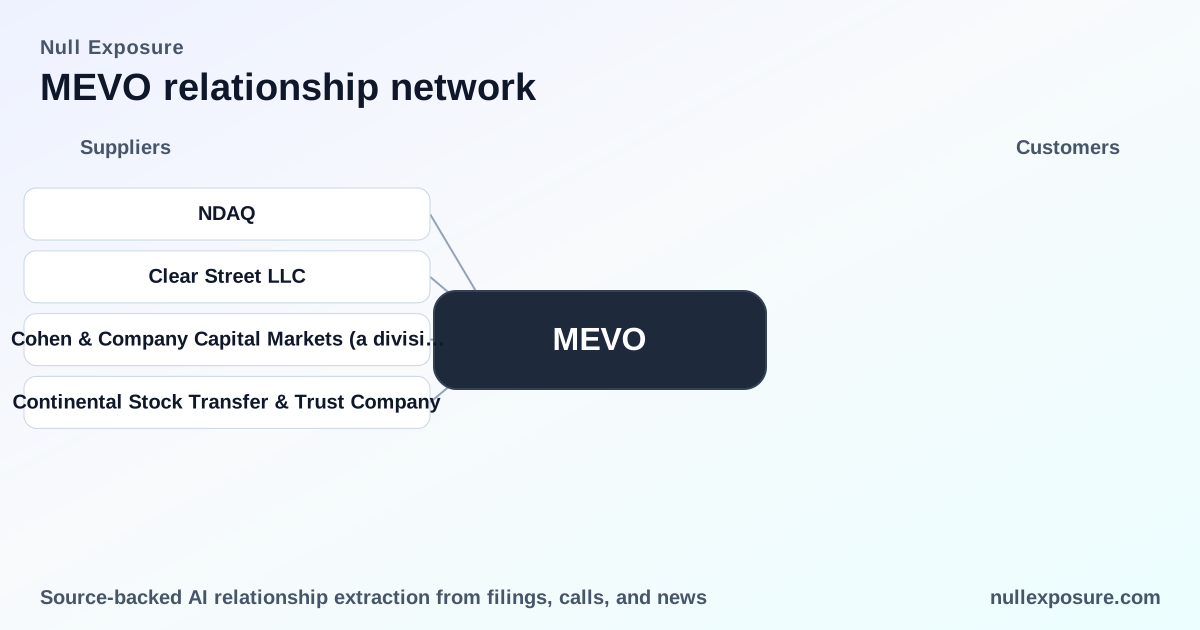
MEVO (supplier view): Market plumbing, counterparty map, and what it means for investors
MEVO operates as a publicly traded vehicle whose economics and shareholder mechanics are driven by capital-markets services rather than operating revenue; the company monetizes through equity issuance and the liquidity its listed securities provide to stakeholders, while third-party vendors — exchanges, underwriters and transfer agents — supply the essential market infrastructure that enables that monetization. For investors and operators evaluating MEVO as a counterparty or partner, the supplier roster is small, conventional, and concentrated around regulated capital‑markets intermediaries whose performance directly determines trading, settlement and investor access.
If you want a concise supplier risk briefing and ongoing supplier-monitoring tools, start here: https://nullexposure.com/
What the supplier mix reveals about MEVO's operating posture
MEVO’s supplier list is functionally narrow and focused on capital‑markets execution. This is a transactional, market-facing contracting posture: relationships are event-driven (listings, unit separations, offerings) rather than long-term supply contracts for goods or services. That structure creates a few practical implications for investors:
- Concentration is inherent and acceptable: a SPAC/blank‑check structure commonly relies on a handful of market intermediaries; concentration is not a structural flaw but a source of operational leverage and counterparty risk.
- Criticality is high for each supplier: any disruption at the exchange, lead book‑runner, co‑manager or transfer agent directly impacts liquidity, tradability and corporate actions.
- Maturity and regulatory oversight are favorable: counterparties in MEVO’s roster are established, regulated players, which reduces operational exoticness but does not eliminate settlement or reputational risk.
No explicit constraints or vendor limitations were provided in the vendor data payload; as a company‑level signal, the absence of constraint disclosures suggests there were no flagged contractual restrictions or unusual vendor covenants captured in this extract.
Supplier-by-supplier breakdown (plain English summaries)
The Nasdaq Stock Market LLC (Nasdaq)
Nasdaq is the listing venue referenced for separate trading of MEVO’s Class A ordinary shares and warrants, meaning MEVO’s liquidity and market tiering depend on Nasdaq’s listing rules and market structure. According to a GlobeNewswire press release distributed via The Manila Times on February 19, 2026, MEVO elected to separately trade its Class A ordinary shares and warrants on the Nasdaq Global Market (https://www.manilatimes.net/2026/02/19/tmt-newswire/globenewswire/m-evo-global-acquisition-corp-ii-announces-the-separate-trading-of-its-class-a-ordinary-shares-and-warrants-commencing-february-19-2026/2280603).
Clear Street LLC
Clear Street acted as a co‑manager on the offering, supplying execution, bookbuilding and secondary market capabilities that support distribution and aftermarket liquidity. The GlobeNewswire/Manila Times notice of February 19, 2026 lists Clear Street as co‑manager for the offering (https://www.manilatimes.net/2026/02/19/tmt-newswire/globenewswire/m-evo-global-acquisition-corp-ii-announces-the-separate-trading-of-its-class-a-ordinary-shares-and-warrants-commencing-february-19-2026/2280603).
Cohen & Company Capital Markets (a division of Cohen & Company Securities, LLC)
Cohen & Company Capital Markets served as lead book‑running manager, directing the primary distribution strategy and underwriting mechanics that determine initial pricing and allocation. The same February 19, 2026 issuance confirms Cohen & Company Capital Markets as lead book‑running manager (https://www.manilatimes.net/2026/02/19/tmt-newswire/globenewswire/m-evo-global-acquisition-corp-ii-announces-the-separate-trading-of-its-class-a-ordinary-shares-and-warrants-commencing-february-19-2026/2280603).
Continental Stock Transfer & Trust Company
Continental Stock Transfer & Trust Company is MEVO’s transfer agent; brokers must contact Continental to separate units into Class A ordinary shares and warrants, which makes Continental operationally essential for shareholder recordkeeping and corporate actions. The instruction to contact Continental as transfer agent is documented in the GlobeNewswire release of February 19, 2026 (https://www.manilatimes.net/2026/02/19/tmt-newswire/globenewswire/m-evo-global-acquisition-corp-ii-announces-the-separate-trading-of-its-class-a-ordinary-shares-and-warrants-commencing-february-19-2026/2280603).
Operational and investor implications — what to watch next
The supplier list is standard for a public acquisition vehicle, but the investor issues are concrete and actionable:
- Liquidity and tradability hinge on Nasdaq: any change in listing status, tier qualification or market rules at Nasdaq will directly affect MEVO’s public valuation and the mechanics for warrants and units. Monitor exchange notices and rule changes.
- Underwriting and distribution execution risk led by Cohen & Company: as lead book‑runner, the firm’s settlement performance and allocation decisions influence aftermarket supply and early pricing behavior. Performance here is measurable (fills, stabilization activity) and impacts float and volatility.
- Secondary execution and market‑making duties from Clear Street: co‑manager activity supports spread compression and order flow; significant withdrawal or operational issues at Clear Street would increase trading costs for MEVO shares.
- Corporate action friction centered on the transfer agent: Continental’s handling of unit separations is a discrete operational gate — backlogs or processing errors would directly delay shareholders’ ability to trade or exercise warrants.
For a practical monitoring approach, prioritize exchange and transfer‑agent notices, and watch underwriter syndicate activity around follow‑on offerings and any redemption windows. If you need a tailored supplier risk scorecard for MEVO, start here: https://nullexposure.com/
Final assessment and recommendations for investors
MEVO’s supplier footprint is small, conventional, and concentrated on regulated capital markets intermediaries — a clear and navigable counterparty map for investors. That concentration creates both efficiency (straightforward governance, predictable market mechanics) and single‑point operational risk (listing or transfer agent disruptions have immediate effects). Active investors should:
- Track Nasdaq listing notices and rule changes for immediate market impact.
- Review public filings and offering materials to understand underwriter warrants, overallotment options and stabilization arrangements.
- Confirm transfer‑agent procedures and timelines before executing unit separation or warrant exercises.
If you want a structured, ongoing supplier exposure analysis for MEVO or other suppliers in your portfolio, explore our analytical offerings at NullExposure: https://nullexposure.com/
The supplier roster is simple but critical; treat each counterparty as a near-term operational dependency that directly colors MEVO’s liquidity and shareholder experience.