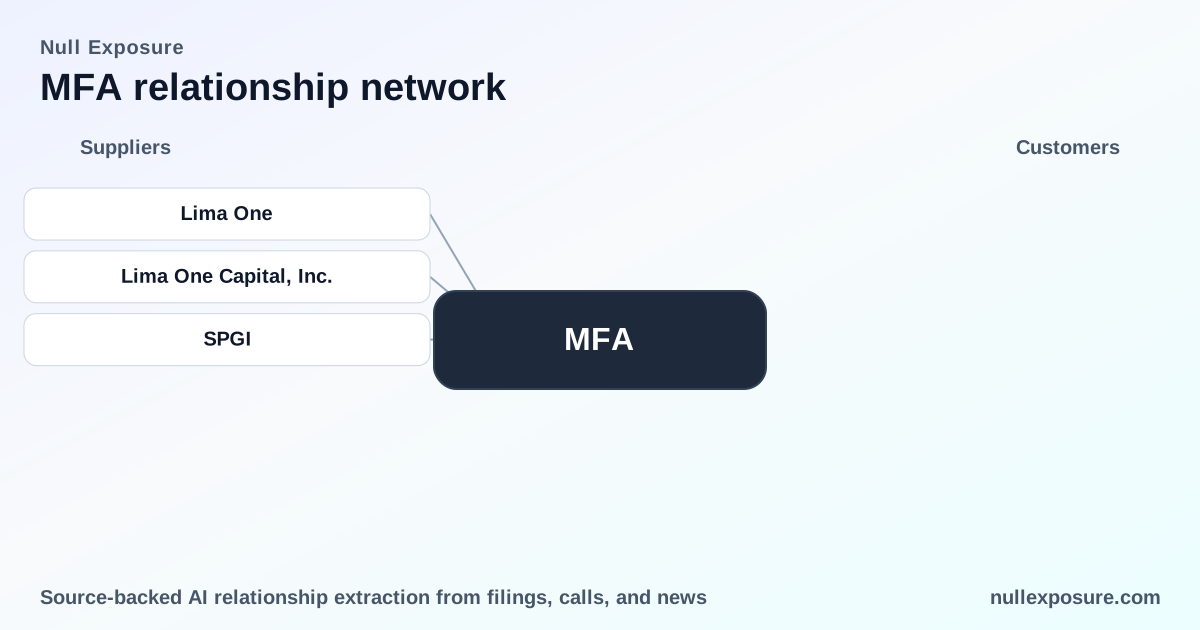
MFA Financial: supplier relationships, financing posture, and what investors should price
MFA Financial is a mortgage REIT that acquires residential whole loans and agency securities and monetizes those assets by earning net interest spread and financing benefits from securitizations and repurchase agreements. The company runs a hybrid financing franchise: it taps short-dated repurchase facilities for liquidity and levered volume while layering in longer-term securitizations and senior notes to lock in stable funding, and it sources originated loans from originators to replenish inventory. Investors should value MFA as a financing and spread-capture business whose upside depends on asset deployment, margin management, and counterparty funding stability. For operational diligence and further supplier mapping, visit https://nullexposure.com/.
Why supplier relationships matter for a mortgage REIT
MFA’s economics hinge on three moving parts: the yield profile of assets it buys, the cost and tenor of its funding, and the operational ability to acquire and service loans. Supplier links — originators, rating agencies, and financing counterparties — directly influence each leg of that triad. The relationships in the public record show MFA both as a buyer/partner with originators and as a sponsor/servicer in structured financings, exposing it to typical counterparty, liquidity and margining dynamics that dominate mortgage REIT risk/return.
If you want a deeper supplier risk scan, see the MFA supplier hub at https://nullexposure.com/ for structured summaries.
What the record shows about MFA’s named counterparties
Lima One — recent loan originations that MFA purchased
MFA disclosed the acquisition of $226 million of business-purpose loans originated by Lima One as part of $1.9 billion of asset purchases in the quarter, alongside $1.2 billion in Agency securities and $443 million in non‑QM loans. This transaction indicates an ongoing originator-to-investor flow that MFA uses to deploy excess cash into higher-yielding whole loans. (Reported in MFA’s Q4 2025 earnings coverage; see The Globe and Mail transcript / March 10, 2026: https://www.theglobeandmail.com/investing/markets/markets-news/Motley%20Fool/285530/mfa-financial-mfa-q4-2025-earnings-call-transcript/)
Lima One Capital, Inc. — strategic partner and portfolio seller (historical)
MFA’s relationship with Lima One Capital dates back to a strategic partnership that evolved from whole‑loan buyer into an acquiring partner; a 2021 report captures Lima One’s CEO noting MFA’s transition to a strategic partner after MFA began buying whole loans to support Lima One’s growth. This historical tie underscores a multi-year origination channel for MFA’s acquisition pipeline. (Upstate Business Journal coverage referencing FY2021 comments on the relationship: https://upstatebusinessjournal.com/business-news/mfa-to-acquire-lima-one-capitals-1-12b-portfolio-assets/)
S&P Global Ratings — ratings counterparty on MFA-sponsored securitizations
MFA routinely acts as sponsor and servicing administrator for securitizations; S&P Global Ratings evaluated one deal structure and outlined expected tranche ratings (AAA to A for senior classes) tied to MFA’s senior‑subordinate structure and excess spread protections. This highlights MFA’s use of rated, structured issuance as a source of non‑recourse, longer‑dated financing. (American Banker / AS Report on MFA securitization activity; FY2022 commentary: https://asreport.americanbanker.com/news/mfa-2022-inv2-returns-for-all-investor-214-5-mbs)
Operating-model constraints that drive valuation and risk
MFA’s public disclosures and supplier mentions reveal a financing posture that blends short-term flexibility with periodic long-term funding anchors. These are company-level signals investors must bake into valuation and stress scenarios:
- Contracting posture — dual tenor funding: MFA uses both short-term repurchase agreements and term warehouse facilities for day-to-day financing while also issuing longer-dated senior notes and structured securitizations that lock in funding through 2029 and beyond. That mix provides both funding agility and interest-rate re‑pricing exposure.
- Concentration and counterparty profile: MFA reports financing arrangements with roughly 14–15 counterparties and warns that adverse developments at major financial institutions could materially curtail borrowing capacity, signaling material counterparty concentration risk at large counterparties.
- Criticality of service relationships: MFA’s role as sponsor and servicing administrator for securitizations and its reliance on loan sub‑servicers and outside vendors makes supplier continuity operationally critical to cashflow collection and collateral management.
- Maturity and activity: The relationship stage is active — MFA was compliant with covenants and reported significant outstanding unpaid principal balances across asset-backed financing agreements, indicating ongoing deployment and live counterparty exposure.
- Scale of spend and asset buying: Company disclosures note multi‑hundred‑million and multibillion dollar acquisition flows (e.g., ~$2.6 billion in residential whole loans in 2024), signaling a high transaction scale that elevates the importance of reliable originator channels and diverse funding partners.
These characteristics mean investors must price both the upside of spread capture and the downside of sudden market-driven reductions in short-term funding or forced deleveraging.
Risk and opportunity: what management’s supplier choices imply
- Upside: MFA’s access to originators such as Lima One provides a steady funnel of higher-yielding whole loans that can meaningfully lift earnings when funded efficiently. Its ability to place assets into rated securitizations generates non-recourse funding that reduces mark-to-market funding volatility.
- Downside: Heavy use of short-term repurchase financing creates refinancing and margin-call risk; an adverse move in counterparties’ willingness to extend repo lines would force asset sales at inopportune times. The company’s reliance on large counterparties makes it susceptible to systemic squeezes in stress scenarios.
- Execution sensitivity: Loan acquisition scale (hundreds of millions per quarter historically) means operational execution — underwriting, servicing and timely securitization — is decisive for realized returns.
For a practical, supplier-focused risk checklist and live counterparty map, go to https://nullexposure.com/.
Final read: how to approach MFA from an investor or operator perspective
MFA is a yield-seeking, funding-sensitive business where supplier relationships are not peripheral — they are central to both growth and risk management. Investors should underwrite MFA on a dual axis: the durability of originator channels (to sustain asset deployment) and the stability/diversity of funding counterparties (to preserve earnings through market cycles). Operational buyers or partner originators should view MFA as a large, active acquirer with documented buying programs; rating agencies and structured-finance market participants treat MFA’s securitizations as material components of its funding fabric.
If your mandate is to monitor counterparty exposure, set up a supplier-tracking workflow and the complete MFA supplier dossier is online at https://nullexposure.com/ — use the materials there to align diligence, stress scenarios and covenant monitoring.
Bold, supplier-aware diligence will separate investors who profit from MFA’s spread capture from those who underprice its funding fragility.