MFA Financial (MFAO): Supplier Relationships and Operational Signals for Investors
MFA Financial operates as a mortgage real estate investment trust that acquires, finances and services residential whole loans and mortgage-related securities. The company monetizes through net interest spread on financed assets, securitization and repurchase financing structures, servicing and origination economics via its Lima One subsidiary, and periodic capital markets activity (including Senior Notes and at-the-market equity offerings). Understanding MFAO’s supplier and counterparty map is essential because the business model blends long-duration asset exposure with short-duration funding and concentrated counterparty relationships. Explore the company profile and supplier signals at https://nullexposure.com/.
One-page supplier map: who MFAO deals with and why it matters
MFAO’s public disclosures and market commentary show a compact but consequential supplier and counterparty footprint: a mix of mortgage originators/servicers, short-term financing counterparties (repo providers), and large banking counterparties that take on concentrated exposure. The firm uses third-party servicers for loan management, relies on short-term repurchase agreements for liquidity, and raises longer-term capital via senior notes and securitizations. These choices create a hybrid contracting posture — long-maturity asset exposures financed with both long-term notes and short-term, rollable repo lines — which drives both return generation and funding volatility.
If you want the source-level supplier intelligence aggregated for diligence, see the MFAO supplier profile at https://nullexposure.com/.
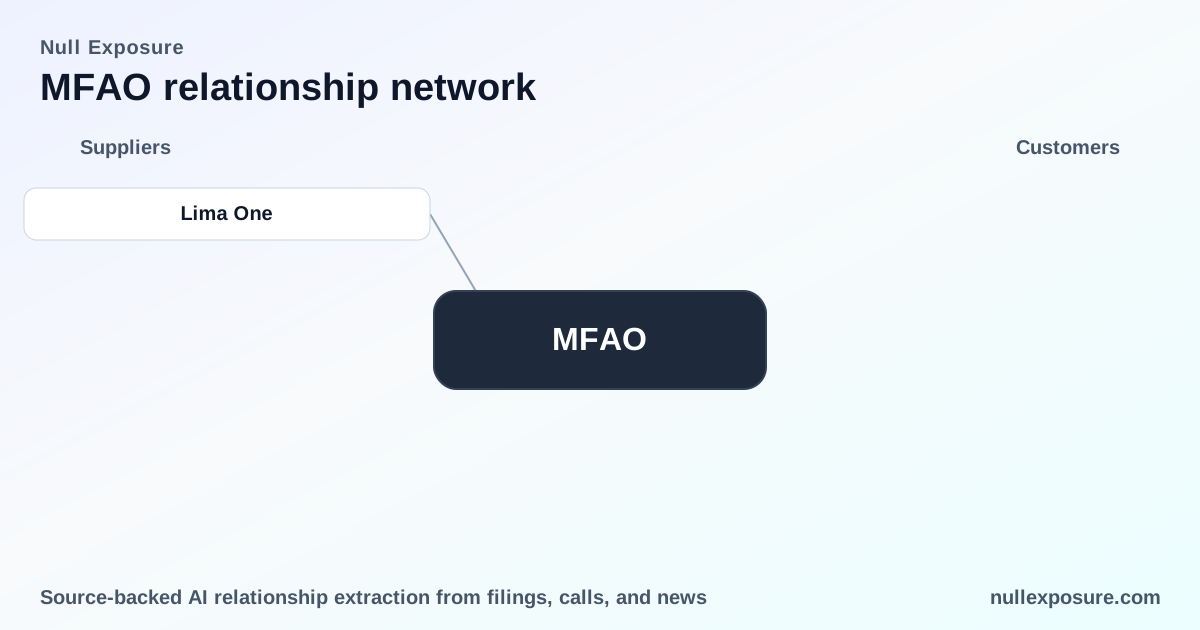
The named supplier relationship in public results: Lima One
Lima One is identified in market reporting as MFA Financial’s mortgage origination and servicing vehicle focused on U.S. residential business-purpose loans. According to a TradingView news item published March 10, 2026, MFA Financial’s activities include originating and servicing business-purpose loans through its Lima One subsidiary, which feeds the company’s whole‑loan investment pipeline and servicing platform (TradingView, March 10, 2026: https://www.tradingview.com/news/tradingview:d5b57f1741d32:0-mfa-financial-inc-sec-10-q-report/).
- Lima One functions as an originator/servicer that supplies loans for MFAO’s investment inventory; that operational link is a core producer of assets that MFAO finances or securitizes.
How the disclosed constraints shape MFAO’s operating model
The disclosure excerpts available present a consistent internal logic about contracting posture, concentration, criticality and maturity:
-
Contracting posture — hybrid and maturity-mismatched. MFAO finances long-duration assets via both long-term, non-recourse securitizations and multi-year notes and via short-term repurchase agreements that reset frequently. Disclosures reference 15‑year leases, Senior Notes maturing in 2029, and repurchase agreements that typically run one to six months. The net effect: asset/liability mismatches are a structural driver of liquidity and repricing risk (company filings and disclosure excerpts, 2024–2025).
-
Counterparty concentration — material exposures to a few very large banks. MFAO reported that as of December 31, 2024, Wells Fargo represented roughly 9.1% and Barclays roughly 5.9% of stockholders’ equity at risk under financing agreements, signaling meaningful concentration to a small number of large counterparties (company disclosures, Dec 31, 2024).
-
Criticality of third-party services. MFAO relies on third‑party servicers to manage mortgages underlying its whole-loan portfolio, and it uses external security monitoring and sales agents under its ATM distribution agreement. These supplier roles are operationally critical because loan performance monitoring and funding executions require uninterrupted third-party service availability (company disclosure excerpts, 2024).
-
Maturity profile and active counterparty base. The company maintained financing agreements with 14–15 counterparties across 2023–2024, indicating an active, multi-counterparty funding network intended to diversify short-term repo and secured lending sources, while still retaining measurable single-counterparty concentration (company filings, 2024).
-
Materiality signal. Several disclosures present financing counterparties where MFAO had greater than 5% of stockholders’ equity at risk, which is an explicit materiality threshold that investors should treat as a direct risk metric (company disclosures, Dec 31, 2024).
What each contractor role implies for operational and investment risk
-
As a service provider: Third-party servicers are central to loan performance and collections; operational failures or vendor transitions can materially affect cash collections and loss mitigation. MFAO’s reliance on external monitoring and threat response tools also creates supplier dependency in cyber and operational resilience.
-
As a buyer of originator loans: MFAO actively buys loans from non-controlling originators; the company disclosed non-controlling investments in certain originators totaling about $16.8 million, highlighting sourcing relationships that supply asset flow and the need to monitor originator credit quality.
-
As a financing counterparty (repo and bank lenders): The short-term repo posture creates rollover risk, while longer-term Senior Notes create scheduled maturities that require refinancing or liquidity planning (notably 8.875% Senior Notes due Feb 15, 2029 and 9.00% Senior Notes issued Apr 17, 2024 due Aug 15, 2029, per company disclosures).
Practical takeaways for investors and operations teams
-
Funding mix is the primary pivot risk. The business earns spreads on long-dated assets while depending materially on short-dated repo financing and a handful of large bank counterparties; under stress, repo lines or concentrated lender weakness would compress liquidity and increase refinancing costs.
-
Counterparty concentration demands active monitoring. Wells Fargo and Barclays together represent material exposure under financing agreements; institutional credit monitoring and scenario testing should focus on these providers’ willingness to continue repo and secured financing facilities under stress.
-
Vendor resilience is a must. Because servicing and security monitoring are outsourced, operations teams must require contractual SLAs, contingency plans, and regular operational audits with servicers.
-
Capital markets levers exist but are not unlimited. MFAO uses securitizations, non‑recourse financing and an ATM equity program to manage capital; investors should track issuance cadence and the company’s ability to place longer-term notes or securitizations when repo markets tighten (company disclosures, 2024).
If you want a concise supplier risk scorecard and proprietary relationship map for MFAO, visit https://nullexposure.com/ to request the full profile.
Final recommendation and next steps
MFA Financial’s supplier architecture is deliberately hybrid: it leverages originator/servicer relationships (Lima One) to produce loan assets while funding those assets through a combination of short-term repo, securitizations and longer-term notes. That hybridization creates opportunities for spread capture and securitization arbitrage, and it creates funding concentration and rollover risk that investors and operators must actively manage. Track counterparty concentrations to large banks, the maturity schedule of senior notes through 2029, and the operational resilience of third‑party servicers.
For a deeper operational read and relationship evidence tailored to due diligence or integration planning, go to https://nullexposure.com/ and request the MFAO supplier dossier.