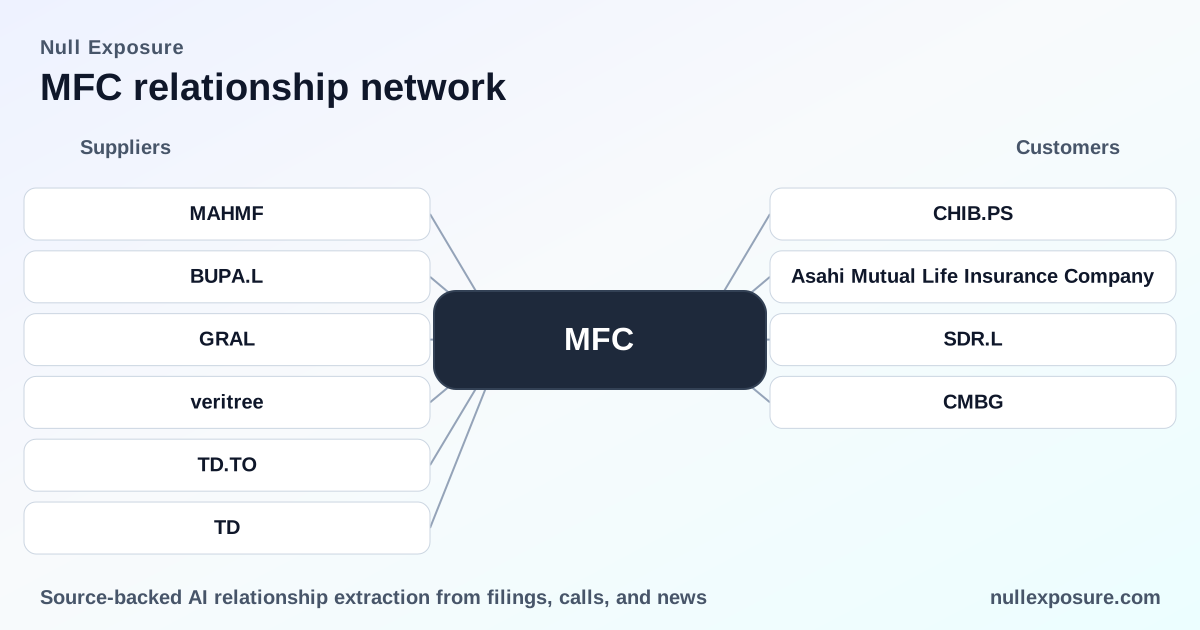
Manulife Financial (MFC): Partnering for distribution, product breadth, and ESG value
Manulife operates as a global insurer and wealth manager that monetizes through life insurance premiums, wealth and asset management fees, and group benefits across Asia, Canada and the U.S. The company leverages strategic partnerships and joint ventures to accelerate distribution, add capability to product suites, and signal ESG commitments, while core underwriting and asset management generate recurring cash flows. Manulife’s scale—roughly $57.2 billion market capitalization and $30.98 billion in trailing revenue—gives it bargaining power to structure partner relationships that are commercially significant and regionally targeted. For primary research on Manulife supplier exposure, visit https://nullexposure.com/ for full supplier mappings.
How Manulife structures partner exposure and what that implies for investors
Manulife runs a mix of equity joint ventures, strategic collaborations, and vendor relationships. From an investor perspective the company-level operating signals are straightforward:
- Contracting posture — strategic and equity-linked: Manulife pursues 50:50 joint ventures and commercial collaborations rather than one-off vendor contracts, indicating a preference for shared upside and governance influence.
- Concentration — geographically diversified: Partnerships are tailored to geographic goals (India distribution, Hong Kong healthcare, Canada product innovation), limiting single-market concentration but increasing complexity of cross-border execution.
- Criticality — partnerships are operationally material: Distribution JVs and product integrations are directly tied to new-premium growth and customer retention, not discretionary enhancements.
- Maturity — mixed: greenfield and established alliances: Some relationships are newly announced market-entry vehicles, while others extend existing product distribution and ESG programs.
No explicit supplier constraints were listed in the records reviewed; that absence should be read as a company-level signal that disclosed supplier limits or restrictive covenants were not captured in the available relationship entries. Investors should triangulate with filings and earnings commentary for any off‑balance-sheet commitments or contingent obligations.
The relationships that matter right now
Below I cover each supplier or partner identified in the company’s recent disclosures and media coverage. Each entry is concise, investor-oriented, and sourced.
Mahindra & Mahindra — market entry via 50:50 joint venture (India)
Manulife announced a 50:50 joint venture with Mahindra & Mahindra to enter the Indian life insurance market, leveraging Mahindra’s local distribution network and Manulife’s insurance expertise to accelerate market share. This is a strategic distribution-led entry that materially expands Manulife’s Asia growth runway. According to a March 2026 news report, the JV is positioned to combine local reach with global product capabilities (InsiderMonkey, FY2026).
Bupa International — healthcare offering collaboration (Hong Kong)
Manulife disclosed a strategic collaboration with Bupa International in Hong Kong to broaden healthcare choices and sustainable healthcare solutions for customers, positioning Manulife to deepen group and individual health product offerings in a region with rising healthcare demand. This was presented in Manulife’s 2025 Q4 earnings call as an initiative to enhance customer healthcare options (MFC 2025 Q4 earnings call, 2025Q4).
GRAIL — clinical-product integration for early cancer detection (Canada)
Manulife became the first insurer in Canada to offer access to GRAIL’s Galleri multi-cancer early detection test, integrating a high-profile clinical screening product into insurance-access channels and potentially altering claims dynamics through earlier detection. Management highlighted this product availability in the 2025 Q4 earnings call as a customer health benefit and differentiator (MFC 2025 Q4 earnings call, 2025Q4).
veritree — ESG and reforestation technology partner (global/Canada)
Manulife is tapping Vancouver-based veritree’s technology for its reforestation program, using veritree’s platform to operationalize forestation commitments and public ESG reporting. This partnership reinforces Manulife’s sustainability agenda and underpins public-facing carbon-offset initiatives reported in major press coverage (The Globe and Mail, FY2026).
TD Securities — analyst coverage and market intelligence (Canada/Global)
TD Securities provided updated research coverage and an upgraded analyst outlook on Manulife driven by earnings momentum; while not a supplier in the traditional sense, TD’s research relationship influences investor perceptions and market positioning. The coverage was recorded in March 2026 press releases noting an analyst valuation update tied to Manulife’s earnings (The Globe and Mail press release, FY2026).
What these relationships mean for valuation and risk
Collectively, these relationships show Manulife executing a distribution-and-product amplification strategy: equity JVs for market access in Asia, clinical product tie-ins to differentiate insurance offers, and ESG vendors to support non-financial commitments. Key investor takeaways:
- Revenue upside: The Indian JV and healthcare collaborations open incremental new-premium channels in high-growth segments; these relationships are growth-accretive rather than cost-center projects.
- Margin and claims dynamics: Clinical integrations like Galleri could alter claims timing and severity, with potential long-term actuarial implications that investors should model conservatively.
- Reputational and regulatory risk: High-visibility ESG partnerships and healthcare integrations increase public scrutiny; successful execution requires robust compliance and governance.
- Diversification: Geographic and functional spread reduces single-counterparty concentration but increases executional complexity across jurisdictions.
For a deeper supplier exposure map and to track these relationships as they evolve, go to https://nullexposure.com/.
Practical next steps for investors and operators
- For investors: Stress-test growth scenarios that incorporate JV revenue ramps in India and adoption curves for health-product integrations; calibrate valuation multiples to the underlying premium growth assumptions.
- For operators and risk teams: Prioritize governance of equity partnerships and embed clear reporting metrics for product-linked clinical outcomes and ESG delivery.
- Monitor earnings transcripts and regional filings for capital commitments tied to new joint ventures and for explicit KPI disclosures related to partner performance.
For ongoing monitoring tools and an actionable supplier relationship index, visit https://nullexposure.com/ for the latest updates and supplier-level detail.
Conclusion — Manulife’s partner set reflects a deliberate strategy to marry distribution scale with product differentiation and ESG credibility. These relationships are commercially material and strategically aligned with the company’s multi-region growth thesis, and they should be incorporated into any forward-looking valuation or operational risk assessment.