MFG Supplier Intelligence: what investors need to know about strategic vendors and capital partners
MFG operates as a diversified financial services platform that monetizes through lending, payments, asset management and fee income; its supplier relationships reveal where the company outsources specialized capabilities—non-financial disclosure systems and select strategic equity alliances—to control operating leverage and regulatory exposure. This note analyzes the supplier signals in the public record, isolates operating-model implications, and outlines the investment questions that flow from those supplier ties. For further company supplier coverage and comparative analysis, visit https://nullexposure.com/.
Quick read: two relationships, outsized signals
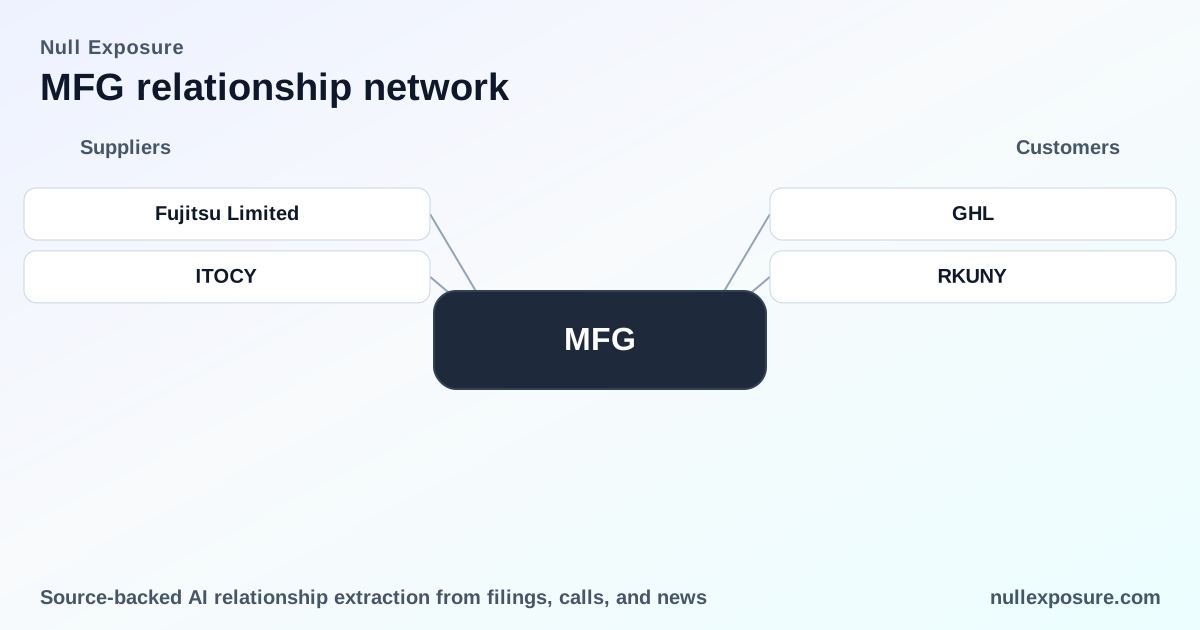
The public feed for MFG identifies two named external partners: Fujitsu Limited, contracted to provide a human-capital disclosure support service, and ITOCHU, referenced in investor Q&A around a capital partnership and Rakuten Card. Both relationships speak to outsourcing of specialized compliance/technology work and active capital-partnership management, respectively. Details and citations follow.
What Fujitsu’s Eco Track engagement tells the market
Fujitsu announced the introduction of “FUJITSU Sustainability Solution Eco Track” to support Mizuho Financial Group’s human-capital disclosure processes in FY2026. The engagement signals that MFG is outsourcing specialized non-financial reporting infrastructure to a major systems integrator rather than building that capability in-house, which preserves core capital and accelerates compliance timelines. According to Fujitsu’s global press release (Jan 26, 2026) and a matching press distribution (ACN Newswire, Mar 2026), the service is explicitly positioned to assist Mizuho with human capital disclosure in its sustainability management.
How ITOCHU surfaces in MFG’s capital-partnership dialogue
ITOCHU surfaced in MFG’s 2024 Q2 earnings call in questions related to the Rakuten Card alliance and potential changes in capital partnerships tied to share transactions in Greenhill. The reference underscores active management of strategic equity holdings and co-investor relationships, a component of MFG’s corporate-development playbook that influences capital allocation and partner alignment. The exchange was captured in the MFG earnings call transcript for 2024 Q2.
Relationship roundup — every named partner in the record
- Fujitsu Limited — Fujitsu introduced Eco Track, a non-financial information collection and disclosure support service deployed for Mizuho to assist with human-capital disclosure in sustainability management; see Fujitsu global press release (Jan 26, 2026) and ACN Newswire distribution (Mar 2026).
- ITOCHU — Mentioned during MFG’s 2024 Q2 earnings call in the context of the Rakuten Card alliance and ITOCHU’s sale of Greenhill shares, reflecting discussion of potential capital-partnership changes; see MFG 2024 Q2 earnings call transcript.
Operating-model constraints and company-level signals
No explicit supplier-contract constraints were provided in the public feed; treat the absence as a company-level signal about disclosure posture and procurement maturity rather than evidence there are no constraints. From the relationship set, derive these operational signals:
- Contracting posture: MFG prefers engaging established, large suppliers for specialized, compliance-sensitive services (e.g., Fujitsu for sustainability disclosure), indicating a conservative, risk-averse procurement posture.
- Concentration: The visible supplier universe is narrow in the public record, which implies potential concentration risk for specialized functions even if broader vendor lists exist off-record.
- Criticality: Non-financial reporting (human capital disclosure) and capital partnerships are mission-critical for regulatory standing and strategic execution; outsourcing these functions transfers operational dependency to third parties.
- Maturity: Engagements with global incumbents like Fujitsu and references involving ITOCHU indicate mature, institutional supplier relationships rather than ad hoc vendor arrangements.
Investment implications: risks and value levers
The supplier profile produces a clear set of investor-relevant takeaways:
- Regulatory and reputational risk management is delegated but structured. Outsourcing sustainability disclosure to Fujitsu reduces execution risk but raises vendor-dependency and third-party assurance as monitoring priorities.
- Capital-alliance complexity affects strategic optionality. Public discussion of ITOCHU and share sales in Greenhill tied to Rakuten Card suggests MFG’s corporate-development decisions impact balance-sheet flexibility and partnership risk.
- Cost and scalability trade-offs favor outsourcing. Using a systems integrator for disclosure lowers upfront investment and accelerates time-to-compliance, improving near-term margins relative to in-house build.
- Concentration monitoring required. A narrow set of visible partners increases the need to track contract terms, SLAs, data access, and exit mechanics.
Key items for portfolio teams and operators to monitor:
- Contract length, termination rights, and SLA penalties with Fujitsu for disclosure services.
- Evolution of the Rakuten Card alliance and any capital movements involving ITOCHU and Greenhill that change co-investor alignment.
- Evidence of supplier diversification for other critical non-financial reporting and IT functions.
For a wider supplier risk view and comparative benchmarks, see our coverage at https://nullexposure.com/.
Practical next steps for active investors and operators
- Request the latest supplier contract summaries and SOC/assurance reports for disclosure tools.
- Track MFG investor communications for updates on the Rakuten Card alliance and any formal capital-partnership rearrangements.
- Model vendor-concentration scenarios into stress tests for regulatory fines or service outages.
For direct access to MFG supplier dossiers, visit https://nullexposure.com/ — our platform aggregates public supplier signals and ties them to investor questions.
Closing verdict
The public supplier signals for MFG convey a deliberate outsourcing strategy for compliance-critical systems and hands-on management of strategic equity partnerships. That combination reduces near-term capex and accelerates compliance but introduces vendor concentration and partnership governance risks that materially affect operational resilience and strategic optionality. Investors should prioritize contract-level disclosure and ongoing monitoring of capital-partnership developments as the primary lenses for valuation and operational risk assessment.
For continued updates and comparative supplier analytics, see https://nullexposure.com/.