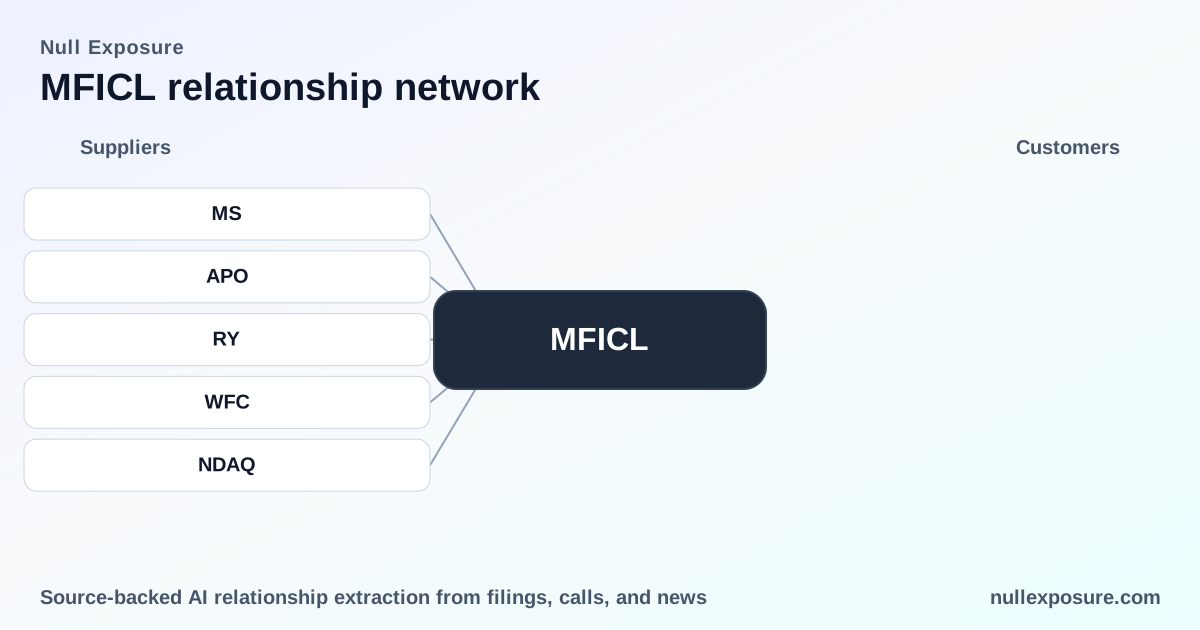
MFICL: Who Powers the Capital, Advisory and Listing Backbone
MidCap Financial Investment Corporation (MFICL) operates as an externally managed, closed-end credit investment vehicle that monetizes through asset management fees and capital market issuances—collecting base and incentive fees for portfolio management while sourcing funding through public note offerings and secured facilities. Its economics depend on the strength of its external manager and the depth of its capital-market relationships, with material flows routed to Apollo affiliates for investment and administrative services and to global banks for debt placement and trading liquidity. For a concise dashboard of supplier relationships and risk signals, visit https://nullexposure.com/.
The business model in plain terms: fee-for-service plus capital markets distribution
MFICL is externally managed: Apollo Investment Management, L.P. (AIM) runs day-to-day portfolio decisions under a fee arrangement that includes a base management fee and performance-based incentive fees, which is the primary monetization engine for the manager relationship. The company sources balance-sheet funding through unsecured note issuance and a multi-currency revolving credit facility, and lists its debt on Nasdaq to support secondary liquidity. Company filings around FY2024 disclose an amended senior secured facility with extended maturities and recurring administrative fee flows to Apollo affiliates, signaling a long-term, service-centric contracting posture with concentrated third-party dependency on Apollo. Learn more on supplier footprints at https://nullexposure.com/.
Who shows up in the capital markets and service roster
Below I list every supplier relationship captured in available reporting and what each partner contributes to MFICL’s operating model.
-
Morgan Stanley & Co. LLC — Morgan Stanley acted as a joint book-running manager on MFICL’s $750 million unsecured note offering, underwriting distribution and primary placement responsibilities for the issuance (FinancialContent press release, Dec 6, 2023: https://markets.financialcontent.com/pennwell.waterworld/article/gnwcq-2023-12-6-midcap-financial-investment-corporation-prices-public-offering-of-750-million-800-unsecured-notes-due-2028).
-
RBC Capital Markets, LLC — RBC served alongside Morgan Stanley and Wells Fargo as a joint book-running manager, participating in syndication and distribution of the 2023 unsecured notes (FinancialContent press release, Dec 6, 2023: same source).
-
Wells Fargo Securities, LLC — Wells Fargo acted as a joint book-running manager for the same $750 million unsecured offering, providing underwriting and dealer placement capacity (FinancialContent press release, Dec 6, 2023: same source).
-
Apollo Global Securities, LLC — Apollo Global Securities is listed as a co-manager on the 2023 note offering, supporting distribution and reflecting intra-group capital markets capability tied to the external manager relationship (FinancialContent press release, Dec 6, 2023: same source).
-
Apollo Investment Management, L.P. (AIM) — AIM is the investment adviser to MFICL and receives a structured fee (base + incentive) for portfolio management; filings identify AIM as controlling day-to-day investment decisions and administrative oversight (company filings, FY2023–FY2024 reporting and investment advisory agreement language).
-
Apollo Global Management, Inc. (AGM) — AGM is the parent affiliate associated with MFICL’s external manager and is party to a licensing agreement allowing MFICL to use the “Apollo” name while AIM remains adviser; AGM’s affiliates also provide administrative facilities and services (company filing excerpts describing license and service arrangements, FY2024).
-
The Nasdaq Global Select Market (Nasdaq, Inc.) — MFICL’s notes are expected to be listed on Nasdaq Global Select Market under the trading symbol “MFICL,” providing a public trading venue and secondary-market visibility for its unsecured notes (FinancialContent press release, Dec 6, 2023: same source).
Each relationship is actionable: the banks supply underwriting and distribution, Apollo affiliates provide management and administration, and Nasdaq provides listing and liquidity infrastructure.
Operating constraints that shape risk and optionality
Investors should treat the following signals as structural characteristics of MFICL’s supplier posture rather than incidental facts:
-
Long-term contracting and credit facilities: Filings document an amended and restated senior secured revolving credit facility with maturity extended through October 17, 2029, and references to first-lien term debt, indicating multi-year funding commitments and lender covenants that influence liquidity flexibility (company filings, Oct 17, 2024 amendment).
-
Embedded licensing tied to the manager: MFICL holds a non-exclusive, royalty-free license to use the “Apollo” name conditioned on continued investment advisory services from AIM; that linkage is a governance lever that constrains branding and potentially limits manager replacement without a concurrent licensing shift (company filings, licensing language).
-
Service-provider concentration: Apollo affiliates function as investment adviser, administrator, and office lessor, with fees and expense reimbursements flowing to AIM/AIA; this creates operational concentration risk and potential conflict-of-interest vectors that the board explicitly monitors (administration and advisory agreement excerpts).
-
Material spend and fee scale: Reported expense categories indicate meaningful recurring spend in professional services and administration—annual line items and segment-level totals in the $1m–$400m range across categories—signaling high fixed-cost support from third-party providers and non-trivial fee leakage to the manager and administrator (fiscal expense reporting FY2023–FY2024).
What this means for investors and operators
-
Credit and distribution risk are partnered risks: The underwriting trio (Morgan Stanley, RBC, Wells Fargo) plus co-manager Apollo Global Securities give MFICL broad distribution capability; however, primary market execution quality and secondary liquidity depend on continuing access to these banks and to public listing on Nasdaq.
-
Operational dependency on Apollo is critical: AIM and AIA supply core functions—investment decisions, administration, facilities, and certain personnel—so governance and fee structure are central to shareholder value. The licensing tie to AGM further reduces strategic independence.
-
Contract maturity reduces refinancing risk in the near term: The extended revolving facility and long-term debt create predictability for funding through 2029, yet investors should monitor covenant schedules and fee accruals that could compress distributable cash flow.
If you require a structured monitor of MFICL’s supplier exposures or a comparative view across peer-managed vehicles, explore our research tools at https://nullexposure.com/.
Tactical takeaways for portfolio and vendor managers
-
Negotiate transparency on administration costs and allocations from AIM/AIA; the filings show explicit reimbursements for rent and personnel that are material to SG&A.
-
Monitor underwriter performance on new issuances and secondary trading liquidity on Nasdaq; execution spreads and aftermarket depth drive funding economics for future note sales.
-
Insist on scenario clauses in vendor oversight that address manager transition and the licensing arrangement—brand licensing is conditional and therefore a potential friction point in any governance change.
For institutional access to ongoing supplier analytics and alerts on MFICL counterparties, visit https://nullexposure.com/ for subscription options and supplier-risk products.
Final assessment
MFICL is operationally integrated with Apollo and reliant on established global banks for capital-market access; that structural mix produces stable fee-driven revenues for the manager while concentrating operational and governance risk with a single manager/affiliate family. Investors should value the predictable funding runway through 2029 and price in managerial concentration and fee flows when assessing net asset value and downside resilience.