Mistras Group (MG): Supplier relationships and what they mean for investors
Thesis — Mistras Group operates a technology-enabled asset protection business that monetizes through inspection services, sensor hardware/software and recurring structural health monitoring contracts. The company sells engineering services and integrates third-party sensing technology into its monitoring platforms, creating a mix of project revenue and higher-margin recurring service streams tied to installed sensors and analytics.
Explore supplier intelligence and relationship impact at https://nullexposure.com/.
Market positioning and how supplier choices feed revenue Mistras is a mid‑cap industrial services provider with a clear commercial model: deliver inspection and testing services, install sensing hardware, then convert installations into recurring monitoring and analytics contracts. The firm reported roughly $724 million in trailing‑twelve‑month revenue and a gross profit of $226.9 million, which supports a service-heavy operating model that leverages both field technicians and embedded sensor technology. Key commercial levers are sensor penetration (which drives recurring revenue), integration capability (which preserves margin), and customer concentration on critical industrial assets (which creates stickiness).
Financial signals reinforce a company that is transitioning more revenue toward technology-enabled services: forward P/E of 14.45 and an EV/EBITDA of ~9.4 indicate the market prices a combination of stable service cash flows and growth optionality from productized monitoring. Institutional ownership is material at ~60%, while insiders hold a meaningful 39% stake—both signals that governance and strategic moves around supplier selection will be closely watched by capital markets.
No explicit contractual constraints disclosed — a company-level read There are no supplier constraint excerpts provided in the materials reviewed. That absence is itself a signal: no explicit, disclosed contractual limitations are recorded that would force reliance on a single supplier or impose unusual contracting terms. Present company-level characteristics relevant to supplier risk include:
- Contracting posture: Mistras operates as an integrator and service provider and therefore favors supplier relationships that are commercial and scalable rather than sole‑source long‑term manufacturing arrangements. This favors flexible, reversible supplier ties that can be swapped as sensor technologies evolve.
- Concentration: The business model is service-centric rather than dependent on a single hardware vendor; supplier concentration risk is therefore moderate unless a given sensor supplier becomes the de‑facto standard for critical asset classes.
- Criticality: Suppliers that provide novel, validated structural sensors (wireless crack detection, continuous monitoring) are high‑criticality because they enable recurring analytics and maintenance contracts.
- Maturity: Mistras blends mature inspection services with newer sensor integrations; supplier relationships that are technology‑intensive sit at a lower maturity and higher innovation risk than legacy inspection services.
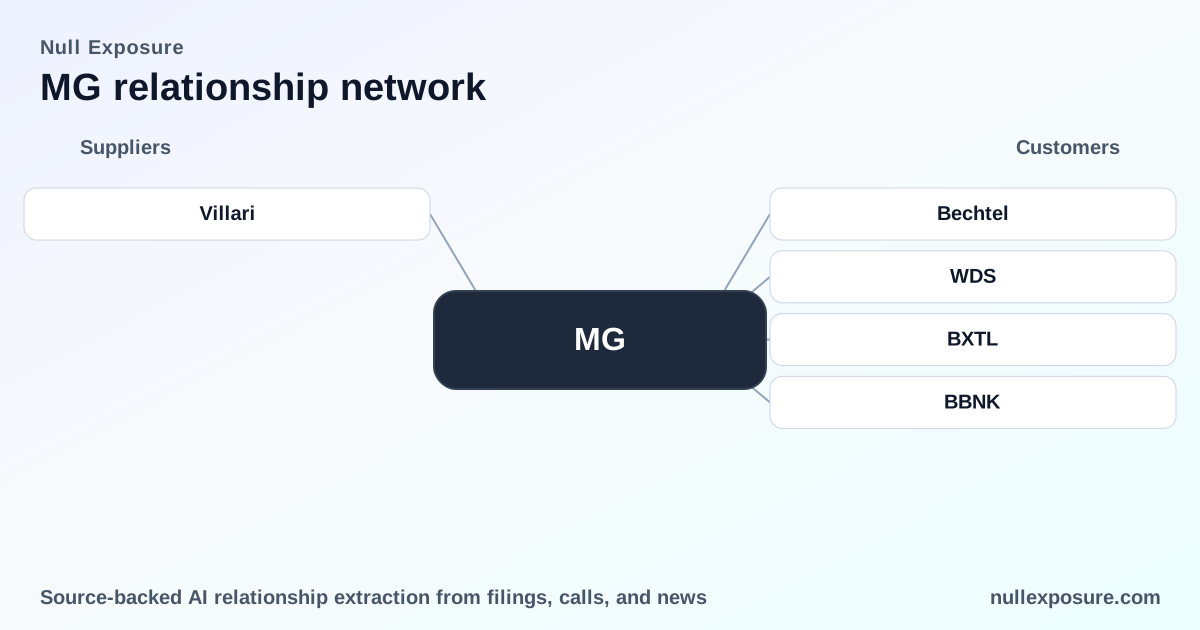
The Villari partnership — wireless crack detection integrated into Mistras’ offering Mistras announced a commercial partnership with Villari to offer wireless crack detection sensors for steel assets, enabling continuous structural health monitoring and proactive maintenance. According to a GlobeNewswire press release dated October 14, 2025, the collaboration enables Mistras to deploy Villari’s sensor technology across steel structures vulnerable to cracking and to offer continuous, data-driven monitoring to its customer base. A news item replicated on QuiverQuant in March 2026 covered the same commercial alliance and emphasized the integration of Villari sensors into Mistras’ monitoring solutions.
- Partnership description: Mistras will offer Villari’s wireless crack detection sensors to customers, integrating the sensors into its monitoring services to drive continuous, data‑driven asset management (GlobeNewswire, Oct 2025; QuiverQuant, Mar 2026).
- Commercial effect: The tie‑up converts a hardware capability (wireless sensors) into a recurring service opportunity for Mistras—selling installation, connectivity and analytics on an ongoing basis (GlobeNewswire, Oct 2025).
Why the Villari relationship matters to investors This partnership is an example of how Mistras converts supplier technology into annuity‑like revenue. Villari’s sensors are high‑criticality components for customers with steel infrastructure because they enable earlier failure detection and can reduce unplanned downtime. For Mistras, the business impact is twofold: an immediate product offering to win new projects, and longer‑term recurring revenue from monitoring and analysis contracts tied to sensor installations.
Operational and financial considerations
- Upside: accelerated sensor adoption materially improves lifetime customer revenue and margins as services shift from one‑off inspections to subscription analytics.
- Execution risk: integration, field deployment logistics, and proof of long‑term reliability will determine conversion rates from pilot installs to recurring contracts.
- Supplier leverage: because no exclusive constraints are recorded, Mistras can negotiate terms or roll alternative sensors into its platform if commercial performance requires it—this preserves procurement flexibility.
Middle‑stage analysis and where to look next Investors should watch adoption metrics (number of sensors installed, percentage converting to monitoring contracts), renewal rates and margin on monitoring services versus one‑time inspection fees. The market is signaling reasonable optimism: forward P/E compresses the high single‑digit to mid‑teens valuation into a profile where execution on sensor monetization matters. For more detailed supplier mapping and to monitor evolving partner footprints, visit https://nullexposure.com/.
Risk factors framed for an investor
- Technology risk: wireless sensing for crack detection is still evolving; failure to demonstrate consistent field accuracy reduces upsell potential.
- Commercial conversion risk: sensors must transition from proof‑of‑concept to enterprise‑scale deployments to meaningfully move revenue mix.
- Competitive risk: other sensor manufacturers or integrated solutions could win share if they offer better economics or easier integration.
Valuation and portfolio signals Mistras trades with a market cap around $461 million and TTM revenue of $724 million, which implies investors pay for recurring service potential more than hardware margins. The analyst consensus target price of $17 and forward P/E of 14.45 position the stock for upside if monitoring revenues scale. Insider ownership (near 40%) and institutional stakes (~60%) align management and market incentives around successful supplier integrations and margin improvements.
Conclusions and actionable next steps Mistras’ partnership with Villari is a strategic supplier relationship that advances the company’s shift from inspection-only revenue toward recurring monitoring contracts powered by sensor technology. Investors should view supplier relationships as a direct lever on margin expansion and revenue durability. Monitor install cadence, contract conversion, and renewal economics to assess whether sensor partnerships are delivering the expected annuity value.
If you want deeper supplier-level visibility, research tools and relationship dashboards are available at https://nullexposure.com/. For an enterprise view of how supplier integrations change earnings quality and risk exposure, begin analysis at https://nullexposure.com/.