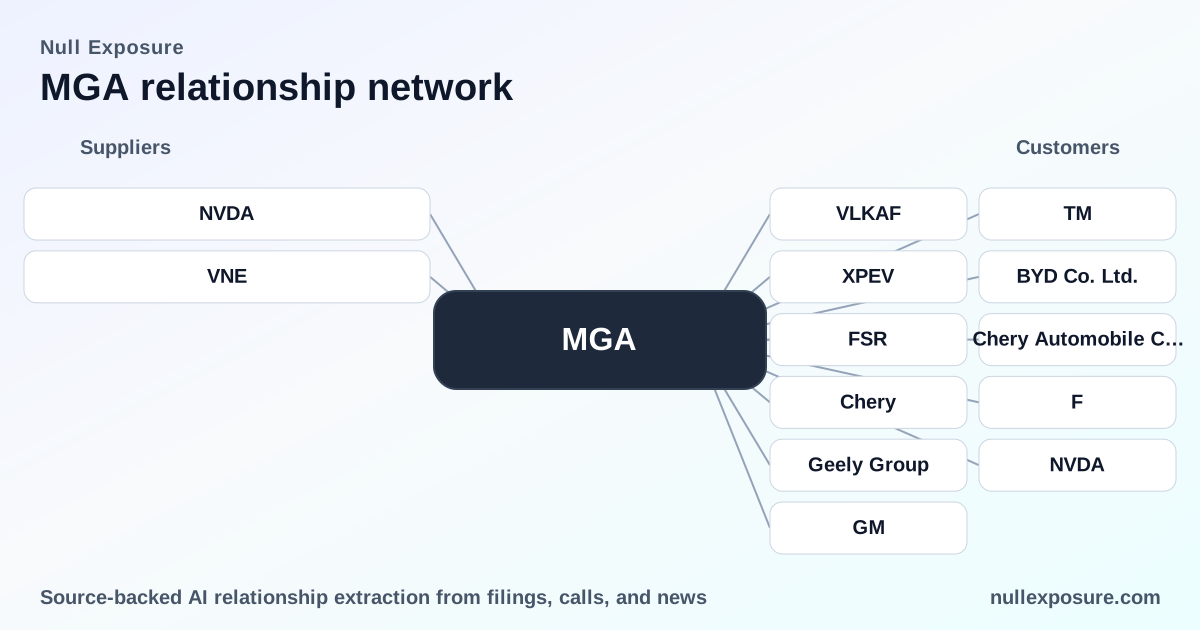
Magna International (MGA) — supplier relationships and what they mean for investors
Magna is a diversified automotive supplier that designs and manufactures vehicle components, systems and modules for global OEMs, monetizing through long-term engineering contracts, volume parts manufacturing and systems integration services. Its scale—roughly $42.0 billion in trailing revenue and a market capitalization near $15.8 billion—lets Magna capture both recurring production margins and higher-value systems-integration fees as vehicles incorporate more software and sensors. For investors and operators evaluating supplier exposure, the company functions as an engineering-led integrator whose commercial outcomes track OEM program awards, margin leverage on production volumes, and the pace of ADAS/EV content adoption. For a deeper supplier-risk view visit https://nullexposure.com/.
How Magna’s business model translates into supplier risk and return
Magna’s operating model combines repetitive, high-volume manufacturing with program-based systems work. That mix creates a dual commercial posture:
- Production economics: predictable, volume-driven margins that scale with vehicle builds and program life cycles.
- Program dependency: concentrated revenue tied to multi-year OEM contracts and platform wins; engineering success directly converts into production revenue.
Financial context is decisive: $42.0B revenue (TTM) and $4.04B EBITDA indicate meaningful absolute scale, but a ~2.0% net profit margin and mid-single digit operating margin show the business is capital- and cost-sensitive. Institutional holders control roughly 75% of shares, which supports polished capital markets access but makes the stock responsive to consensus views on automotive cycles and content growth. Learn more about supplier posture at https://nullexposure.com/.
Company-level constraints and commercial signals investors should weigh
No explicit contractual constraints were disclosed in the relationship feed, but company-level signals drive how to think about Magna’s supplier economics:
- Contracting posture — engineering-led, long-cycle commercial commitments. Magna wins platform-level work that requires front-loaded R&D and multi-year validation cycles before production revenue accrues. That implies working capital and backlog dynamics are critical to cash flow timing.
- Concentration — program and OEM dependency. Although diversified across products and geographies, Magna’s economics are tied to a finite set of platform awards; loss or delay of a major program compresses near-term volume and margin leverage.
- Criticality — high to OEMs for system integration. Magna competes to deliver modules and full systems; successful delivery is mission-critical for OEM launch schedules and safety systems.
- Maturity — incumbent with scale and margin pressure. The firm is a mature supplier balancing high fixed-cost manufacturing with incremental systems revenue from ADAS/EV content; margin expansion depends on content-per-vehicle growth and cost discipline.
These company signals explain why Magna trades as a cyclical supplier with optionality into higher-margin systems integration as vehicles become more software- and sensor-intensive.
What the reported supplier relationships tell us
Magna’s recent relationship mentions underscore its push into ADAS and integrated compute solutions.
NVIDIA — system integration for DRIVE Hyperion-compatible ECUs
Magna announced it will offer DRIVE Hyperion-compatible ECUs and Tier‑1 integration services for NVIDIA DRIVE AV platforms, marrying NVIDIA compute with Magna’s systems engineering and validation capabilities. According to a GlobeNewswire release in January 2026, this initiative positions Magna as an integrator for AI compute platforms in production vehicles and strengthens its leverage in autonomous and ADAS content wins. (GlobeNewswire, Jan 2026)
Veoneer — radar-enabled ADAS showcased at CES
Coverage of Magna’s CES 2026 showcase highlighted Veoneer-enabled radar capabilities and RBC Capital Markets’ sector commentary emphasized Magna’s ADAS traction and OEM relationships. Simply Wall St. referenced RBC’s view that the radar showcase reframes Magna’s competitive position in mid-range radar and ADAS systems. (Simply Wall St. summary of CES 2026 / RBC commentary)
Investment implications for operators and portfolio managers
Magna’s supplier relationships reflect a broader strategic pivot from commodity parts to systems and software-enabled modules, which changes risk-return tradeoffs for investors and OEM partners.
- Upside drivers: winning NVIDIA-based compute programs and expanding radar/ADAS offerings increase content per vehicle, which can drive meaningful margin improvement if production volumes scale and integration challenges are managed.
- Execution risks: program ramp timing, validation complexity for compute-enabled ECUs, and supply-chain volatility remain primary operational risks; any delay in OEM launches or component shortages compress near-term profitability.
- Balance-sheet considerations: given the capital intensity of tooling and program development, cash conversion and backlog disclosure matter for near-term valuation sensitivity.
- Market signals: a forward P/E materially below some tech-enabled peers (forward P/E ~8.1 in the provided overview) reflects market skepticism about content transition speed—this creates an asymmetric payoff if Magna converts system wins into production volume.
For operators evaluating Magna as a supplier, the practical takeaway is capability alignment: Magna offers deep systems-integration expertise, but contracts will be structured around long validation horizons and tight launch milestones.
If you want a supplier-risk scorecard and relationship mapping for your portfolio, start here: https://nullexposure.com/.
Key takeaways and actions for investors
- Magna is shifting from component supplier to systems integrator; NVIDIA and Veoneer relationships evidence that strategy.
- Value realization depends on program wins converting to production volume and improved content per vehicle.
- Primary risks are program ramp execution, OEM timetable shifts, and margin pressure from fixed-cost manufacturing.
For a focused review of Magna’s supplier relationships and tailored procurement risk metrics, visit https://nullexposure.com/ to request an engagement.
Final verdict: Magna’s scale and engineering breadth make it a credible partner for next‑generation ADAS and compute platforms; investors should weigh program conversion risk against the upside of higher content per vehicle and strengthen monitoring of program milestones, validation progress, and cash conversion metrics.