Millennium Group International Holdings (MGIH): supplier profile and implications for investors
Millennium Group International Holdings generates revenue by manufacturing and selling paper-based packaging across Greater China, Southeast Asia, Australia and the United States; the company monetizes through product sales to consumer and industrial clients, supported by regional manufacturing and distribution. With trailing revenue of $25.3 million and negative operating profitability, supplier relationships and operating leverage fundamentally determine the company’s margin recovery path and operational resilience. Learn more about supplier signals and commercial exposure at https://nullexposure.com/.
Why suppliers are a strategic lens for MGIH investors
Packaging companies run on margins that are tightly coupled to raw material costs, production capacity and logistics discipline. Millennium Group’s model is straightforward: design and produce paper packaging and sell finished goods internationally. When revenue is modest and EBITDA is negative (-$5.03 million trailing twelve months), supplier terms, concentration and procurement flexibility directly drive near-term cash flow and the viability of margin improvement.
MGIH’s capital and ownership profile influences supplier negotiating dynamics. Insiders control 88.9% of shares outstanding, institutional ownership is below 1%, and the float is constrained. That ownership structure produces a governance and contracting posture where management-led commercial decisions dominate supplier selection and continuity. For investors evaluating supplier risk, this ownership profile translates into concentrated decision-making and potentially expedited vendor changes when management prioritizes margin repairs.
For a closer look at the company metrics that inform supplier risk, visit https://nullexposure.com/ to access supplier intelligence and relationship mapping.
Key financial and operating facts that shape supplier leverage
- Revenue (TTM): $25.3 million; Gross profit: $4.7 million. These figures show thin absolute scale relative to global packaging peers.
- EBITDA (TTM): -$5.03 million; Operating margin (TTM): -28.9%; Profit margin: -24.9%. Negative profitability means supplier terms (credit days, consignment, pricing pass-through) will determine cash burn trajectory.
- Market capitalization: $15.98 million; Shares outstanding: ~11.25 million; Float: 1.25 million. Market size constrains access to capital alternatives, increasing the operational importance of supplier financing and payment terms.
- Geographic footprint: Mainland China, Hong Kong, Vietnam, Southeast Asia, Australia, U.S. — cross-border logistics and FX exposure add contractual complexity.
These factors combine to create a procurement posture where cost predictability, working capital accommodations and supply-chain continuity are top priorities for management.
Supplier relationships recorded in the public results
The public results returned one named relationship relevant to investors and operators:
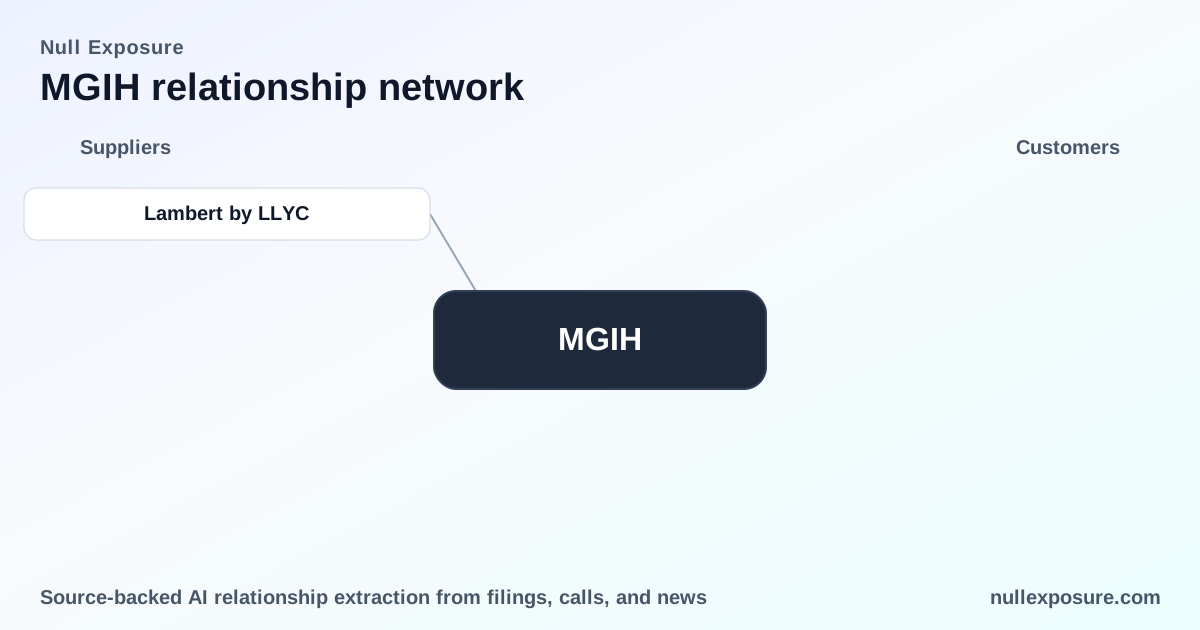
Lambert by LLYC
Lambert by LLYC acted as the media and investor-relations contact for Millennium Group’s public communications; a March 10, 2026 press release carried a contact listing for Lambert by LLYC and provided IR contact information for Millennium Group. This relationship is commercial and communications-focused rather than a direct production supplier, but it affects market signaling and stakeholder engagement. Source: Yahoo Finance press release (March 10, 2026) reporting Millennium Group’s corporate announcement and listing Lambert by LLYC contact details — https://finance.yahoo.com/news/millennium-group-international-holdings-expands-113000158.html.
No additional supplier entities were returned in the reviewed records. The presence of a retained IR/PR firm indicates an emphasis on market-facing communications; it is not a manufacturing or raw-material supplier and does not substitute for sourcing risk disclosures. Source: the same Yahoo Finance release (March 10, 2026).
What the absence of explicit supplier constraints signals
The search results contain no explicit supplier constraints or contractual limitations. That absence is a company-level signal: no supplier-specific contractual disclosures or supply-side litigation appeared in the reviewed public filing and press material. For operators and procurement strategists this implies two things:
- Supplier risk is currently not documented publicly, so due diligence must extend to commercial contracts, payment terms, and logistics arrangements that are often kept off public filings for private suppliers.
- Investors must treat supplier exposure as an operational variable rather than a documented legal constraint; supply continuity, price pass-through clauses and inventory practices become the practical levers that influence margins.
Do not interpret the absence of public constraints as evidence of low risk; instead treat it as a prompt for deeper diligence on vendor concentration, raw material sourcing, and contract terms.
Operational constraints and procurement posture — what to watch
Several company-level signals define the procurement posture and supplier risk profile for Millennium Group:
- Concentration of control: With insiders owning nearly 89% of the company, procurement and supplier renegotiations will be executed under centralized leadership with limited external investor pressure.
- Scale and maturity: Small market capitalization and negative profitability indicate the company is in an operational restructuring or growth-limited stage, where supplier concessions and flexible payment terms are critical to stabilizing cash flow.
- Criticality of packaging inputs: Paperboard, inks, specialty coatings and freight are essential inputs; any sustained price inflation or logistics disruption directly compresses margins. Investors should demand clarity on pass-through mechanisms and hedging practices.
- Commercial vs. operational suppliers: Publicly visible relationships are dominated by communications partners; operational counterparties (raw material vendors, contract manufacturers, third-party logistics) are not disclosed in the reviewed materials and require direct inquiry.
Key implications for investors and operators:
- Prioritize discovery of vendor concentration metrics and payment terms.
- Verify whether suppliers provide short-term working capital accommodations or require accelerated cash conversion.
- Confirm inventory levels versus order cadence to understand disruption buffers.
Practical next steps for diligence
- Request copies of master supply agreements, pricing escalation clauses, and any exclusivity terms for major raw materials. The most material value drivers sit in these contracts.
- Validate logistics partners and cross-border customs arrangements given the multi-jurisdiction footprint.
- Evaluate working capital sensitivity under scenarios of raw material price spikes and freight cost increases.
For institutional-grade supplier intelligence, connect with specialist sourcing analytics and track supplier continuity at scale through reliable platforms. Learn more and begin tailored supplier due diligence at https://nullexposure.com/.
Bottom line for investors
Millennium Group International Holdings is a small, geographically dispersed packaging manufacturer whose near-term performance is governed by supplier economics and working capital execution. Negative EBITDA, constrained market capitalization and concentrated insider ownership make supplier terms a decisive lever for margin recovery. The only named external relationship in the available results is a retained communications firm, indicating market-facing outreach but leaving procurement exposures opaque. Investors must move from surface-level disclosures to contract-level interrogation to quantify supplier concentration, payment terms, and contingency arrangements.
For a focused supplier risk brief and relationship mapping tailored to MGIH, visit https://nullexposure.com/ and commission a targeted review.