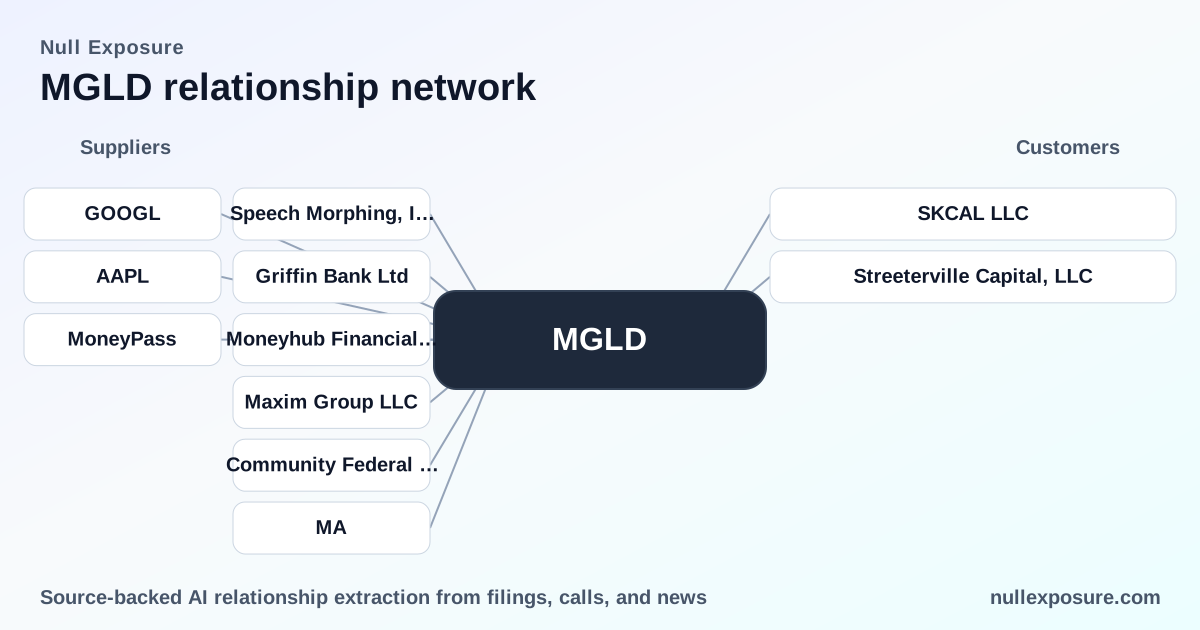
Marygold (MGLD) — supplier relationships and what they mean for investors
Marygold operates as a fintech platform under its subsidiary Marygold & Co., monetizing through layered banking partnerships, card program economics, app distribution, and capital markets activity that funds product rollout. Revenue drivers are concentrated around deposit and card relationships with partner banks, transaction routing and card acceptance economics via Mastercard, and distribution through app stores and Open Banking partners. For investors evaluating supplier risk and strategic upside, the company’s supplier map is compact, operationally critical, and oriented toward rapid consumer adoption. Learn more about supplier intelligence at https://nullexposure.com/.
How these partnerships fit into Marygold’s operating model
Marygold runs a light-asset, partnership-first model: the company front-ends a consumer app while outsourcing regulated banking services, payment rails, and some technology capabilities. That structure reduces capital intensity but increases vendor concentration and operational dependency — partner banks and card networks are critical to customer experience, compliance and transaction flow. Recent capital raises executed with a placement agent underpin an active growth posture: Marygold is funding product rollout rather than building vertically integrated banking infrastructure in-house.
Relationship roll call — who supplies what and why it matters
Below I cover every supplier relationship surfaced in public reporting and what each partner contributes to Marygold’s product delivery and go-to-market.
-
Speech Morphing, Inc. — Marygold partnered with Speech Morphing to introduce customized multilingual voices and conversational AI into its mobile banking app, expanding accessibility and user experience features. According to The Digital Banker reporting in FY2023, this is a customer-facing product enhancement meant to differentiate the app’s conversational capabilities. (The Digital Banker, FY2023)
-
Griffin Bank Ltd — Griffin Bank provides the UK savings accounts that sit behind Marygold’s consumer offering in that market, enabling deposit-taking functionality without Marygold holding the bank charter. SiliconCanals reported this partner role as part of the UK app launch in FY2025. (SiliconCanals, FY2025)
-
Moneyhub Financial Technology Ltd — Moneyhub supplies Open Banking services including Account Information and Payment Initiation for Marygold’s UK product, powering aggregation and payment flows. This relationship underpins account connectivity and PSD2-style capabilities noted in coverage of the UK launch. (SiliconCanals, FY2025)
-
Maxim Group LLC — Maxim Group acted as exclusive agent for a private placement used to finance Marygold’s next-stage rollout activities, signaling active capital markets engagement to support growth. This arrangement was disclosed in FY2024 reporting on Marygold’s financing activity. (SiliconCanals, FY2024)
-
Community Federal Savings Bank — Community Federal Savings Bank is the FDIC-insured banking partner providing U.S. banking services for Marygold accounts in the United States, enabling deposit custody and regulatory compliance for retail customers. This bank-provider relationship was disclosed in FY2023. (The Digital Banker, FY2023)
-
Mastercard — Marygold issues a contactless Debit Mastercard that leverages Mastercard’s global acceptance network for transactions, a core element of card economics and customer utility; merchant acceptance and network routing are essential to the product value proposition. Reporting identified Mastercard as the card network supporting Marygold’s debit product in FY2023. (The Digital Banker, FY2023)
-
Google Play Store — The Marygold app is distributed via the Google Play Store in the UK and elsewhere, supplying the primary Android distribution channel and discovery path for customers. App store availability for the UK launch was noted in FY2025 coverage. (SiliconCanals, FY2025)
-
Apple App Store — Marygold also uses the Apple App Store for iOS distribution, ensuring coverage across major mobile platforms and preserving a full-market consumer distribution strategy. This availability was reported in FY2025. (SiliconCanals, FY2025)
-
MoneyPass — MoneyPass provides the surcharge-free ATM network access (cited as 37,000 ATMs) that supports Marygold’s debit product customer experience in the U.S., reducing friction for cash access and limiting customer churn driven by ATM fees. This network relationship was disclosed in FY2023 reporting. (The Digital Banker, FY2023)
What the relationship map implies for MGLD’s risk and operating constraints
-
Contracting posture and criticality. Marygold relies on a small number of high-criticality suppliers (banking partners, card network, app stores). These relationships are not ancillary — they are foundational to deposit custody, payments, distribution, and on-device experience. Operational continuity depends on stable contractual terms with a few vendors.
-
Concentration and counterparty exposure. The supplier set demonstrates intentional concentration: a handful of banks and payment networks provide essential services. Concentration accelerates scaling when contracts are favorable and increases downside if one partner changes terms or restricts services.
-
Maturity and strategic posture. The mix of private placement financing via Maxim Group and recent product launches suggests Marygold is in active growth mode rather than steady-state maturity. Capital is being deployed to expand product reach rather than to rework core infrastructure.
-
Distribution and go-to-market constraints. App store distribution and third-party Open Banking providers are central to customer acquisition and product functionality in the UK; these are lower-barrier but externally governed channels where platform policies and fees affect economics.
-
Company-level signal on distribution channels. A constraint excerpt evidences a distributor role in Marygold’s ecosystem: the text about an authorized dealer relationship (Brigadier as an authorized SecurTek dealer) signals that Marygold’s broader operating model accepts third-party distribution and dealer relationships as part of its commercial approach. This indicates willingness to use third-party distributors where appropriate, which is a company-level signal about contracting strategy rather than a claim about any single supplier in the list.
If you want a deeper supplier risk assessment or counterparty-specific clauses that investors should press for in diligence, start here: https://nullexposure.com/.
Investment implications and the practical view for operators
-
Upside: Partnerships let Marygold scale retail features quickly with lower capital requirements; voice AI and Open Banking integrations accelerate product differentiation in crowded markets. If customer acquisition costs remain controlled, the partner-driven model multiplies revenue per account without heavy balance-sheet expansion.
-
Risk: Concentration with a few banks and a single card network creates vendor risk that directly affects deposits, compliance and transaction flows. App store policies and payment initiation partners shape distribution economics and feature availability. Active contract management and contingency plans with secondary providers are non-negotiable for risk mitigation.
-
What operators should prioritize: secure long-dated terms with bank partners, negotiate favorable interchange and settlement mechanics with card partners, and build fallback routing for Open Banking and app distribution compliance.
For a tactical review of Marygold’s supplier contracts, or to map counterparty clauses that protect revenue and continuity, visit https://nullexposure.com/.
Bottom line
Marygold’s supplier strategy is deliberate: outsource regulated banking and payment rails to accelerate product-market fit while using partnerships to add UX differentiation such as conversational AI. That structure creates clear path to scale but concentrates operational risk in a small set of suppliers; investors should value Marygold’s growth potential against the company’s dependence on partner stability and capital support. For tailored supplier diligence and detailed counterparty analysis, see https://nullexposure.com/.