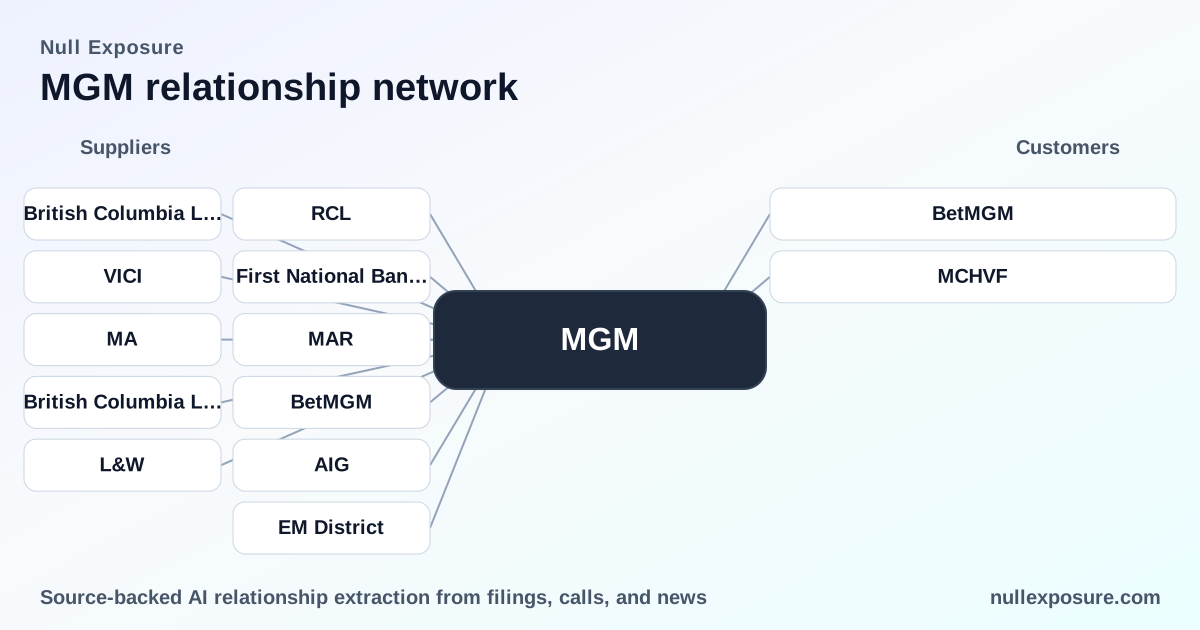
MGM Resorts International: supplier footprint and what investors should price in
MGM Resorts International operates destination resorts, casinos, hotels and entertainment venues and monetizes through gaming revenue, hotel operations, food & beverage and ancillary services, plus growing digital wagering and loyalty monetization channels. The company captures high-margin spend on property operations while leveraging branded partnerships, co‑branded cards and long‑term real estate lease structures to extract recurring cash flow from core assets. For investors evaluating supplier relationships, the mix of card issuers, loyalty partners, real‑estate landlords and regional operators defines both upside (loyalty monetization and cross‑sell) and structural risks (lease obligations and third‑party distribution). Learn more at https://nullexposure.com/.
Quick operational frame: how supplier contracts shape cash flow
MGM’s operating model blends direct operations with outsourced and licensed relationships. Core hotel and casino revenue is generated on property, while loyalty partnerships, payment card arrangements and licensed responsible‑gaming programs convert non‑operational channels into revenue or customer acquisition funnels. MGM’s reported Revenue (TTM) of $17.5bn and EBITDA of $2.35bn underline an asset‑heavy but cash‑generative business; long‑term lease obligations and third‑party landlords increase leverage measured on an enterprise basis.
A company‑level constraint signal from MGM’s filings indicates a preference for long‑term, triple‑net leasing of domestic properties, which pushes obligations off the operating ledger and into long‑dated contractual commitments. This contracting posture supports stable occupancy economics but concentrates counterparty and refinancing risk. For sourcing and due diligence, note that lease maturity and landlord concentration are material for credit and operational stability.
Supplier relationships that matter right now
Below I cover every relationship extracted from current news and filings. Each entry is a concise, plain‑English description with a source reference.
-
Celebrity Cruises — MGM’s co‑branded card and loyalty promotions include an annual cruise benefit that can be redeemed with Celebrity Cruises, giving MGM Rewards cardholders travel options that extend loyalty value beyond hotels. Source: ThePointsGuy coverage of the MGM Rewards Iconic Mastercard (Mar 2026) — https://thepointsguy.com/credit-cards/mgm-rewards-iconic-mastercard/.
-
First National Bank of Omaha (FNBO®) — FNBO is the issuing bank for the MGM Rewards Iconic Mastercard, handling card issuance under license and thereby taking on regulatory and credit risk associated with the card program. Source: ThePointsGuy (Mar 2026) — https://thepointsguy.com/credit-cards/mgm-rewards-iconic-mastercard/.
-
Marriott International — Marriott Bonvoy integration channels high‑spending loyalty members into MGM properties, particularly in the luxury tier, acting as an upstream customer‑acquisition engine for MGM rooms and premium experiences. Source: market commentary in FinancialContent (Feb 2026) — https://markets.financialcontent.com/stocks/article/finterra-2026-2-24-the-great-normalization-a-deep-dive-into-mgm-resorts-nyse-mgm.
-
BetMGM — BetMGM is integrated into MGM’s payments and loyalty ecosystem so that cardholders can earn rewards and tier credits on BetMGM deposits, making digital wagering a strategic monetization channel for MGM Rewards. Source: ThePointsGuy (Mar 2026) — https://thepointsguy.com/credit-cards/mgm-rewards-iconic-mastercard/.
-
New Hampshire Insurance Company (AIG) — AIG’s New Hampshire Insurance Company provides coverage for certain card or program risks, transferring underwriting exposure away from MGM for specified benefits. Source: ThePointsGuy (Mar 2026) — https://thepointsguy.com/credit-cards/mgm-rewards-iconic-mastercard/.
-
Royal Caribbean — As with Celebrity Cruises, MGM Rewards card benefits include options to redeem an annual cruise benefit with Royal Caribbean, expanding the rewards footprint into cruise customers. Source: ThePointsGuy (Mar 2026) — https://thepointsguy.com/credit-cards/mgm-rewards-iconic-mastercard/.
-
EM District — MGM is partnering with Thai retail developer EM District to expand outreach in Thailand, hosting business delegations in Macau and promoting Macau tourism in Bangkok shopping centers to drive inbound travel flows. Source: Yogonet news (Mar 2026) — https://www.yogonet.com/international/news/2026/03/09/117952-mgm-expands-thailand-outreach-through-partnership-with-retail-developer-em-district.
-
British Columbia Lottery Corporation (BCLC) — MGM uses BCLC’s GameSense program under license for responsible‑gaming education and messaging, aligning MGM’s RG initiatives with an established external program to standardize floor and digital responsible‑gaming efforts. Source: MGM investor release (Feb 26, 2026) — https://investors.mgmresorts.com/2026-02-26-MGM-RESORTS-BETMGM-COMMIT-OVER-1-MILLION-TO-RESPONSIBLE-GAMING-INITIATIVES-DURING-PROBLEM-GAMBLING-AWARENESS-MONTH.
-
British Columbia Lottery Corporation (trademark/licensing) — MGM explicitly states GameSense is a registered trademark of BCLC used under license by MGM, formalizing the IP relationship and brand control for responsible‑gaming content. Source: MGM investor release (Mar 9, 2026) — https://investors.mgmresorts.com/2026-03-09-MGM-Resorts-International-Will-Present-at-the-J-P-Morgan-Gaming,-Lodging,-Restaurant-and-Leisure-Management-Access-Forum.
-
British Columbia Lottery Corp. (press coverage) — Industry reporting highlights that MGM and BetMGM are expanding RG messaging and in‑venue programs through the shared GameSense approach, indicating coordinated marketing and compliance efforts. Source: Deadspin coverage (Mar 2026) — https://deadspin.com/legal-betting/betmgm-mgm-resorts-investing-over-1m-in-responsible-gaming-research/.
-
VICI Properties — Analysts and filings highlight that MGM’s long‑term lease obligations to VICI materially increase total leverage when included with reported debt, making the VICI relationship a cornerstone of capital‑structure analysis. Source: FinancialContent analysis (Feb 2026) — https://markets.financialcontent.com/stocks/article/finterra-2026-2-24-the-great-normalization-a-deep-dive-into-mgm-resorts-nyse-mgm.
-
Marriott Bonvoy — The card program affords MGM Rewards cardholders automatic Pearl status and reciprocal Marriott Bonvoy Silver Elite benefits, deepening cross‑brand loyalty benefits that boost cross‑channel spend. Source: ThePointsGuy (Mar 2026) — https://thepointsguy.com/credit-cards/mgm-rewards-iconic-mastercard/.
-
Mastercard International Incorporated — The MGM co‑branded card is issued under a Mastercard license, placing payment‑network rules and settlement mechanics under Mastercard’s framework. Source: ThePointsGuy (Mar 2026) — https://thepointsguy.com/credit-cards/mgm-rewards-iconic-mastercard/.
-
VICI Properties Inc. (operational note) — VICI’s public comments that they own assets like National Harbor and contract MGM to run operations underscore the landlord/operator split and the operational reliance MGM has on third‑party real‑estate owners. Source: InsiderMonkey transcript of VICI earnings call (Q4 2025) — https://www.insidermonkey.com/blog/vici-properties-inc-nysevici-q4-2025-earnings-call-transcript-1705194/.
-
L&W — Slot supplier L&W has launched progressive content in Asia at properties including MGM Macau and MGM Cotai, indicating MGM’s supplier relationships extend into gaming‑equipment and content sourcing for non‑U.S. markets. Source: GGRAsia (Mar 2026) — https://www.ggrasia.com/no-sign-that-data-outside-u-s-compromised-says-wynn-resorts-after-hacking-attack.
What investors should infer from the supplier map
-
Contracting posture: long‑term, asset‑backed, and license‑oriented. MGM uses long‑term lease structures with third‑party landlords and licenses external programs (GameSense, Mastercard) to shift operational and regulatory responsibilities off the balance sheet while preserving customer access. The company constraint signal on triple‑net, long‑term leases should be treated as a structural factor when modeling adjusted leverage.
-
Concentration and criticality: landlord and card partners are high‑impact. Relationships with VICI and FNBO/Mastercard are critical — they affect capital structure, property access and distribution reach. VICI lease obligations are a single‑line item that materially affects enterprise leverage; card issuance partners control customer acquisition economics.
-
Maturity and diversification: partnerships extend global reach but create cross‑jurisdictional exposure. EM District and L&W illustrate geographic diversification into Asia and Southeast Asia, but also expose MGM to regional regulatory and operational complexity. The Marriott and Cruise partnerships enlarge loyalty utility and reduce customer acquisition cost per high‑value guest.
-
Operational implications for due diligence. Underwriting MGM credit or equity should include scenario analysis for lease repricing/renewal, card partner churn or licensing disputes, and regulatory shifts in digital wagering that affect BetMGM‑linked revenue.
If you want a consolidated supplier risk scorecard and positional analysis tailored to your portfolio, visit https://nullexposure.com/ for a focused briefing.
Investment takeaway and next steps
- Bull case: Loyalty integrations, a diversified partner set (cards, cruises, Marriott) and monetization of BetMGM transactions create incremental high‑margin revenue streams, supporting a forward multiple that compresses trailing volatility.
- Risk case: The long‑term triple‑net leases and concentrated landlord exposure to VICI increase adjusted leverage and refinancing sensitivity; card issuance and insurance partners create operational dependency.
To convert this into action: request an asset‑level lease maturity schedule and the MGM/VICI lease exhibits, and evaluate the MGM Rewards card economics (take rates, interchange revenue split) in a pro‑forma revenue build. For tailored exposure analysis and supplier scoring, visit https://nullexposure.com/ to commission a focused supplier risk report.
Bottom line: MGM’s supplier relationships are strategically aligned to expand loyalty monetization and global distribution, but investors must price in the leverage and concentration embedded by long‑term leases and critical third‑party issuers.