MGRT (Mega Fortune Company Limited): How the supplier plays its cards in IoT markets
Mega Fortune Company Limited builds and sells Internet‑of‑Things solutions and services to industrial and enterprise customers, monetizing through product sales, systems integration and recurring service contracts. The company is a small‑cap, profitable IoT vendor with a tight insider ownership structure and a recent capital‑markets engagement led by EF Hutton. Investors and operators evaluating supplier relationships should weigh healthy unit economics and small scale against concentrated control, limited float, and a valuation that prices growth expectations. For a structured view of MGRT’s partner footprint, visit https://nullexposure.com/.
Why this supplier matters: product economics and scale
Mega Fortune reports trailing‑twelve‑month revenue of roughly $11.1m with gross profit of $5.6m, implying strong gross margins for an IoT integrator. Operating margin (21.2%) and a positive net profit profile (profit margin 16.1%, diluted EPS $0.17) show the business is not a pure startup burn story — it already converts revenue to earnings at scale. These figures are reported through the company’s latest quarter (2025‑09‑30).
At the same time, MGRT is a compact operator: market capitalization ≈ $124m, shares outstanding 13.75m and a float of 3.75m. The stock trades at a premium multiple relative to its scale — Price/Sales ~11.16 and EV/EBITDA ~52 — indicating the market is valuing future growth more than current size. That valuation posture affects supplier negotiations and funding dynamics: counterparties will encounter a vendor that is profitable today yet under strong market growth expectations.
A single financing relationship — what it tells you
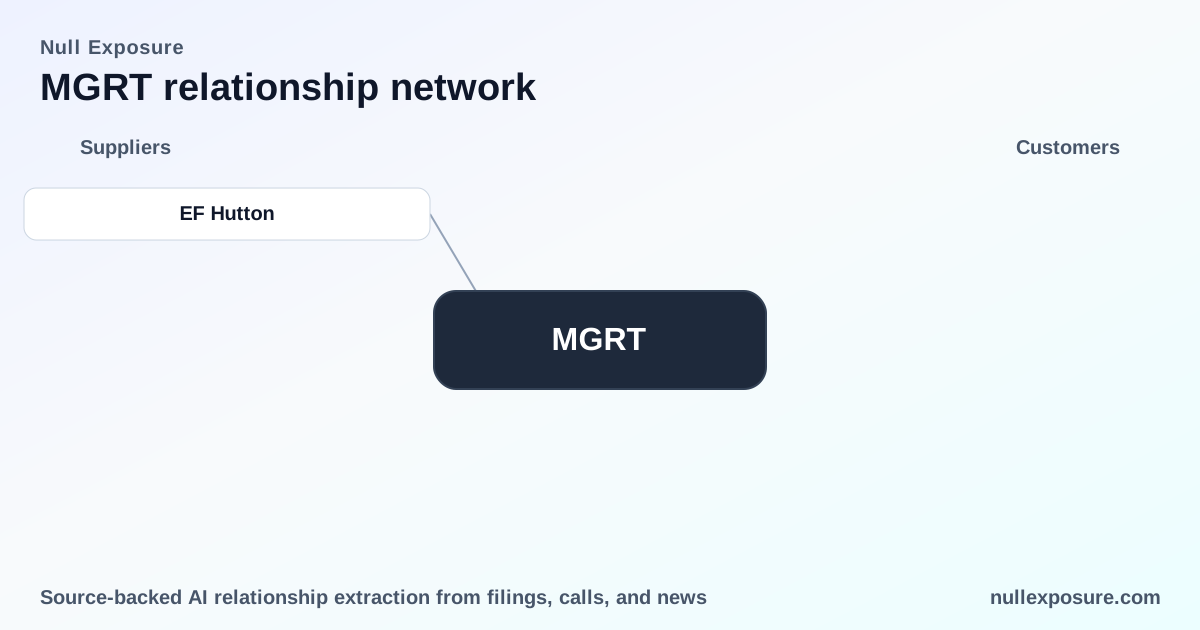
MGRT’s disclosed public relationship in the supplier scope is a capital‑markets engagement with EF Hutton.
- EF Hutton is listed as the sole bookrunner on MGRT’s offering, consistent with the company’s recent filing to raise approximately $17 million; the transaction was reported by Renaissance Capital on March 10, 2026 (Renaissance Capital IPO coverage, 2026‑03‑10: https://www.renaissancecapital.com/IPO-Center/News/107608/Hong-Kong-IoT-company-Mega-Fortune-files-and-sets-terms-for-a-$17-million-U).
This relationship is primarily financial and transactional — it signals MGRT’s use of boutique/global investment‑bank distribution rather than an extended syndicate.
What the capital markets partnership implies for suppliers and operators
MGRT’s engagement with EF Hutton as sole bookrunner shows the company is pursuing controlled access to public capital markets rather than a broad underwriting syndicate. For suppliers and channel partners, that has practical implications:
- Contracting posture: MGRT is likely to prefer tightly managed external relationships when closing funding or public‑market events, using a single-lead advisor to minimize leakage and maintain negotiation leverage.
- Liquidity and counterparty exposure: Limited float (roughly 27% of shares outstanding) and insider ownership reportedly at ~72.7% create a governance environment where founders/insiders drive decisions and external investors have minimal sway.
- Commercial predictability: MGRT’s positive margins and EBITDA indicate financial predictability, supporting multi‑quarter service agreements, but counterparties should price for an operation that is still small and concentrated.
For more context on supplier risk and capital posture, see https://nullexposure.com/ for our broader supplier intelligence coverage.
Operating constraints and company‑level signals
There are no relationship‑specific contractual constraints disclosed beyond the EF Hutton underwriting role. Company‑level signals — drawn from financials and ownership data — shape how partners should approach MGRT:
- Concentration of control: With insiders controlling a substantial majority of shares and institutional ownership effectively negligible (~0.003%), strategic decisions and supplier approvals are controlled centrally. That increases speed but reduces bargaining leverage for external partners.
- Liquidity constraint: A small free float (3.75m shares) constrains market liquidity and raises the cost of any equity‑linked arrangements. Suppliers negotiating equity or warrants should account for limited secondary market depth.
- Maturity and criticality: MGRT’s margins and positive returns on equity (ROE
21.1%) indicate a business beyond early proof‑of‑concept, yet absolute revenue scale ($11.1m) keeps it in the small‑cap, vendor‑dependent category; the company is important to customers requiring niche IoT expertise but not yet a dominant, mission‑critical platform in most enterprise stacks. - Valuation pressure: High multiples (P/S >11, EV/EBITDA ~52) impose expectations for visible growth; suppliers who tie revenue recognition or milestone payments to scaled deployments will be dealing with a vendor that needs demonstrable topline expansion.
Practical implications for counterparties and operators
If you are evaluating MGRT as a supplier or partner, translate the signals into commercial terms:
- Negotiate clear payment terms and staged deliverables: the company’s profitable base supports service continuity, but limited scale increases execution risk on large roll‑outs.
- Favor fixed‑fee or milestone‑based contracts over equity compensation because insider concentration and low float reduce the attractiveness and liquidity of stock‑based payments.
- Use the EF Hutton relationship as a marker of MGRT’s capital strategy: expect discrete, transaction‑oriented financing events rather than continuous public issuances, so plan for periodic funding inflection points that can affect supplier receivables.
Bottom line for investors and procurement teams
MGRT is a profitable, small‑cap IoT supplier with strong gross economics but concentrated ownership and a valuation that assumes growth. The company’s use of EF Hutton as sole bookrunner for its recent offering highlights a controlled, boutique approach to capital markets. Operational partners will find a financially disciplined counterparty with limited public float; they should structure agreements to protect cash flow and avoid reliance on illiquid equity compensation.
For further due diligence and to map MGRT’s partner network, consult our supplier coverage and analytics at https://nullexposure.com/. If you want a tailored assessment of MGRT relative to your vendor portfolio, contact our team through https://nullexposure.com/ for a supplier risk briefing.