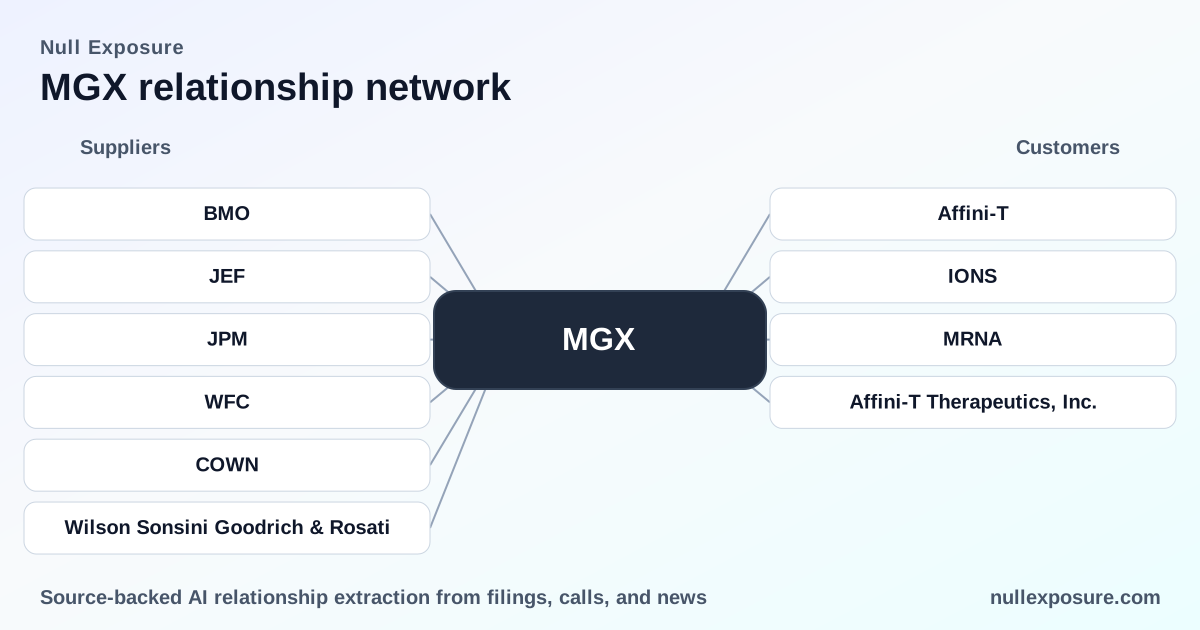
MGX supplier map and what it means for investors
Metagenomi (MGX) operates as an early-stage gene‑editing therapeutics company that monetizes by developing proprietary genome‑editing platforms and advancing candidates through clinical development toward licensing or commercialization. The company funds operations through capital markets activity and partnerships, while outsourcing a large portion of experimental, manufacturing and logistics work to third parties. Investors should treat MGX as a development‑stage biotech with meaningful real‑estate lease obligations, concentrated third‑party operational dependencies, and typical service‑provider contracting that balances long lease commitments with cancelable program contracts.
Read the supplier analysis and deal partner roster at https://nullexposure.com/ for follow up and deeper supplier screening.
Who handled the IPO and who advised on IP — a compact roster
Below are the relationships surfaced in public coverage around MGX’s financing activity. Each listing is one or two sentences plus a citation to the public report.
- J.P. Morgan — J.P. Morgan served as one of the joint bookrunners on Metagenomi’s offering, joining a multi‑bank syndicate that priced the deal. Renaissance Capital reported the bank’s role in the IPO syndicate on March 10, 2026. (Renaissance Capital, news, March 10, 2026)
- Jefferies — Jefferies was appointed as a joint bookrunner on the same transaction, reflecting the company’s choice to spread underwriting across several mid‑ and bulge‑bracket firms. (Renaissance Capital, news, March 10, 2026)
- BMO Capital Markets — BMO Capital Markets participated as a joint bookrunner alongside the other firms, signaling a syndication strategy designed to broaden investor reach. (Renaissance Capital, news, March 10, 2026)
- Wells Fargo Securities — Wells Fargo Securities joined the underwriting group as a joint bookrunner for the offering, contributing distribution capacity to the transaction. (Renaissance Capital, news, March 10, 2026)
- TD Cowen — TD Cowen was named as one of the joint bookrunners on Metagenomi’s IPO, completing the multi‑bank syndicate reported in the market coverage. (Renaissance Capital, news, March 10, 2026)
- Wilson Sonsini Goodrich & Rosati — Wilson Sonsini advised Metagenomi on patent and IP matters related to the offering and intellectual property position, providing legal support aligned with the company’s technology commercialization plan. (Wilson Sonsini press release, March 2026)
What these relationships tell you about MGX’s financing posture
The underwriting syndicate is conventional for a life‑science IPO: multiple bookrunners expand distribution and signal a standard capital markets execution, not a reliance on a single lead underwriter. Wilson Sonsini’s role on IP advice is consistent with a biotech preparing to translate platform assets into enforceable commercial rights—an important element investors prize when judging long‑term value capture.
- Capital markets focus: The presence of five joint bookrunners indicates MGX chose syndication to broaden investor access and manage execution risk, a normal strategy for companies with limited operating revenue and a need to raise meaningful R&D capital.
- Legal and IP risk management: Retaining prominent IP counsel demonstrates management is prioritizing patent estate defenses, which is essential for negotiating future license or manufacturing deals.
Explore supplier exposure and counterparty signals in detail at https://nullexposure.com/ for procurement and legal vendor due diligence.
Supply, contracting posture and financial constraints — what the filings reveal
Company disclosures provide a clear set of operating model signals that matter to suppliers and operators:
- Long‑term real estate commitment: MGX subleases and occupies significant office, lab and research space with a term extending to March 2031, and disclosed $63.4 million of remaining non‑cancelable lease obligations as of December 31, 2024. This is a material fixed‑cost commitment on the corporate balance sheet and implies multi‑year operating leverage that raises the importance of conserving capital or securing reliable financing.
- Short‑term program contracts for R&D: Most third‑party agreements for preclinical studies, CRO services and supplies are shorter‑term and generally cancelable, which gives MGX operational flexibility to reallocate programs and control discretionary spend.
- Manufacturing and distribution roles are outsourced and critical: The company states it contracts outside manufacturers for materials and expects to rely on third parties for packaging, labeling, storage and distribution, placing outsourcers in a critical role for both clinical timelines and any future commercialization.
- Spending footprint concentrated in mid‑range commitments: Lease liabilities fall in the $10M–$100M spend band, indicating sizable fixed commitments, while other supplier arrangements are often described as immaterial or cancelable — a mix of concentrated fixed real‑estate spend and dispersed programmatic supplier spend.
These factors combine into a contracting posture that is dual‑track: fixed long‑term occupancy obligations on one hand, and flexible, cancelable third‑party research and manufacturing engagements on the other. That structure reduces vendor lock‑in for certain services but raises the strategic importance of manufacturing and logistics partners.
Risks, concentration and maturity — what investors should weigh
- Capital intensity and negative operating margins. MGX reports negative EBITDA and a limited revenue run‑rate (Revenue TTM ~$25.2M; EBITDA negative ~$90.7M), which confirms the company is in a capital‑consuming development stage and dependent on access to capital and underwriting capacity.
- Counterparty criticality. Third‑party manufacturers, CROs and distribution partners are mission‑critical: delays or failures in those relationships can directly impact trial timelines and product readiness.
- Lease concentration. The long sublease through 2031 with large remaining obligations creates fixed overhead risk if financing or revenue growth stalls.
- Ownership and analyst context. Insider holdings are elevated (~28.6%) and institutions hold ~20.1%, while consensus analyst coverage (four buys, one hold; target ~$9.33) points to positive market expectations but also to concentrated investor positioning.
Key takeaway: MGX is a development‑stage biotech with a standard syndicate of investment banks for capital raises, professional IP counsel, and a supplier mix that is flexible for R&D but concentrated and critical in manufacturing and distribution.
Practical next steps for investors and operators
- Confirm manufacturing and logistics counterparties and their capacity/quality certifications before underwriting commercial risk. Request current CMO and cold‑chain partner references and capacity schedules.
- Stress‑test cash flow against the lease liability schedule through March 2031 and model dilution scenarios tied to potential clinical delays.
- For procurement teams, prioritize dual‑sourcing options for critical materials and negotiate service‑level agreements that align with trial timelines.
For a deeper supplier risk map, procurement playbook, or counterparty due diligence on MGX, visit https://nullexposure.com/ to commission tailored supplier intelligence and contracting guidance.
Final assessment and what to watch
Metagenomi’s public supplier signals are coherent with a company at the clinical development inflection: diversified underwriters, expert IP counsel, heavy reliance on outsourced manufacturing and logistics, long real‑estate commitments, and cancelable program contracts for R&D. Investors should monitor follow‑on financing cadence, CMO engagements, and execution against clinical milestones — those three vectors will determine whether MGX converts its platform into lasting value or faces extended dilution. For direct contractor and vendor intelligence tied to MGX’s supplier network, return to https://nullexposure.com/ and request the supplier dossier used by professional investors and operators.