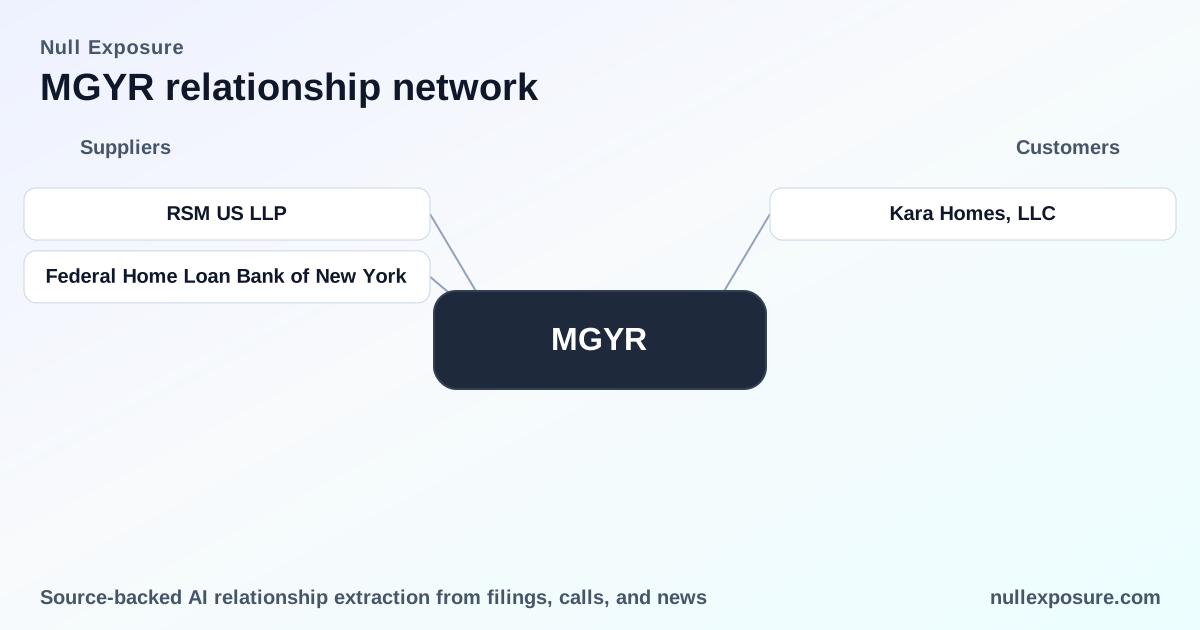
Magyar Bancorp (MGYR) — supplier relationships that matter to owners and operators
Magyar Bancorp is the holding company for Magyar Bank, a regional U.S. bank that earns its margin from traditional banking activities — net interest income on loans funded by deposits, plus fee income from commercial and retail services. The company monetizes through credit origination and deposit intermediation while returning capital via a modest dividend; its compact balance sheet and regional footprint make counterparty relationships — auditors, funding networks, and community funding partners — disproportionately important to operational continuity and regulatory confidence. For investors evaluating MGYR as a supplier counterparty or as a buyer relying on Magyar, the company’s supplier map is small but material: auditor oversight and Federal Home Loan Bank membership are the visible anchors of its external dependencies.
For an organized view of supplier risks and relationships, visit the NullExposure homepage: https://nullexposure.com/
Why supplier relationships are strategically relevant for a small regional bank
Smaller bank holding companies operate with concentrated vendor sets. A single auditor, a funding membership platform, or a technology provider can influence capital markets perception, regulatory comfort, and access to contingency liquidity. For MGYR:
- Contracting posture is conservative and continuity-focused: the re-ratification of an independent auditor signals a preference for stable third-party oversight rather than frequent vendor rotation.
- Concentration is high by necessity: a handful of counterparties can drive outsized operational and reputational risk for a $109M market cap institution.
- Criticality is binary: relationships with an independent auditor and Federal Home Loan Bank membership are essential for regulatory reporting, liquidity channels, and community programs.
- Maturity of relationships shows governance discipline: formal ratification and ongoing membership activity demonstrate long-cycle supplier commitments rather than ad hoc engagements.
These characteristics shape negotiation leverage, renewal timing, and contingency planning for counterparties and investors alike.
The relationships on record — clear and consequential
RSM US LLP — the independent auditor
Magyar’s shareholders ratified RSM US LLP as the independent auditor for the fiscal year ending September 30, 2026, and also approved executive compensation on an advisory basis at the same meeting. This ratification affirms continuity in audit oversight and external financial assurance into FY2026, which is significant for investor confidence and regulatory reporting cadence. According to a Globe and Mail report on March 10, 2026, the shareholder vote confirmed RSM’s role for the coming fiscal year.
Federal Home Loan Bank of New York — membership and community grants conduit
Magyar Bank’s membership in the Federal Home Loan Bank of New York was the channel through which the bank distributed $195,000 in grants to 38 local businesses and nonprofits as part of its pandemic response and community support activities. That membership signals both an operational funding conduit and a community-programming partner, reflecting access to collective liquidity tools and grant programs. A MyCentralJersey article dated October 4, 2021 covered the grant distributions conducted through the Federal Home Loan Bank of New York.
Constraints and company-level signals for counterparties
There are no supplier-specific constraints disclosed in the available relationship data; the constraints record is empty. As a company-level signal, this absence implies that publicly visible contractual limits or supplier-specific restrictions were not reported in the source materials reviewed. From the corporate and market data, investors should treat the following as company-level characteristics rather than contract excerpts:
- Lean supplier footprint: the public record shows a narrow set of external partnerships in the supplier scope reviewed, consistent with a small regional bank’s operational profile.
- Governance and oversight prioritized: auditor ratification into FY2026 is a governance signal indicating stable control environments and formal shareholder oversight.
- Funding and community channels are institutionalized: FHLB membership is a functional hedge for local lending activity and community program delivery, and it contributes to contingency liquidity options beyond deposit balances.
- Maturity bias: recorded interactions span multiple years (FHLB activity in 2021; auditor ratification in 2026), which reflects multi-year supplier engagements rather than one-off relationships.
These company-level signals influence counterparty negotiations: expect standard banking vendor terms, emphasis on continuity clauses, and priority for audit and liquidity partners.
What this means for investors and operators — a practical checklist
Magyar’s supplier profile is small, visible, and strategically concentrated. Translate that into actionable items:
- Governance signal: auditor continuity reduces near-term reporting risk; investors can treat FY2026 financial statements as being prepared under consistent external oversight (Globe and Mail, March 2026).
- Liquidity and community exposure: FHLB membership supplies both grant distribution capability and a liquidity backstop, which supports loan origination strategies and local franchise reputation (MyCentralJersey, Oct 2021).
- Counterparty negotiation posture: expect Magyar to favor longer-term supplier arrangements and stable counterparty panels, with vendor risk management sized to a regional bank’s operating scale.
- Capital and valuation context: the company trades at a trailing P/E of 10.8, price-to-book below 1.0, and a modest dividend yield (~1.5%), framing supplier risk as a contributor to overall valuation resilience rather than a primary driver.
For detailed supplier risk scoring and covenant analytics on MGYR, see the NullExposure homepage: https://nullexposure.com/
Bottom line and recommended next steps
Magyar Bancorp’s public supplier footprint is limited but strategically meaningful: an independent audit relationship with RSM through FY2026 and active Federal Home Loan Bank membership are the two visible supplier links that materially influence governance, reporting, and liquidity options. For counterparties evaluating MGYR, prioritize audit continuity and FHLB-related funding terms in diligence; for investors, treat these relationships as stabilizing factors that reduce execution risk for a small regional bank.
To explore merchant-level risk exposure, vendor criticality, and relationship timelines across MGYR and its peers, visit NullExposure for a structured supplier-risk view: https://nullexposure.com/