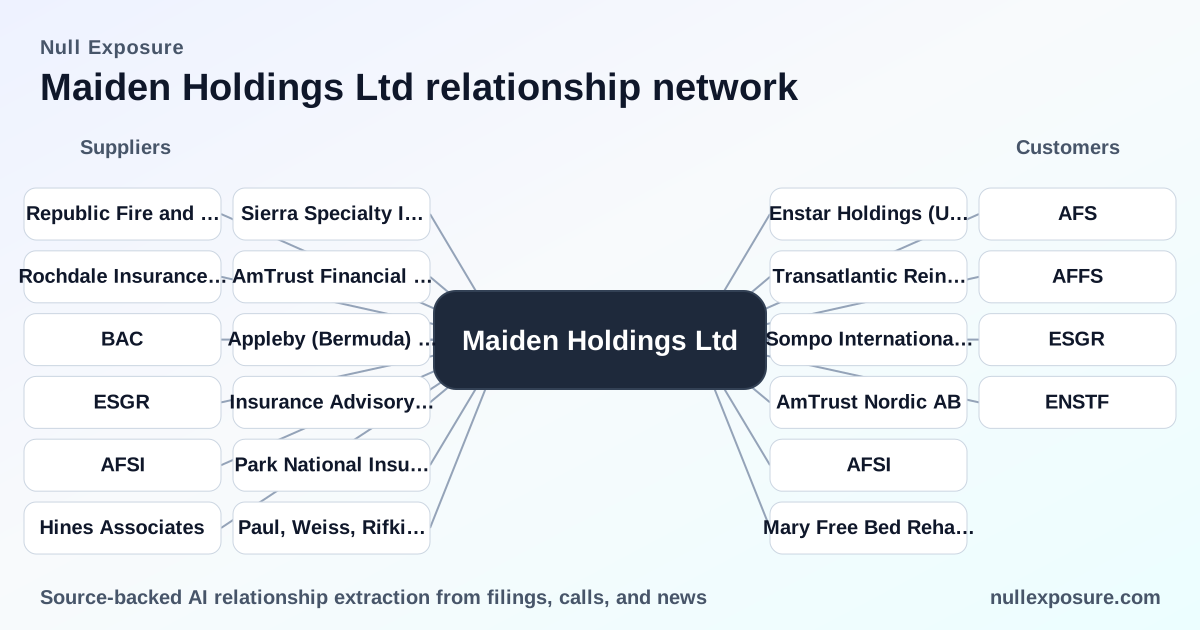
Maiden Holdings (MHLA): Supplier network, strategic constraints, and what investors should act on
Maiden Holdings operates as a reinsurer to regional and specialty insurers across the U.S., Europe and internationally, monetizing via underwriting margins, investment income on fixed‑income portfolios, and strategic transactions that reshape its operating footprint. The company writes risk through both its own structures and third‑party program carriers, cedes and retrocedes risk to manage volatility, and extracts value through portfolio sales and corporate combinations. Investors should evaluate Maiden on counterparty concentration, the underwriting capacity architecture it relies on, and the liquidity profile of its euro‑denominated fixed income holdings. Learn more at https://nullexposure.com/.
How Maiden actually operates and where revenue comes from
Maiden underwrites reinsurance and specialty insurance business and uses ceded reinsurance and retrocession to manage volatility and capital needs. Revenue streams are ordinary: premiums earned, less ceded reinsurance, plus investment yield on fixed‑income holdings; the company also pursues corporate transactions—mergers, asset sales and commutations—that materially change the capital and liability mix. Maiden reports a material allocation to floating‑rate securities (51.1% of fixed income at Dec‑31, 2024) and substantial euro‑denominated bond exposure, which ties the company’s interest‑rate and FX sensitivity to EMEA rates and currency movements. Those balance‑sheet choices define both upside (higher coupon capture in rising rate environments) and downside (market and reinvestment risk).
The company’s contracting posture is intermediary‑heavy: Maiden depends on insurance carriers and capacity providers to distribute and underwrite program business, and it routinely engages external legal and financial advisors when executing strategic options. Those relationships are operationally central. For a deeper supplier map and deal context, visit https://nullexposure.com/.
The supplier and advisor relationships you must know
Below I cover every named relationship in the public results and give the plain‑English takeaway for investor diligence.
-
Sierra Specialty Insurance Company — Kestrel will continue to write business through Sierra Specialty as one of the AmTrust carrier subsidiaries used post-transaction; this operational linkage makes Sierra a critical conduit for program distribution. (Bermuda Insurance Magazine, March 10, 2026: https://www.bermudareinsurancemagazine.com/maiden-to-merge-with-us-specialty-programme-insurer)
-
AmTrust Financial Services, Inc. — Maiden’s prospective combined company will write business through AmTrust subsidiaries and has an option to acquire those insurers, creating material counterparty and strategic optionality; AmTrust is also a historical counterparty in loss commutation transactions. (Bermuda Insurance Magazine, March 10, 2026; Royal Gazette reporting on a 2019 commutation: https://www.bermudareinsurancemagazine.com/maiden-to-merge-with-us-specialty-programme-insurer; https://www.royalgazette.com/other/business/article/20190814/maiden-holdings-reports-15-4m-loss/)
-
Appleby (Bermuda) Limited — Appleby is acting as independent legal counsel to the disinterested members of Maiden’s board, indicating governance oversight and external legal review in the transaction process. (Bermuda Insurance Magazine, March 10, 2026: https://www.bermudareinsurancemagazine.com/maiden-to-merge-with-us-specialty-programme-insurer)
-
Insurance Advisory Partners LLC — Insurance Advisory Partners serves as Maiden’s exclusive financial advisor, signaling the board has engaged a specialist M&A advisor to evaluate strategic alternatives. (Bermuda Insurance Magazine, March 10, 2026: https://www.bermudareinsurancemagazine.com/maiden-to-merge-with-us-specialty-programme-insurer)
-
Park National Insurance Company — Listed among AmTrust’s carrier subsidiaries that will continue to be used post-transaction, Park National is part of the distribution and capacity network Maiden relies upon. (Bermuda Insurance Magazine, March 10, 2026: https://www.bermudareinsurancemagazine.com/maiden-to-merge-with-us-specialty-programme-insurer)
-
Paul, Weiss, Rifkind, Wharton & Garrison LLP — Paul Weiss is legal counsel to Maiden, underscoring high‑end legal support for transaction structuring and regulatory work. (Bermuda Insurance Magazine, March 10, 2026: https://www.bermudareinsurancemagazine.com/maiden-to-merge-with-us-specialty-programme-insurer)
-
Republic Fire and Casualty Insurance Company — Another AmTrust carrier cited as part of the continuing underwriting platform; operational continuity across these carriers is central to the combined company’s ability to write program business. (Bermuda Insurance Magazine, March 10, 2026: https://www.bermudareinsurancemagazine.com/maiden-to-merge-with-us-specialty-programme-insurer)
-
Rochdale Insurance Company — Also named in the suite of AmTrust carriers used for writing Kestrel’s business; this reinforces that a group of AmTrust insurers collectively function as Maiden’s distribution partners. (Bermuda Insurance Magazine, March 10, 2026: https://www.bermudareinsurancemagazine.com/maiden-to-merge-with-us-specialty-programme-insurer)
-
BoA Merrill Lynch (BAC) — Maiden retained BoA Merrill Lynch historically to evaluate strategic alternatives, a signal that the company has previously engaged investment‑banking resources to pursue value‑enhancing options. (Company news citing BoA Merrill Lynch, FY2018; source: Bermuda Insurance Magazine summary of corporate activity: https://www.bermudareinsurancemagazine.com/news/maiden-holdings-stresses-discipline-as-q1-results-slide-3974)
-
Enstar Group Ltd — Maiden has used Enstar for loss portfolio transfers and adverse development cover under a master agreement, reflecting reliance on third‑party capital and run‑off specialists to de‑risk prior liabilities. (Royal Gazette reporting, FY2019: https://www.royalgazette.com/other/business/article/20190814/maiden-holdings-reports-15-4m-loss/)
-
AmTrust Financial Services Inc. (AFSI) — Separately recorded in a 2019 context, AmTrust was the counterparty to a $330.7 million commutation of workers’ compensation loss reserves, demonstrating a historical capital‑management relationship that materially altered reserve risk. (Royal Gazette, FY2019: https://www.royalgazette.com/other/business/article/20190814/maiden-holdings-reports-15-4m-loss/)
-
Hines Associates — Hines advised Maiden on the sale of Swedish subsidiaries, indicating Maiden uses external advisors for asset dispositions and portfolio optimization. (Bermuda Insurance Magazine, FY2024: https://www.bermudareinsurancemagazine.com/maiden-sells-swedish-subsidiaries-to-mystery-buyer)
What the relationship map tells investors: strategic constraints and risk posture
-
Counterparty concentration is real and material. Maiden’s operational ability to write program business is linked to a small group of AmTrust carrier entities, and the company itself notes that insolvency or refusal to reimburse by a capacity provider would materially impair the combined company’s results. That is a top investment risk—counterparty failure would immediately reduce premium capacity and could force reunderwriting or capital infusions.
-
Balance‑sheet sensitivity to EMEA rates and FX. The company’s non‑USD holdings were 100% euro‑denominated at year‑end, and over half of fixed income investments are floating‑rate securities; this creates both income opportunity and market risk tied to European interest rates and euro moves.
-
Mature, active relationships with specialist advisors and run‑off partners. Maiden has repeatedly used external investment banks, law firms and run‑off groups (BoA Merrill Lynch, Paul Weiss, Appleby, Enstar, Hines, Insurance Advisory Partners) to execute transactions and commutations—a signal that the company executes strategic changes via external expertise rather than purely in‑house capacity.
For a concise supplier risk scorecard and deeper counterparty timelines, explore the platform at https://nullexposure.com/.
Investment conclusion and next steps
Maiden is a specialized reinsurer with material counterparty dependence on a small set of AmTrust carriers, significant EMEA fixed‑income exposure, and an active willingness to reshape its portfolio through advisors and commutations. Investors should prioritize (1) counterparty credit assessments of AmTrust entities, (2) scenario analysis of funding capacity if one or more capacity providers reduce support, and (3) mark‑to‑market sensitivity of euro and floating‑rate holdings. Maiden’s market capitalization (~$1.02B) and a dividend yield near 4.95% make the company relevant to yield‑seeking portfolios, but that yield is earned in a structurally concentrated underwriting model.
If you evaluate insurer/reinsurer counterparty risk or run‑off transactions, start your diligence at https://nullexposure.com/—the supplier map and advisory records inform deal timing and exposure remediation.