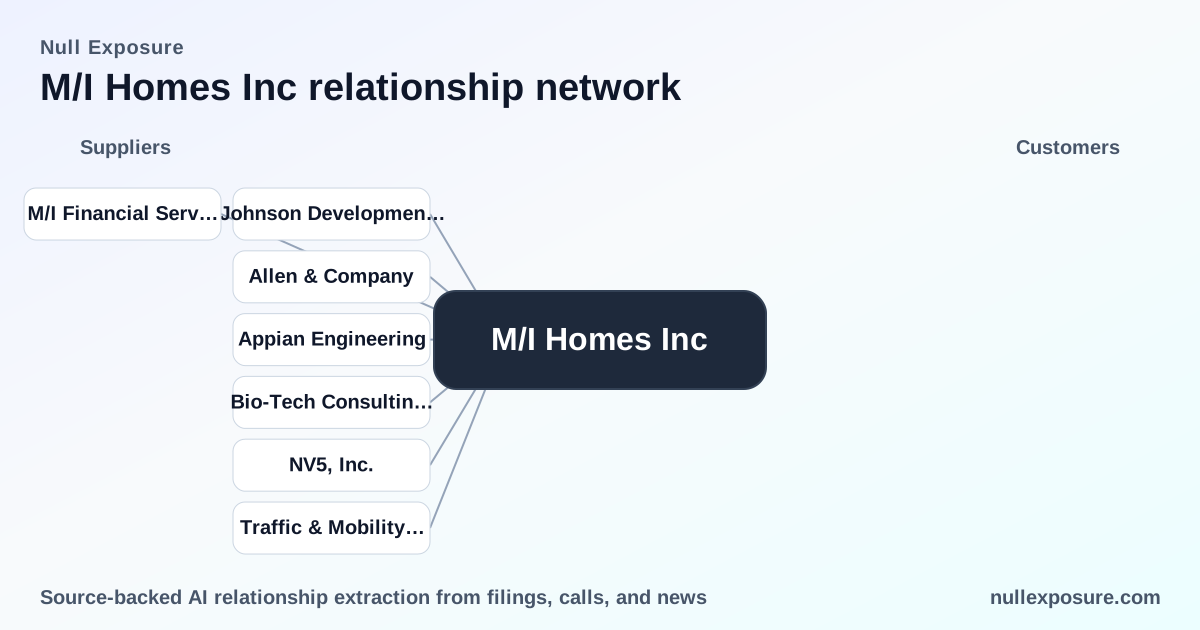
M/I Homes (MHO): supplier landscape and what it means for investors
M/I Homes builds single‑family homes across a multi‑state footprint and captures value through home sales plus vertically integrated mortgage, title and closing services via its in‑house affiliate. The company monetizes by acquiring land, developing subdivisions, selling completed homes and extracting ancillary finance and closing fees from buyers — a model that amplifies gross margins but also concentrates financing counterparty exposure. For investors and operators evaluating supplier relationships, the critical questions are how M/I balances broad subcontractor usage, local development partners, and its mortgage facility exposure to sustain throughput and protect margins.
Explore supplier intelligence and ongoing monitoring at https://nullexposure.com/.
How M/I structures partner work on the ground
M/I relies heavily on local development partners and a large footprint of subcontractors for site work and home construction. That mix delivers operational scalability and local market access while creating operational dependency on many small vendors for execution and warranty remediation.
Johnson Development Services
M/I Homes is jointly developing a Houston‑area community with Johnson Development Services, an affiliate of Johnson Development Corp., indicating a traditional developer-builder joint venture to accelerate geographic expansion in the region. According to Houston Agent Magazine (Aug 2021), the partnership is aimed at materially increasing M/I’s presence in the Houston market.
Allen & Company (surveyor)
Allen & Company acted as the surveyor on the Grassmere Reserve and neighboring Wolf Lake Ranch projects in the Apopka/Zellwood area, supporting M/I’s land‑to‑lot conversion for 153 home lots. GrowthSpotter reported Allen & Company’s participation in the April 2024 announcement of these lot purchases and planned ground break.
Appian Engineering (civil engineer)
Appian Engineering provided civil engineering services for the Apopka subdivision that M/I closed on in April 2024, helping translate raw land into buildable lots and infrastructure plans. GrowthSpotter (Apr 2024) lists Appian among the professional services engaged on Grassmere Reserve.
Bio‑Tech Consulting, Inc. (environmental engineer)
Bio‑Tech Consulting performed environmental engineering for the same Apopka development, preserving wetlands and shaping the open‑space plan that allocates roughly 70% of the site to conservation, per GrowthSpotter’s April 2024 coverage.
NV5, Inc. (geotechnical engineer)
M/I engaged NV5 for geotechnical engineering on the Apopka projects, securing subsurface and soils analysis crucial for foundation design and lot grading; this relationship was noted in GrowthSpotter’s Apr 2024 article on M/I’s lot acquisition.
Traffic & Mobility Consultants (traffic engineer)
Traffic & Mobility Consultants served as the traffic engineering advisor for the Grassmere Reserve development, underlying permitting and access decisions for the planned 153‑lot subdivision, as described in GrowthSpotter (Apr 2024).
M/I Financial Services (in‑house mortgage, title, closing)
M/I operates an in‑house affiliate, M/I Financial Services, which provides mortgage, title and closing services and thereby internalizes additional margin streams from buyers who finance through the affiliate. MarketBeat filings and alerts from March 2026 document this vertical integration and note its prominence in M/I’s customer offering (MarketBeat, Mar 2026).
What the supplier and constraint signals tell investors
The extracted constraints give a clear window into how M/I’s supplier posture and financing shape operational risk and upside.
-
Geographic breadth and local market strategy: M/I is active in 220 communities across 17 markets in ten states, which supports scale diversification but requires extensive local supplier networks to execute simultaneously (company filing language). This is a company‑level signal that delivery risk is geographically distributed but execution risk is granular.
-
Subcontractor model with warranty exposure: M/I uses subcontractors for nearly all aspects of construction and site improvements, and while those firms are contractually responsible for defects, M/I retains ultimate warranty responsibility to homeowners. This service‑provider contracting posture drives lower capital intensity but emphasizes supplier management and quality control as critical operating capabilities.
-
Material financing exposure tied to in‑house mortgage operations: The MIF Mortgage Repurchase Facility is an annually renewed funding line that supported mortgage origination; as of Dec 31, 2024, there was $286.2 million outstanding under that facility, and $80.4 million of letters of credit were outstanding under the credit facility — a direct counterparty and liquidity signal for the finance arm. These are explicit facility exposures cited in company disclosures.
Together these characteristics define a builder with low fixed‑asset concentration but high operational complexity: broad geographic reach reduces single‑market revenue risk, while heavy subcontractor reliance raises operational and warranty execution risk. The mortgage affiliate increases per‑transaction economics but introduces financing concentration that investors must monitor.
For quick reference, the constraints signal:
- Broad U.S. geographic exposure (10 states, 17 markets).
- Heavy use of subcontractors; M/I retains warranty obligations.
- Large, renewable mortgage facility exposure (~$286.2M outstanding at 2024 year‑end).
- Material contingent credit commitments (letters of credit ~$80.4M at 2024 year‑end).
Learn more about supplier risk frameworks and coverage at https://nullexposure.com/.
Investment implications and operational recommendations
-
Margin upside vs financing risk: Verticalizing mortgage and title through M/I Financial Services raises overall transaction margin and customer lock‑in, but the balance sheet and contingent funding lines backing that business are material — monitor facility renewals and counterparty appetite closely.
-
Execution is the core risk: With subcontractors building most units, procurement discipline, contractor vetting and warranty reserve management are central drivers of realized profitability; supplier failures or local labor constraints will directly pressure completion cadence and margins.
-
Localized partnerships accelerate expansion but create partner risk: Joint development with regional players like Johnson Development Services accelerates market entry but transfers some control. Track JV terms and rights to understand profit share and exit dynamics.
For operators doing vendor due diligence, prioritize contracting terms that allocate warranty obligations clearly, require performance bonds or retainage for critical trades, and establish escalation protocols tied to home closings and warranty costs.
Bottom line and next steps
M/I Homes’ model balances scale and margin expansion through vertical finance and broad subcontractor networks. Investors should view the supplier base as a strategic asset that drives execution risk, while the mortgage affiliate is a lever for incremental earnings with a quantifiable funding dependency.
If you want continual visibility into supplier relationships, contract posture and financial commitments that affect operational risk, visit https://nullexposure.com/ for platform access and bespoke reports. Explore supplier intelligence and monitor changes in real time at https://nullexposure.com/ — it is the fastest way to incorporate supplier signals into investment decisions.