MIAX (Miami International Holdings): Who they hire, how they fund, and what it means for investors
Miami International Holdings operates and monetizes a regulated trading venue ecosystem built around options, derivatives and related listing services. The company generates recurring revenue from transaction and listing fees, supplemented by growth investments funded through capital markets activity; in early 2026 MIAX executed a secondary offering supported by a broad syndicate of investment banks that underlines how the company finances growth and manages liquidity on its balance sheet. For investors and operators evaluating supplier and underwriting relationships, the syndicate composition and exchange counterpart disclosures are a direct window into MIAX’s contracting posture and market positioning.
Learn more about how we map supplier relationships at NullExposure: https://nullexposure.com/
How MIAX’s business model translates into supplier economics
MIAX is an exchange operator: primary revenue derives from per-trade transaction fees and listing/market data services, while operating leverage comes from fixed technology and regulatory costs amortized over growing volumes. The latest public metrics show Revenue TTM of $1.364B and Gross Profit of $430.53M, which reflects a mature marketplace business with meaningful scale. Trading venues require specialized service providers (underwriters for capital raises, market technology partners, international listing channels) and these supplier relationships are both strategic and recurring.
From a contracting perspective MIAX demonstrates a capital-markets-heavy posture — it regularly engages multiple underwriters in syndicated deals rather than single-source mandates, which spreads execution risk but creates complex coordination needs during capital events.
Concrete signals about operating constraints and business characteristics
- Contracting posture: MIAX leverages multi-bank syndicates for capital raises and places emphasis on distribution breadth rather than single-counterparty dependency — a company-level signal derived from recent underwriting activity.
- Counterparty concentration: Institutional ownership is material (about 45.6% of shares), implying MIAX is accustomed to dealing with large financial counterparties and sell-side relationships are strategically important.
- Criticality: As an exchange operator, MIAX’s platform is mission-critical to customers; any supplier disruption in listing, market data, or clearing relationships would be operationally significant.
- Maturity and capital approach: The company runs a mature exchange with positive operating margin metrics but uses the public markets to raise growth capital; syndicate composition for offerings shows a standard, investment-bank-driven funding model rather than private-credit reliance.
For deeper supply-side intelligence on MIAX, visit NullExposure’s research hub: https://nullexposure.com/
Who MIAX worked with in the FY2025/FY2026 coverage window
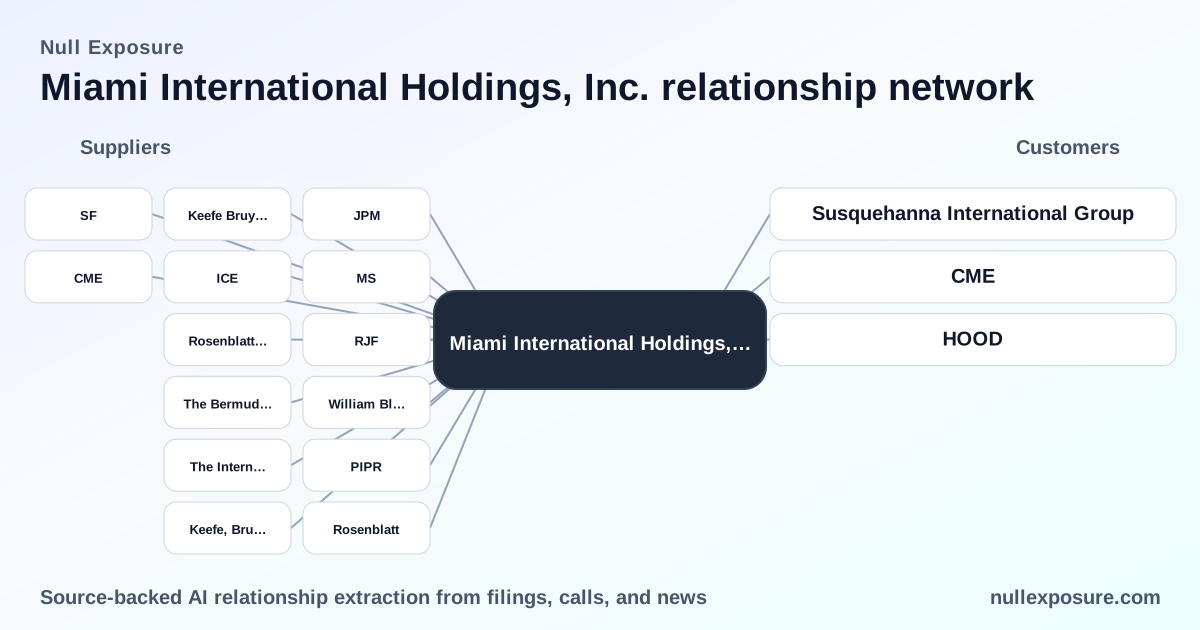
Below are every counterparty or supplier relationship referenced in the aggregated results, with a plain-English summary and the source for that item.
- J.P. Morgan — J.P. Morgan acted as one of the lead joint bookrunning managers on MIAX’s secondary public offering announced and priced in March 2026, signaling top-tier banking distribution support for the raise (reported by FXNewsGroup and Renaissance Capital on 2026-03-10; see https://fxnewsgroup.com/ and https://www.renaissancecapital.com/).
- Morgan Stanley — Morgan Stanley served as a lead joint bookrunner alongside J.P. Morgan and others for the March 2026 secondary offering, providing blue‑chip underwriting muscle for MIAX’s capital transaction (reported on 2026-03-10; see https://news.futunn.com/ and https://www.renaissancecapital.com/).
- Piper Sandler — Piper Sandler was named a lead joint bookrunning manager on the same secondary offering, indicating MIAX sourced distribution across both global and specialist underwriters (reported 2026-03-10; see https://fxnewsgroup.com/ and https://news.futunn.com/).
- Raymond James — Raymond James participated as a joint bookrunning manager on the deal, reflecting MIAX’s use of regional and middle‑market underwriting channels in its syndicate (reported 2026-03-10; see https://fxnewsgroup.com/ and https://news.futunn.com/).
- Rosenblatt / Rosenblatt Securities — Rosenblatt Securities was included among the joint bookrunners for the secondary offering, showing MIAX’s allocation of roles to smaller securities firms for distribution and placement work (reported 2026-03-10; see https://fxnewsgroup.com/ and https://www.renaissancecapital.com/).
- William Blair — William Blair is listed as a joint bookrunner on the offering, underscoring MIAX’s strategy to combine large and boutique underwriters to broaden retail and institutional reach (reported 2026-03-10; see https://www.renaissancecapital.com/ and https://fxnewsgroup.com/).
- Keefe, Bruyette & Woods (A Stifel Company) — Keefe, Bruyette & Woods appeared in the syndicate as a joint bookrunning manager, signaling MIAX’s engagement with specialty financial institutions familiar with capital markets in the exchange and financial technology sectors (reported 2026-03-10; see https://www.renaissancecapital.com/ and https://fxnewsgroup.com/).
- NYSE (Intercontinental Exchange / ICE) — MIAX planned to list under the symbol MIAX on the NYSE as part of its public offering process, confirming a primary exchange listing route and standard public-market litigation and disclosure framework (mentioned in Renaissance Capital coverage, 2026-03-10; see https://www.renaissancecapital.com/).
- CME Globex — Company reporting noted a reduction in expenses related to CME Globex and cited lower transaction fees tied to participant migrations to MIAX Futures Onyx; this shows MIAX’s interactions and evolving cost relationships with CME-related platforms (reported in 2026 FY/Q4 financial reporting summaries; see https://www.bolsamania.com/nota-de-prensa/mercados/).
- The Bermuda Stock Exchange — MIAX referenced international listing channels including the Bermuda Stock Exchange as part of its global listing strategy, highlighting the company’s use of offshore listing vehicles for international issuances (reported by Renaissance Capital on 2026-03-10; see https://www.renaissancecapital.com/).
- The International Stock Exchange Group — The International Stock Exchange Group was cited alongside Bermuda for international listings, indicating MIAX’s active routing of cross-border listing activities through established international exchanges (reported 2026-03-10; see https://www.renaissancecapital.com/).
What this syndicate and counterparty map means for investors
The composition of MIAX’s underwriting syndicate — a mix of top-tier banks (J.P. Morgan, Morgan Stanley), middle-market firms (Raymond James, Piper Sandler), and boutique specialists (William Blair, Rosenblatt, Keefe) — is evidence of an intentional capital markets strategy: MIAX seeks both distribution breadth and sector expertise when raising equity capital. That approach reduces single‑counterparty execution risk but increases coordination complexity during placements, which has operational implications for CFO and IR teams.
CME Globex references in earnings commentary also signal an operational transition: MIAX is absorbing participant migrations to its own futures platform (MIAX Futures Onyx), which reduces reliance on legacy transaction flows and associated expense relationships. Investors should treat this as a strategic shift in revenue mix and expense profile rather than a one-off item (see company financial commentary referenced via bolsamania, March 2026).
If you want a systematic view of MIAX’s supplier map and underwriting cadence, our institutional reporting provides a deeper breakdown: https://nullexposure.com/
Investment takeaways and next steps
- Underwriting depth is a strength — the syndicate composition demonstrates broad distribution capacity for future capital needs.
- Platform transition is underway — migration of participants from third-party venues to MIAX products is altering revenue and expense lines and should be monitored in quarterly disclosures.
- Operational complexity is higher — managing multiple specialty suppliers and underwriters requires strong execution discipline at MIAX.
For a tailored briefing or to explore supplier risk in MIAX’s ecosystem, contact NullExposure through our site: https://nullexposure.com/
This analysis synthesizes disclosed underwriting activity and public financial commentary to give investors a practical view of MIAX’s supplier relationships and the strategic implications for capital structure, operational risk, and revenue durability.