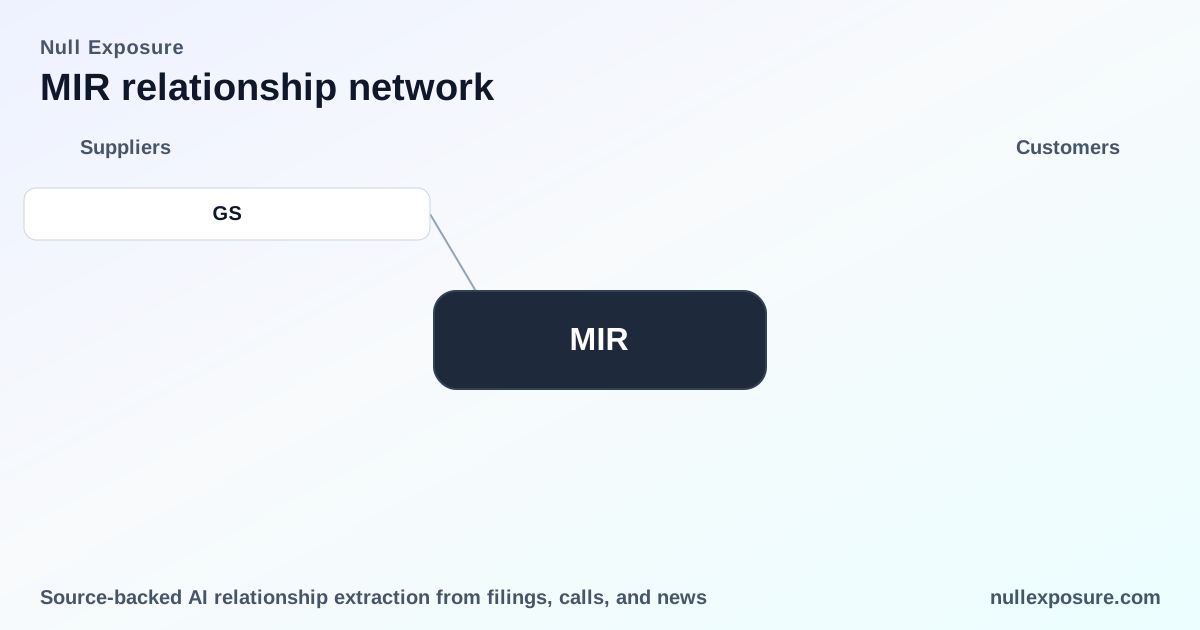
Mirion Technologies (MIR) — Supplier relationship readout and financing context
Mirion operates as a specialized supplier of radiation detection, monitoring and nuclear-support services, monetizing through product sales, long-term service contracts, and targeted acquisitions that expand installed-base revenue and serviceable markets. The company funds growth and working-capital needs through a mix of operating cash flows and external financing, and recent transaction activity has involved external arrangers for bridge financing. For investors and procurement leaders, the intersection of Mirion’s contractual purchase commitments and its capital structure actions creates the most material supplier- and finance-related signals to monitor. Learn more at https://nullexposure.com/.
One-line investment thesis up front
Mirion’s value proposition rests on durable, technical supply relationships and recurring service revenues, but the near-term profile is shaped by non‑cancellable supplier commitments (~$85.2m) and active transaction financing, which together drive working-capital sensitivity and influence supplier negotiating dynamics.
What the public relationship record shows
- Goldman Sachs arranged bridge financing for Mirion’s recent acquisition. A Benzinga report covering the transaction noted that the acquisition will be funded by a bridge loan arranged by Goldman Sachs, signaling use of short‑term external credit to close the deal (Benzinga, March 10, 2026). Source: https://www.benzinga.com/m-a/25/09/47840789/whats-behind-mirions-585-million-nuclear-power-play
How Mirion’s supplier contract profile changes the game
Mirion’s filings disclose material long‑term unconditional purchase obligations that are non‑cancellable and specify fixed or minimum purchase quantities. As of December 31, 2024, those obligations totaled $85.2 million, allocated across fiscal years as $35.9m (2025), $43.0m (2026), $5.0m (2027), $0.7m (2028), and $0.6m thereafter. This is a company-level signal from filings as of year‑end 2024.
- Contracting posture: The evidence of non‑cancellable, fixed-quantity commitments indicates a procurement posture that prioritizes supply continuity and price stability over short-term flexibility. That reduces spot procurement risk but increases sunk exposure if demand softens.
- Concentration and spend scale: The total obligation places Mirion in the $10m–$100m spend band for supplier commitments, implying material line-item exposure across fiscal years rather than a dispersed small-supplier model.
- Maturity and criticality: Multi-year commitments with minimum quantities suggest strategic supplier relationships for critical components or services—suppliers benefiting from revenue visibility; Mirion accepting lock‑in risk.
Why the financing relationship matters to suppliers and operators
Goldman Sachs’ role as bridge arranger is not a supplier contract in the procurement sense, but it affects counterparties across Mirion’s value chain:
- Near-term liquidity management: Bridge financing provides immediate capital to support acquisitions and likely underpins working-capital needs tied to those long-term purchase obligations. A Benzinga report documented Goldman Sachs’ bridge role in the latest acquisition financing (Benzinga, March 10, 2026).
- Counterparty stability: Active use of short-term financing indicates management’s preference for rapid deal execution; counterparties should assess the counterparty credit implications if that bridge refinancing converts into longer-term debt.
- Negotiation leverage: Suppliers with fixed‑quantity contracts gain revenue certainty, but Mirion’s reliance on external financing increases the importance of suppliers’ visibility into cash‑collection cadence and payment terms.
Explore supplier risk coverage and financing reads at https://nullexposure.com/ to benchmark similar supplier profiles.
Timing and cash-flow implications (short, actionable)
The fiscal schedule of purchase obligations concentrates cash outflows in 2025–2026 ($78.9m combined). That concentration creates a near-term funding cliff that aligns with the timing of acquisition financing and suggests why Mirion arranged bridge facilities. According to filings, $35.9m is due in 2025 and $43.0m in 2026, and management has supplemented internal funds with external bridge financing noted by market coverage.
Practical takeaways for investors and operator teams
- Cash-flow sensitivity is elevated: Material, non‑cancellable purchase obligations compress free cash flow and amplify sensitivity to revenue cyclicality; model those obligations explicitly rather than assuming smoothing.
- Supplier negotiating dynamics shift in favor of Mirion for continuity: Long-term minimums create supplier revenue visibility; operators should assess suppliers for over‑reliance on Mirion as a customer or for potential concentration risks.
- Financing cadence matters as an operational signal: Use of bridge loans to fund acquisitions signals management’s willingness to lever short-term capital markets to support strategic M&A; monitor refinancing events and covenant structures for downstream supplier impact.
- Integration risk after acquisitions requires supplier diligence: When Mirion acquires target companies, suppliers and operators should evaluate systems and contract consolidation plans that could affect ordering volumes and payment terms.
Relationship roll call — concise entries for every identified counterparty
Goldman Sachs — The firm arranged a bridge loan to fund Mirion’s acquisition, providing interim financing to close the transaction and bridge the company to longer‑term capital solutions; this was reported by Benzinga on March 10, 2026. Source: https://www.benzinga.com/m-a/25/09/47840789/whats-behind-mirions-585-million-nuclear-power-play
Final assessment and next steps
Mirion operates with meaningful, non‑cancellable supplier commitments and active use of bridge financing for transactions, which together create a clear strategic profile: stable supplier relationships but elevated near‑term funding and cash‑flow exposure. For investors, model the $85.2m obligation schedule explicitly and monitor refinancing outcomes; for suppliers and procurement teams, prioritize dialogue on delivery cadence and payment certainty.
For a deeper supplier relationship scan and transaction-read playbook, visit https://nullexposure.com/ — the fastest route to structured supplier intelligence tailored to investor and operator needs.