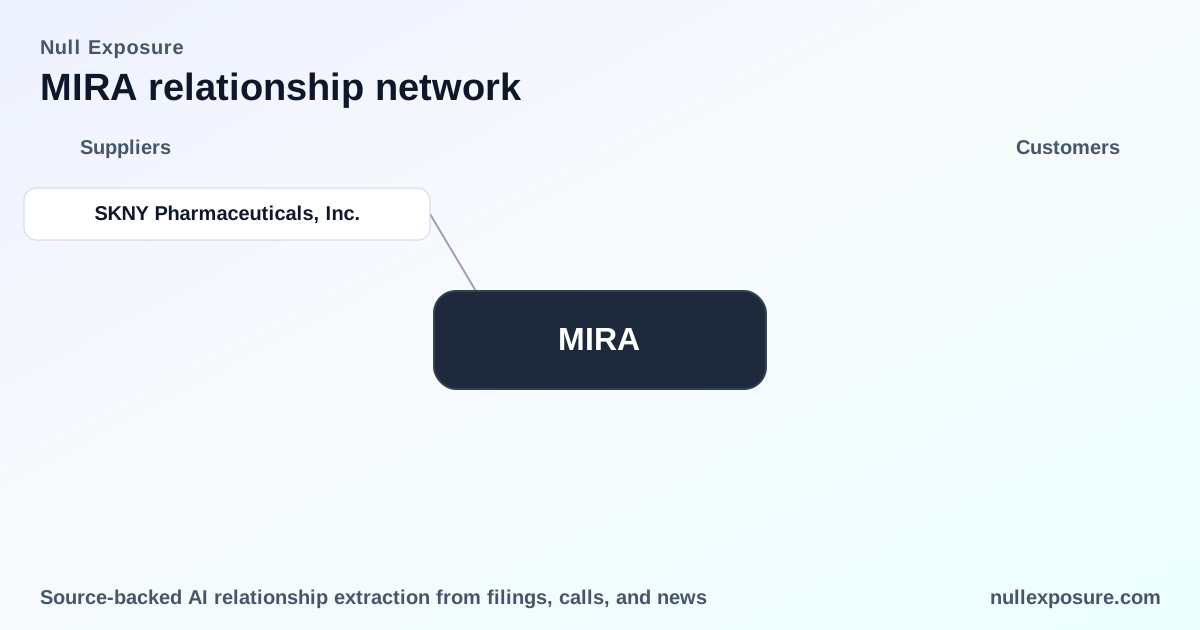
MIRA Pharmaceuticals: acquisition-driven pipeline growth with concentrated supplier and licensing dynamics
MIRA Pharmaceuticals operates as a clinical-stage pharmaceutical developer that builds value through licenses, targeted asset acquisitions, and milestone/royalty economics while outsourcing clinical development and manufacturing. The company monetizes primarily by advancing drug candidates to value-driving inflection points—out-licensing, milestone receipts, and eventual product sales—while managing a compact balance sheet that includes short-term financing facilities. Investors should treat MIRA as a small-cap biotech executing a combo of buy-and-build and licensing strategies, with operational leverage tied to a handful of counterparties. Learn more at https://nullexposure.com/.
The SKNY acquisition: immediate balance-sheet lift, strategic pipeline fit
MIRA closed the acquisition of SKNY Pharmaceuticals, Inc., receiving $5 million in marketable securities at closing, which materially strengthened short-term liquidity and bolstered the company’s pipeline with SKNY-1 focused on obesity and nicotine addiction. According to a company press release published March 10, 2026 on Citizen-Times, SKNY fulfilled closing obligations and contributed the marketable securities to MIRA’s balance sheet (Citizen-Times, March 10, 2026).
How MIRA contracts and funds its operations: short-term notes, licensing deals, and lapsed credit
MIRA’s operating model demonstrates a short-term contracting posture combined with licensing and acquisition activity:
- On financing, the company executed a Bay Shore Note on April 28, 2023 that provided the right to borrow up to $5.0 million from Bay Shore Trust with availability limited to the earlier of two years or completion of an IPO, indicating near-term financing flexibility rather than long-term committed capital (company filing disclosure).
- On licensing, MIRA entered an exclusive license with MIRALOGX on November 15, 2023 for KETAMIR-2 in North America, with a one-time payment and ongoing royalty obligations—illustrating the firm’s reliance on third-party intellectual property arrangements to populate its pipeline (company filing, Nov 15, 2023).
- A loan agreement tied to MIRALOGX had a one-year term and expired November 15, 2024 after no draws; the expiration reflects transient credit arrangements rather than durable debt relationships (company filing).
These documents, disclosed in company filings, show MIRA structures many of its counterparties on time-limited, transactional terms rather than long-dated, captive supply contracts.
Supplier and operational concentration: outsourced manufacturing and clinical services
MIRA relies on a limited number of third parties to manufacture clinical supplies and to run trials, a business model consistent with small clinical-stage developers that prioritize capital efficiency:
- The company explicitly states dependence on third-party manufacturers for clinical product supplies and intends to continue this practice, which creates single- or few-source supply risk for clinical continuity and timing (company filing).
- MIRA also relies on contract research organizations and other service providers for clinical development, making trial execution dependent on external schedules and capacity (company filing).
This structure delivers lower fixed cost and asset intensity but produces high criticality for each supplier relationship; a supplier disruption would quickly affect trial timelines and near-term valuation.
Commercial and geographic footprint: North America focus, specific EMEA trial plans
MIRA holds exclusive North American rights to KETAMIR-2 and related candidates, carrying the right to sublicense intellectual property in that territory—this defines the primary commercialization geography and royalty economics for those assets (company filing, Nov 15, 2023). The company also plans to begin Phase I trials in Israel in Q1 2025 with Phase IIa to follow in Q4 2025, showing a dual-region development approach that blends North American commercial rights with select EMEA clinical execution (company filing).
Risk profile — what investors must watch now
MIRA’s strategic posture produces a compact set of concentrated risks that drive valuation volatility:
- Concentration risk: reliance on a limited set of manufacturers and service providers creates outsized operational risk if a supplier fails to deliver; this is explicitly called out in filings as material to operations.
- Short-term financing profile: facilities such as the Bay Shore Note provide flexibility but do not represent long-tenor capital, so funding events or milestone receipts remain key near-term value drivers.
- Licensing obligations and royalty burden: license agreements (e.g., the MIRALOGX arrangement) include upfront and ongoing royalty commitments that reduce net economics on future sales.
- Execution criticality: with a small portfolio and two core programs, development delays translate quickly to valuation impairment.
For clarity, the company-level signals above come from recent corporate disclosures describing borrowing arrangements, license agreements, supplier dependence, and trial plans (company filings).
Every counterpart explicitly referenced in public materials
-
SKNY Pharmaceuticals, Inc.: MIRA completed an acquisition in which SKNY satisfied closing obligations and contributed $5 million in marketable securities, strengthening MIRA’s balance sheet at close (press release, Citizen-Times, March 10, 2026).
-
MIRALOGX: MIRA signed an exclusive North American license on November 15, 2023 to develop and commercialize Ketamir-2 (also called M209/KETAMIR-2); the agreement included a $0.1 million upfront payment and ongoing royalty obligations of 8% on net sales and 8% on other revenue such as milestones or sublicenses (company filing, Nov 15, 2023). A related one-year loan agreement with MIRALOGX expired without draws on November 15, 2024 (company filing).
-
Bay Shore Trust: Under a Bay Shore Note executed April 28, 2023, MIRA had the right to borrow up to $5 million under a short-term borrowing facility that terminated on the earlier of two years or an IPO (company filing, Apr 28, 2023).
Each of these counterparties is documented in company disclosures and press materials; the SKNY transaction is the most recent public balance-sheet-positive event.
If you are tracking supplier risk and counterparty economics for small-cap biotechs, the combination of asset acquisitions and short-tenor capital makes continuous monitoring essential. Get a consolidated view and ongoing updates at https://nullexposure.com/.
Investment takeaway and next steps
MIRA’s strategy is capital-efficient and deal-driven: acquire or license targeted assets, outsource development, and attempt to capture value through milestones, royalties, and eventual commercialization. That approach yields high upside on successful clinical readouts but concentrates downside in supplier disruptions, short-term funding gaps, and contractual royalty burdens.
For investors and operators evaluating MIRA supplier relationships, prioritize:
- cash runway and milestone schedules;
- single-source manufacturing contracts and contingency plans;
- license economics and outbound royalty obligations.
For continuous monitoring of MIRA’s counterparties and disclosures, visit https://nullexposure.com/.