Mirum Pharmaceuticals (MIRM): Supplier Relationships Drive Execution Risk and Upside
Mirum Pharmaceuticals operates as a clinical-stage biopharma focused on bile-acid and rare-liver therapies, monetizing through product sales of approved medicines, licensing of intellectual property, and advancement of late-stage candidates toward commercialization. The company deliberately outsources core execution — clinical trials, drug manufacturing, and distribution — which compresses fixed cost but concentrates operational risk in a small number of third parties. For investors evaluating Mirum as a supplier-dependent enterprise, the investment case balances pipeline-driven upside against concentration and execution risk in manufacturing, logistics, and specialized clinical services. Learn more about supplier intelligence and risk signals at https://nullexposure.com/.
How Mirum runs the business: an outsourcing-first model with concentrated partners
Mirum’s operating model is clear and repeatable: the company retains discovery and IP control while contracting out execution. Mirum does not own manufacturing facilities and depends on contract manufacturers for active ingredients, finished products, and clinical supplies. It also uses CROs for major trials and relies on a single third-party logistics provider (3PL) in each major market and a single specialty pharmacy for U.S. sales. This structure reduces capital intensity and speeds time-to-market but creates single points of failure that are operationally and financially material.
- Contracting posture: Outsource-heavy. Clinical trials and drug production are principally delivered by third-party CROs and CMOs.
- Concentration: High. Single 3PLs per major market and a single U.S. specialty pharmacy for approved medicine sales create dependency.
- Criticality: High. Suppliers are integral to commercialization and regulatory compliance; disruptions would immediately affect revenue and clinical timelines.
- Maturity: Early commercial / late clinical. Mirum’s model is suited to a company scaling from clinical to commercial stages without owning heavy assets.
Key supplier relationships you need to know
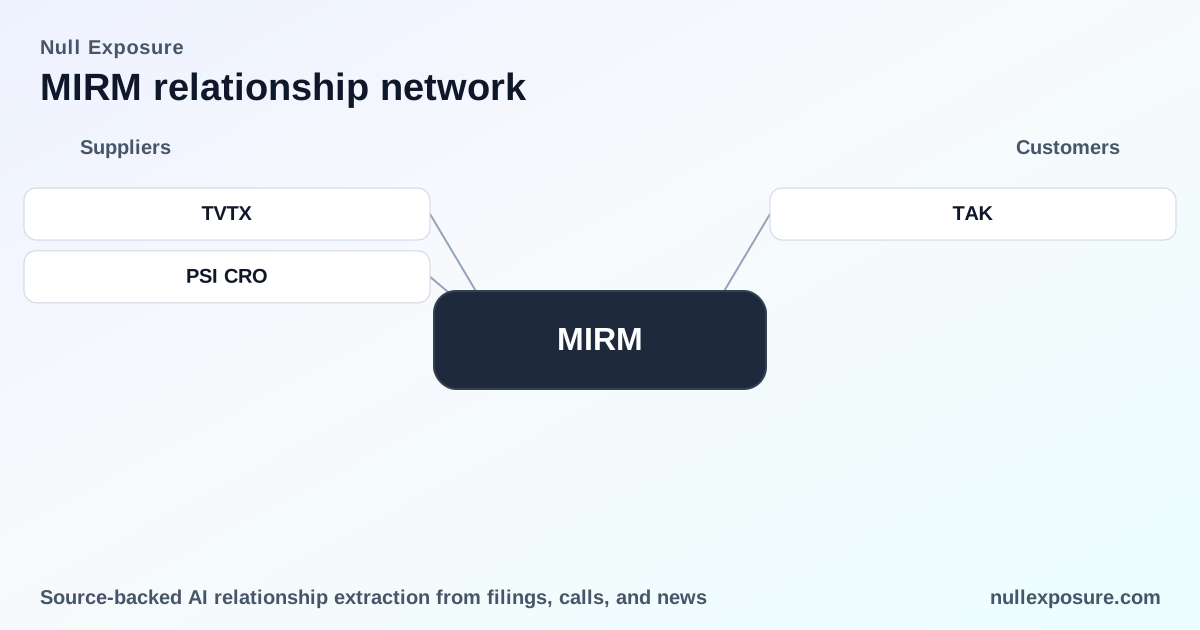
Travere Therapeutics — portfolio acquisition and product lineage
Mirum’s recent deal expanded its portfolio beyond its legacy bile-acid assets by acquiring products that were previously part of Travere’s portfolio. According to a Simply Wall St report dated March 10, 2026, the transaction expanded Mirum’s bile-acid product base and shifted its rare-liver narrative beyond its flagship candidate. The deal increases Mirum’s product breadth but also integrates legacy manufacturing and distribution obligations that will be executed through third parties. Source: Simply Wall St coverage of Mirum buyout of Bluejay, March 10, 2026 (https://simplywall.st/stocks/us/pharmaceuticals-biotech/nasdaq-mirm/mirum-pharmaceuticals/news/mirum-buyout-of-bluejay-shifts-rare-liver-story-beyond-livma/amp).
PSI CRO — external clinical execution for AZURE-4
Mirum is running its Phase 3 AZURE-4 trial with PSI CRO, signaling reliance on established clinical operations partners to deliver a globally relevant study and support potential international commercialization. Simply Wall St noted on March 10, 2026, that engaging PSI CRO demonstrates Mirum’s choice to lean on outside clinical expertise to reach patients beyond the U.S. and to de-risk operational aspects of a complex trial. Source: Simply Wall St analysis of Mirum’s Brelovitug Phase 3 milestones, March 10, 2026 (https://simplywall.st/stocks/us/pharmaceuticals-biotech/nasdaq-mirm/mirum-pharmaceuticals/news/mirums-brelovitug-phase-3-milestones-reframe-rare-disease-gr/).
What the constraint signals tell investors about supplier risk
Mirum’s public disclosures and our signals provide actionable constraints that shape vendor risk and operational posture:
- Material outsourcing: Mirum outsources substantial clinical trial work and drug manufacturing. This is a core business choice that reduces capital requirements but elevates execution risk tied to third parties. Investors should treat supplier performance as a first-order driver of value realization rather than a secondary operational detail.
- Critical distribution concentration: The company’s reliance on a single 3PL per major market and a single specialty pharmacy in the U.S. is a critical vulnerability. Supply chain interruption, contract disputes, or capacity constraints at those partners would directly constrain sales and patient access.
- License-driven IP posture: Mirum is a party to multiple license agreements that underpin its product candidates and marketed products. Licensing gives the company necessary IP freedom to operate, but these contracts require active management to avoid revenue or development interruptions.
- Manufacturer/service-provider dependence: Mirum does not own manufacturing facilities and depends on CMOs and CROs for production and trials. This exposes the company to vendor qualification, regulatory inspection, and continuity risks that can affect both trial timelines and commercial supply.
These constraints are company-level signals: they reflect how Mirum structures its business rather than the attributes of any single supplier, and they elevate the importance of supplier governance and redundancy planning.
Investment implications: where upside and risk intersect
Mirum’s strategy creates a distinct risk-reward profile:
- Upside drivers: The acquisition of additional bile-acid products and advancement of Phase 3 readouts (AZURE-4) are clear value catalysts. Effective execution by PSI CRO and reliable CMO supply chains would translate clinical success into scalable revenues quickly.
- Risk drivers: Supplier concentration and outsourcing dependency are material. A single 3PL or specialty pharmacy problem, or manufacturing noncompliance at a contracted CMO, would disrupt commercialization and impair valuation. Investors must watch contract terms, inventory buffers, secondary supply agreements, and regulatory inspection outcomes.
If you want granular supplier monitoring and contract-level risk signals integrated with your investment workflow, visit https://nullexposure.com/ for tools and supplier intelligence.
Practical monitoring checklist for investors and operators
- Track clinical milestone announcements and any operational notices from PSI CRO and other CROs on trial enrollment and site performance.
- Monitor regulatory filings and inspection reports for contracted CMOs; supplier GMP issues are leading indicators of supply disruption.
- Require disclosure of contingency plans for the single 3PL and specialty pharmacy relationships—look for secondary logistics partners or inventory strategies.
- Review license agreement progress and any milestone/payment terms that could affect cash flow.
Bottom line: execution risk priced into potential upside
Mirum has engineered a capital-efficient model that monetizes IP and late-stage clinical assets through sales and licensing, while outsourcing execution to specialist partners. That model accelerates scalability but concentrates operational risk — particularly in manufacturing, distribution, and clinical operations. For investors, value realization is contingent on supplier performance as much as clinical outcomes. Monitor CRO and CMO performance metrics, contract disclosures, and the single-3PL/specialty-pharmacy dependencies closely.
If you need ongoing supplier risk coverage tied to Mirum’s commercial and clinical timelines, explore our supplier analytics at https://nullexposure.com/.
Final verdict: Mirum’s pipeline progress and portfolio expansion present meaningful upside, but supplier concentration and reliance on third-party manufacturers and logistics providers are material and critical risks that should be incorporated into any valuation or operational diligence.