Milestone Pharmaceuticals (MIST): Supplier relationships, financing partners and what they mean for commercialization
Milestone Pharmaceuticals monetizes etripamil by advancing a self‑administered nasal spray (CARDAMYST) to market while funding commercialization through a mix of royalty financing and outsourced manufacturing and device supply. Revenue will depend on successful launch and scale of etripamil sales; near‑term cash flows are structurally tied to a $75 million royalty purchase arrangement and to the continuity of single‑source manufacturing and device suppliers. For investor diligence on supplier counterparty risk and contract exposure, review operational constraints and partner commitments now. Visit https://nullexposure.com/ for an in‑depth supplier diligence toolkit.
Why the supplier picture drives valuation now
Milestone’s operating model is a classical small‑cap biotech commercialization posture: it outsources manufacturing, device integration and clinical operations rather than owning production assets. Company disclosures state they rely on third‑party contract manufacturing organizations (CMOs) for API, finished product and the nasal spray device, and they do not operate their own manufacturing, storage or testing facilities. The firm also notes it does not yet have a commercial supply agreement and currently sources its sole nasal spray device supplier on an as‑needed basis.
These facts generate three investment‑grade conclusions for risk and optionality:
- Concentration risk is high. Single‑source device supply and heavy CMO reliance increase vulnerability to supply disruption and regulatory non‑conformance.
- Contracting posture is immature. The absence of firm commercial supply contracts indicates procurement is still transitional; this raises execution risk around launch scale‑up.
- Supplier relationships are critical to time to revenue. The company explicitly links commercial approval and manufacturing continuity to its financial condition and commercialization plans.
For a practical supplier risk playbook and relationship scoring, see our service at https://nullexposure.com/.
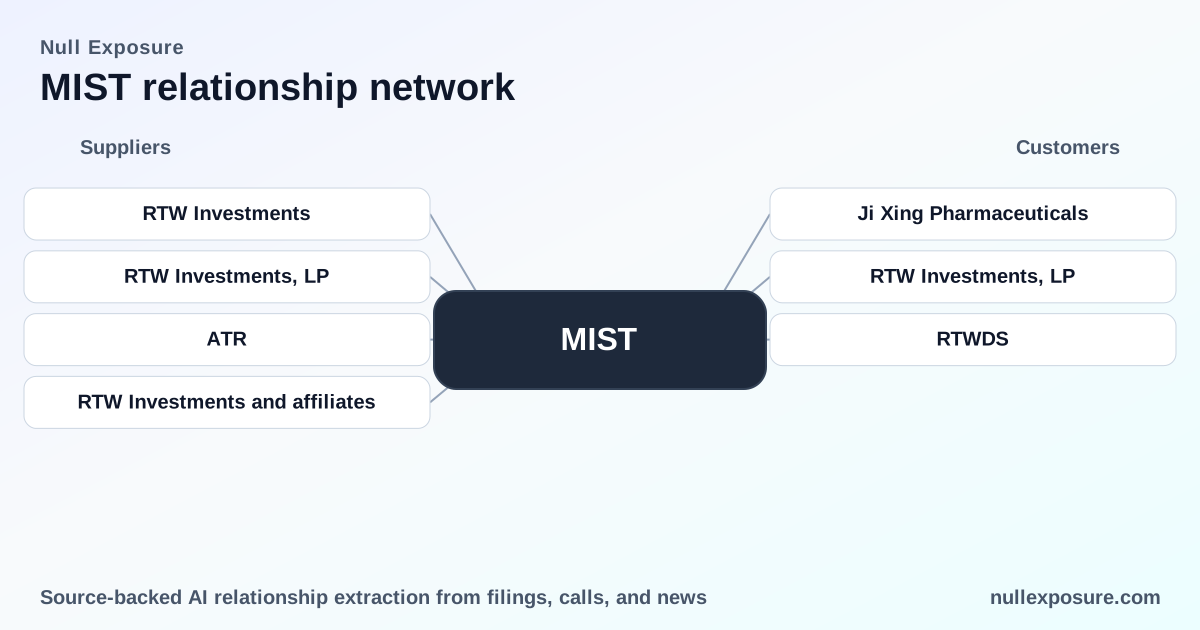
Partner roll call — every relationship cited in the public results
RTW Investments
RTW provided a royalty financing arrangement tied to FDA approval and commercialization planning, structured as a $75 million purchase for future tiered royalty rights on U.S. net sales of etripamil. According to a December 2025 report compiling Milestone updates, multiple outlets highlighted this $75 million royalty financing tied to regulatory milestones (news report, FY2025; https://ts2.tech/en/milestone-pharmaceuticals-mist-stock-update-fda-approves-cardamyst-etripamil-this-weeks-volatility-analyst-forecasts-and-what-to-watch-next-updated-dec-12-2025/).
RTW Investments, LP
Milestone’s public disclosures recorded a March 2023 Royalty Purchase Agreement under which RTW Investments, LP agreed to purchase royalty rights for $75.0 million, conditional on FDA approval by a specified deadline; the deal gives RTW tiered rights to U.S. etripamil sales in exchange for upfront funds (company disclosure reported via Quiver Quant, FY2025; https://www.quiverquant.com/news/Milestone+Pharmaceuticals+Receives+FDA+Approval+for+CARDAMYST%E2%84%A2%2C+First+Treatment+for+PSVT+in+Over+30+Years).
Aptar
Aptar’s Bidose nasal system was identified as the delivery platform for CARDAMYST, with Aptar technology delivering the self‑administered nasal spray format used in commercialization. A December 17, 2025 news item noted Aptar’s Bidose Nasal System delivers CARDAMYST, making it the first FDA‑approved self‑administered nasal spray for PSVT (market report / Finviz, FY2026; https://finviz.com/news/286740/milestone-pharmaceuticals-announces-us-availability-of-cardamyst-etripamil-nasal-spray-the-first-and-only-fda-approved-self-administered-treatment-for-adults-with-paroxysmal-supraventricular-tachycardia-psvt).
Aptar Group, Inc.
Aptar CSP Technologies collaborated with Milestone to develop a custom polypropylene container closure system with a fully integrated cap for CARDAMYST, indicating a design partnership on packaging and user interaction for the nasal spray product (FT Markets announcement, Dec 17, 2025; FY2025 context; https://markets.ft.com/data/announce/detail?dockey=600-202512171700BIZWIRE_USPRX____20251217_BW190273-1).
RTW Investments and affiliates
Additional reporting consolidated the royalty purchase agreement under the broader RTW Investments and affiliates grouping and noted the approval‑tied $75.0 million purchase price and an extended approval deadline in later disclosures (news synthesis, December 2025; https://ts2.tech/en/milestone-pharmaceuticals-mist-stock-fda-approval-of-cardamyst-launch-timeline-and-analyst-forecasts-dec-15-2025/).
What the relationships mean for commercial execution and valuation
The RTW financing is the key near‑term de‑risking instrument for Milestone’s balance sheet, converting future royalty upside into immediate commercialization capital. That improves funding runway but introduces a fixed claim on gross sales through tiered royalties, compressing long‑term EBITDA capture for equity holders. Aptar’s role as device and closure partner is critical to product usability and regulatory packaging compliance, and the firm’s contributions are operationally integral rather than peripheral.
Company‑level constraints reinforce these points:
- Contract type is not fully formalized; Milestone documents state they do not yet have a commercial supply agreement and that a formal supply agreement with the sole device supplier is not in place.
- Materiality of supplier continuity is critical; company statements link unpredictable supply to material adverse effects on commercialization and financial condition.
- Relationship roles are concentrated in manufacturer and service provider categories — CMOs and CROs supply manufacturing and clinical trial services, and Milestone lacks in‑house production capabilities.
- Relationship stage is active but immature for commercial scale‑up, implying a transition from development‑era contracts to market‑scale agreements is required.
Together these signals present a twofold investor thesis: the royalty financing reduces short‑term funding risk, while supplier concentration and absence of firm commercial contracts increase execution risk at launch and scale.
Practical checklist for investors and operators
- Confirm whether Milestone has converted as‑needed supply into firm commercial supply agreements since the FY2025 disclosures; contract terms will materially affect resilience to demand spikes.
- Quantify the royalty burden from the RTW agreement on mid‑cycle and steady‑state sales scenarios to model equity value capture.
- Verify dual‑sourcing or contingency plans for the nasal spray device and key CMOs; single‑source exposure is a realistic operational fragility.
- Scrutinize packaging and device change controls with Aptar to understand regulatory re‑approval risk for any late design changes.
For a guided supplier risk assessment or to commission a supplier continuity stress test, visit https://nullexposure.com/ and request our supplier diligence engagement.
Bottom line
Milestone’s commercialization path for CARDAMYST is financed and supported by a $75 million royalty purchase from RTW and by device and closure partnerships with Aptar. These relationships enable launch but also concentrate execution risk: the royalty structure reduces immediate cash pressure while supplier concentration and the lack of mature commercial supply contracts elevate operational and regulatory vulnerabilities. Investors must evaluate both the cash inflow mechanics from RTW and the robustness of supply contracts with device and CMO partners to form a complete view of upside and downside. For targeted diligence and scenario modeling linked to these supplier relationships, see https://nullexposure.com/.