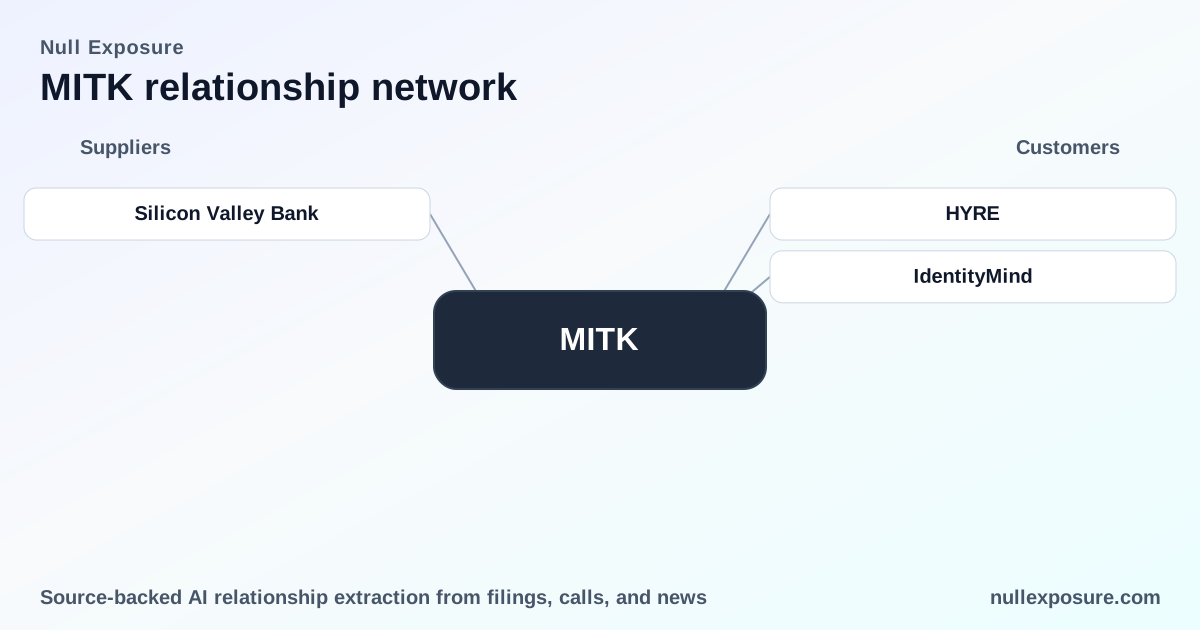
MITK’s supplier profile: concentrated treasury exposure and an explicit third‑party risk posture
MITK runs its business with a concentrated treasury relationship and an explicit program for assessing critical vendors. The company monetizes through its operating business while relying on bank custody and third‑party service providers to execute treasury, payments, and operational workflows — making counterparty and vendor controls central to enterprise risk and investor returns. Investors should treat MITK’s supplier footprint as an operational lever as well as a potential risk concentration. For a broader view of supplier risk across portfolios, visit https://nullexposure.com/.
The headline supplier risk: oversized deposits at Silicon Valley Bank
MITK discloses that it keeps a significant amount of cash and cash equivalents at Silicon Valley Bank, a division of First Citizens Bank, with deposits that exceed insured limits. This is reported in the company’s FY2025 filing and represents a straightforward concentration of liquidity with one banking counterparty. According to MITK’s FY2025 Form 10‑K (fiscal year ended September 30, 2025), the company’s deposits at this institution exceed FDIC insurance thresholds, exposing MITK to uninsured counterparty credit and operational risk.
- Why this matters: uninsured deposits create direct counterparty credit exposure and can influence liquidity management, covenant headroom and recovery options in stressed markets. The relationship is not a third‑party IT vendor risk; it is a treasury counterparty that affects solvency dynamics in adverse scenarios.
- Source: MITK Form 10‑K, FY2025 (fiscal year ended 2025).
What the company’s supplier controls tell investors
MITK states that it performs risk assessments on critical third‑party service providers, software and other tools used in the Company's operations to identify cybersecurity threats. This disclosure signals an active vendor oversight program and a formal contracting posture toward vendors that could create operational or cybersecurity exposures.
- Contracting posture and maturity: explicit mention of risk assessments indicates MITK has documented processes to assess critical suppliers rather than an ad hoc approach. That is a quality signal for operational governance.
- Criticality vs. concentration: while the control posture is positive, a mature vendor assessment program does not eliminate concentration risk — which is material here because the company holds concentrated bank deposits.
- Source: Company disclosure on third‑party risk assessment (as presented in FY2025 filings).
Mid‑analysis: what investors and operators should monitor now
MITK’s combination of concentrated bank deposits and a formal third‑party assessment program frames the immediate checklist for investors and operators:
- Monitor counterparty limits and the breakdown of cash by institution and currency.
- Request evidence of collateralization, sweep arrangements, or alternate custody plans for uninsured balances.
- Validate third‑party assessment scope: does it cover liquidity providers and treasury counterparties, or is it focused only on IT/security suppliers?
- Confirm breach and contingency plans with First Citizens / SVB division given the uninsured exposure.
For tools and supplier insight at scale, see https://nullexposure.com/ for additional supplier analytics and portfolio workflows.
Relationship-by-relationship roundup
Silicon Valley Bank (division of First Citizens Bank) — MITK maintains a significant amount of cash and cash equivalents at Silicon Valley Bank, and the company discloses that its deposits at this institution exceed insured limits, creating concentrated uninsured liquidity exposure. Source: MITK Form 10‑K, FY2025 (fiscal year ended September 30, 2025).
Operational and financial implications for valuation and oversight
From an investment perspective, MITK’s supplier disclosures create five clear implications:
- Valuation sensitivity to liquidity events: uninsured bank exposure increases the probability that a liquidity shock translates into a funding or covenant stress event, which compresses equity value in downside scenarios.
- Counterparty risk pricing: investors should apply a premium for uninsured treasury concentration when modeling downside cashflow recoveries or default probabilities.
- Operational continuity and cybersecurity: the company’s explicit third‑party risk assessment program is a governance positive that reduces residual operational risk over time, but it is not a substitute for counterparty diversification.
- Negotiation leverage for operators: operators can push for contractual protections — such as multi‑bank sweep arrangements, secured lines of credit and explicit SLAs with treasury providers — to convert operational controls into financial resilience.
- Disclosure and monitoring: quarterly transparency on bank balances and material vendor incidents should be requested in investor dialogues.
Recommended actions for investors and operators
- Engage management to obtain a breakdown of cash by institution and to understand contingency plans for uninsured deposits.
- Require documentation that the third‑party risk program explicitly covers treasury counterparties, payment processors and any vendor that could interrupt cash collection or disbursement.
- Insist on stress‑testing results that show outcomes under counterparty default and systemic bank stress scenarios.
For investors seeking deeper supplier risk intelligence or to compare MITK’s posture across peers, learn more at https://nullexposure.com/.
Final assessment — concise takeaways
- Primary risk: MITK’s treasury concentration at Silicon Valley Bank creates a material uninsured deposit exposure that translates into counterparty and liquidity risk for investors. (Source: MITK Form 10‑K, FY2025.)
- Control signal: the company documents a third‑party risk assessment program for critical vendors, indicating an organized approach to supplier governance and cybersecurity risk. (Company disclosures, FY2025.)
- Actionable stance: demand quarterly transparency on bank balances, verify that treasury counterparties fall within the vendor oversight program, and require contingency arrangements to mitigate uninsured deposit exposure.
Bottom line: MITK combines a positive vendor governance posture with a tangible treasury concentration that investors must actively monitor and price. For comparative supplier analytics and monitoring workflows to operationalize these recommendations, visit https://nullexposure.com/.