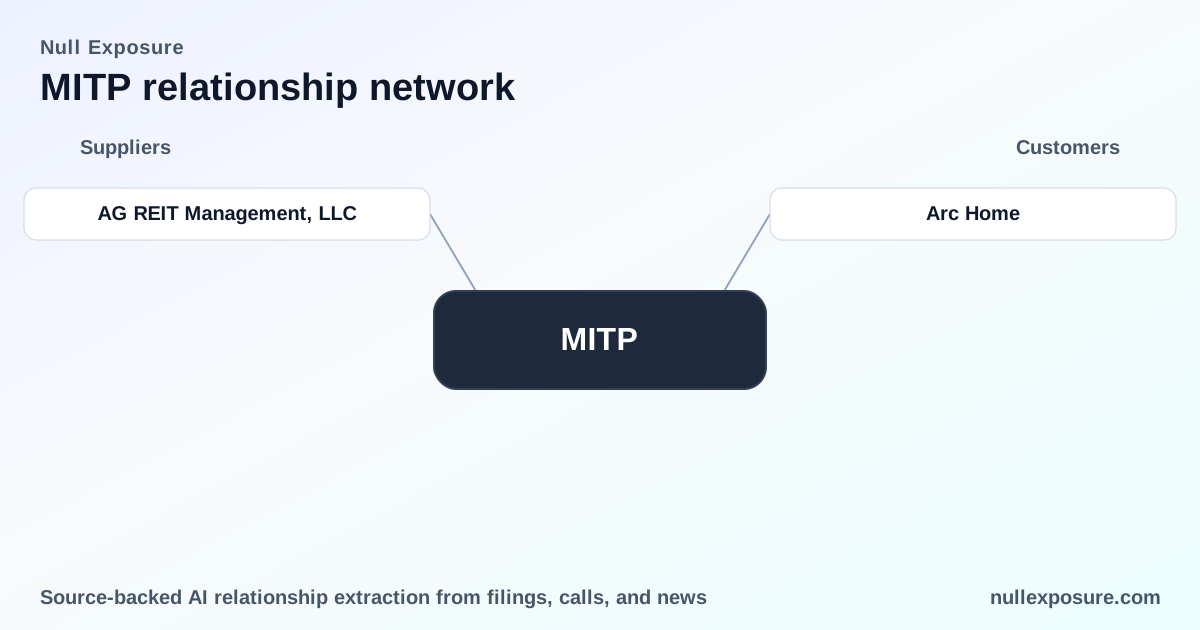
MITP supplier profile: why the management agreement matters for returns and risk
MITP operates as an externally managed residential mortgage investment vehicle that acquires and holds whole residential loans and RMBS, finances these assets through securitizations and short‑term repurchase facilities, and extracts value via net interest margin, servicing income and manager/asset management fees. The company sources loans from a mix of its part‑owned originator and third‑party originators, uses securitizations and repos to fund positions, and outsources core operational functions to an external manager and servicers. For investors, the profitability equation is therefore a function of credit performance, financing costs (especially repo refresh and margin exposure), and the economics of the management/asset‑servicing chain.
Learn more at the Null Exposure homepage: https://nullexposure.com/
Why the AG REIT Management contract is a focal supplier relationship
The single supplier relationship disclosed in the FY2024 filing is a binding management contract that establishes how MITP runs its business. According to the company's FY2024 10‑K, MITP entered into a Management Agreement dated June 29, 2011 with AG REIT Management, LLC, under which the Manager provides the management team, officers and support personnel that execute investment, financing and day‑to‑day operations. This agreement is the contractual backbone for executive decision‑making and fee arrangements and therefore is central to governance, operating cost structure and alignment of incentives (FY2024 10‑K).
Key takeaway: External management is not ancillary — it is the operating engine. Investors must treat the management agreement as a supplier contract that affects operating leverage, fee drag and potential conflicts, not merely an administrative detail.
How MITP contracts, funds and concentrates risk — constraints that define the operating model
The FY2024 disclosures lay out a clear set of operating constraints that shape the supplier and counterparty profile:
- Short‑term financing posture: The company relies materially on short‑term repurchase agreements to fund assets; the filing notes repo tenors “up to one year” for loans and typically 30–90 days for securities, and warns of margin call and refinancing risk if repo lines are not renewed. This creates liquidity and roll‑over sensitivity that makes counterparty access and repo terms a recurring operational focus (FY2024 10‑K).
- Geographic concentration: The portfolio is explicitly composed of residential mortgage loans located throughout the United States, which concentrates underwriting and credit exposure to the U.S. housing market rather than international diversification (FY2024 10‑K).
- Supplier roles and concentration signals: MITP sources a meaningful portion of loans from Arc Home, LLC — an originator in which MITP holds an approximate 44.6% interest — and from other third‑party originators; Arc Home is described as a multi‑channel originator and servicer that can sell loans to MITP or third parties, but has no obligation to sell to the company. The filing also documents the use of third‑party servicers, a separate Asset Manager (Red Creek Asset Management LLC) for portions of its loans, and the external Manager that provides senior staff. Collectively, this produces interdependent supplier relationships spanning origination, servicing and asset management (FY2024 10‑K).
- Active, strategic engagement: MITP’s business plan actively uses securitization and forward purchase commitments (for example, best‑efforts forward purchases from Arc Home) to acquire and finance loans, indicating ongoing, operationally active supplier relationships rather than passive or one‑off agreements (FY2024 10‑K).
- Core product focus: The company emphasizes that residential whole loans are its predominant asset class, signaling concentrated exposure to the home‑loan lifecycle and associated servicing and financing vendors (FY2024 10‑K).
Together, these constraints reveal an operating model that is capital markets dependent, counterparty‑sensitive and operationally outsourced, with financing tenor and originator access as the principal levers that will move returns.
Learn more about the supplier landscape and tools for monitoring counterparties at Null Exposure: https://nullexposure.com/
What this means for counterparty criticality and maturity
- Criticality: The Manager and servicers are critical for execution — they supply the people and processes MITP lacks internally. Disruption or adverse fee changes with those parties would have immediate operational and cost implications.
- Concentration risk: The near‑half ownership of Arc Home creates a channel that is beneficial for origination pipeline but concentrates source risk because Arc Home has no contractual obligation to sell loans to MITP.
- Maturity: The Management Agreement predates the IPO and has been in effect since 2011, indicating a long‑standing relationship with a manager that has been the firm’s ongoing operating partner (FY2024 10‑K).
All reported supplier relationships (concise)
AG REIT Management, LLC — The company has a Management Agreement dated June 29, 2011 with AG REIT Management, LLC under which the Manager provides the management team, officers and necessary support personnel to run MITP’s operations and investments (FY2024 10‑K).
Risk checklist for investors: what to monitor in filings and market signals
- Repo roll‑over spreads, margin call frequency and counterparty haircuts. Short tenors make MITP sensitive to repo market dislocations.
- Securitization cadence and pricing: the company relies on securitization to finance asset growth and manage duration mismatch.
- Arc Home origination volumes and whether Arc Home sells a sustained portion of originations to MITP (forward purchase commitments and pipeline disclosures are leading indicators).
- Fee schedules and incentive structures in the Management Agreement and any asset management arrangements (e.g., Red Creek Asset Management) that can materially affect net returns.
- Servicer performance metrics and regulatory/compliance items that could affect borrower servicing or cashflow collection.
Conclusion: a supplier‑dependent return profile that requires active monitoring
MITP’s return profile is driven by the interaction of credit performance on U.S. residential whole loans, the cost and reliability of short‑term financing, and the economics of external management and servicing arrangements. The single disclosed management relationship with AG REIT Management, LLC is a governance and operational cornerstone, while Arc Home and third‑party servicers/asset managers supply the deal flow and servicing backbone described in the filing. For investors, the primary exposures to monitor are repo liquidity risk, originator concentration, and any changes to management/asset management agreements that would alter fee capture or operational control.
For an ongoing view of supplier risk and counterparty posture for MITP, visit Null Exposure: https://nullexposure.com/
(Primary source for relationships and constraints: MITP FY2024 Form 10‑K disclosures.)