MITT (Mortgage Investment Trust): Supplier relationships, operating posture, and what Arc Home tells investors
Thesis: MITT operates as a residential mortgage REIT that sources mortgage assets through a mix of in‑house and third‑party originators, finances holdings with a blend of short‑term repo facilities and longer‑dated unsecured debt, and monetizes via net interest spread, servicing income, and gain on sale/resale activity. Its commercial model depends on steady access to originations, predictable servicing, and a layered financing stack — investors should underwrite both asset sourcing counterparties and funding counterparties when evaluating MITT exposure. For further supplier intelligence, visit https://nullexposure.com/.
The business model in plain English: where cash comes from and what constrains it
MITT builds a portfolio of residential mortgage-related assets and captures value in three primary ways: interest spread on held mortgage assets, fees and income from retained servicing, and realized gains from loan purchases and sales. The company commits to forward purchases of loans and uses a mix of financing tools — repurchase agreements for short-term leverage and senior unsecured notes for longer-term capital — to match funding to asset duration.
Key operating characteristics:
- Contracting posture: A hybrid of short-term financing (repo lines and one‑year or less arrangements) and medium-term unsecured debt (notes due in 2029) creates both flexibility and refinancing risk. The FY2024 filings show repurchase agreements with generally short maturities and Senior Unsecured Notes totaling roughly $99.5 million in principal, due in 2029.
- Concentration and geography: MITT is focused on the U.S. residential mortgage market, so macro U.S. housing and rate cycles dominate performance.
- Service and staffing model: MITT is externally managed and relies on third‑party servicers and an affiliated manager for executive personnel, which centralizes operating expertise but concentrates execution risk in a few providers.
These operating signals are drawn from MITT’s FY2024 disclosures and related filings.
Why Arc Home matters: the supplier relationship in one paragraph
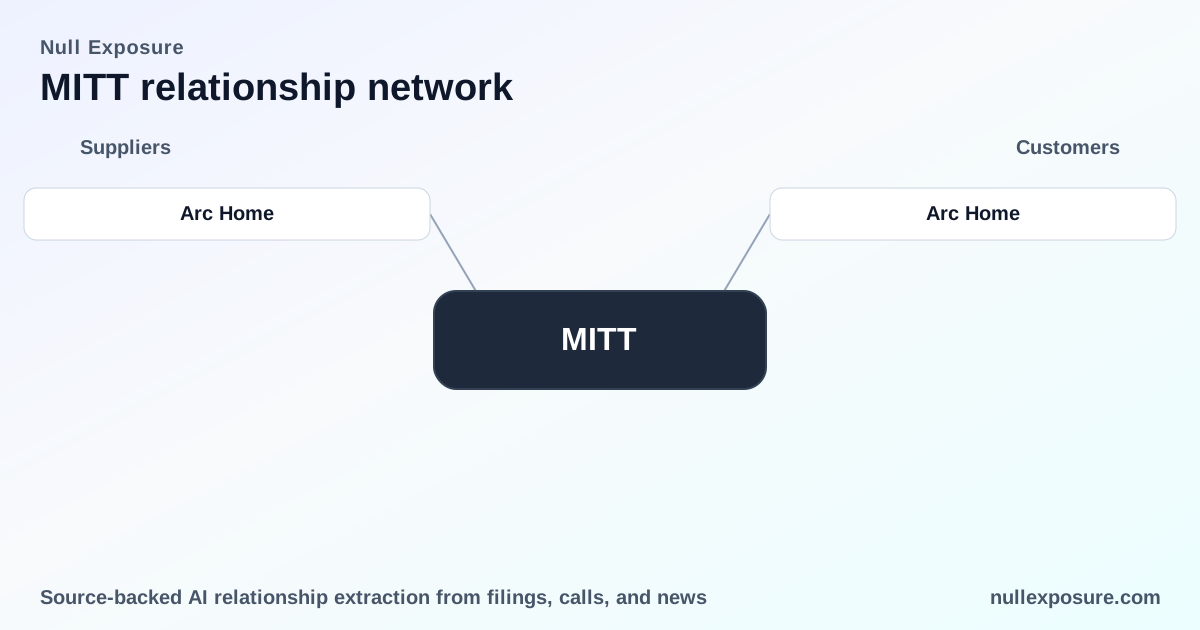
MITT has a structured supplier relationship with Arc Home that covers both loan supply and servicing. MITT enters forward purchase commitments with Arc Home to buy residential mortgage loans on a best‑efforts basis, and the company obtains a significant portion of its assets through Arc Home, an originator and servicer in which MITT owns an approximate 44.6% interest. According to MITT’s FY2024 Form 10‑K, these forward purchase commitments and the equity position in Arc Home are central to MITT’s originating pipeline and servicing footprint (FY2024 10‑K).
Relationship detail: Arc Home
- Arc Home supplies residential mortgage loans to MITT under forward purchase commitments, where MITT commits to purchase loans at agreed prices on a best‑efforts basis. According to MITT’s FY2024 Form 10‑K, this contractual channel is an explicit source of asset flow for the REIT (FY2024 10‑K).
- Arc Home also acts as a servicer and originator; MITT owns an approximate 44.6% interest in Arc Home and obtains loans through that channel as well as other third‑party originators, per the FY2024 filing (FY2024 10‑K).
Every supplier relationship disclosed (concise investor summaries)
Arc Home — MITT executes forward purchase commitments to buy residential mortgage loans from Arc Home on a best‑efforts basis; MITT also owns an approximate 44.6% stake in the originator/servicer and sources a meaningful portion of its assets through this channel, as described in MITT’s FY2024 Form 10‑K (FY2024 10‑K).
(No other supplier relationships were disclosed in the search results provided.)
Constraints and what they reveal about MITT’s risk surface
The disclosure set identifies several company-level constraints that describe MITT’s operating posture and capital structure:
- Mixed maturity financing: MITT runs short‑term repurchase agreements for day‑to‑day leverage while carrying medium‑term unsecured notes due in 2029. This mix delivers funding flexibility but creates refinancing and basis risk when short-term markets tighten or long-term rates reset relative to asset yields (FY2024 10‑K).
- U.S.-centric asset concentration: The portfolio focus is the U.S. residential mortgage market, which concentrates MITT’s exposure to domestic housing cycles and interest‑rate dynamics (FY2024 10‑K).
- External management and service reliance: MITT is externally managed and depends on third‑party servicers to perform loan administration and regulatory compliance, which imposes operational concentration risk and amplifies vendor criticality if a servicer fails or underperforms (FY2024 10‑K).
- Spend/maturity signal: The senior unsecured notes cited in the filings total approximately $99.5 million in principal, a nontrivial medium‑term liability that investors should reconcile against liquidity and asset cash‑flow projections (FY2024 10‑K).
- Active supplier relationships: The disclosures treat originator relationships such as Arc Home as active channels for loan supply, consistent with a model that relies on firm-level forward commitments rather than purely opportunistic purchases (FY2024 10‑K).
These constraints are company-level signals drawn from MITT filings and should inform counterparty diligence and liquidity stress‑testing.
For a consolidated view of supplier relationships and constraints, consult https://nullexposure.com/ for tailored supplier intelligence.
Investment implications: what investors and operators should do next
- Counterparty credit matters. Arc Home’s role as both supplier and servicer — combined with MITT’s 44.6% stake — makes Arc Home a dual leaver of both origination flow and servicing capability; investors should review Arc Home’s capitalization, underwriting standards, and servicing performance metrics as part of credit analysis (FY2024 10‑K).
- Stress test funding pathways. The short-term repo exposure paired with 2029 unsecured notes requires scenario analysis around widening repo haircuts, rate spikes, and securitization market freezes.
- Operational resilience is concentrated. External management and reliance on third‑party servicers create single points of failure; include vendor‑risk tests and contract reviews in investment due diligence.
- Monitor pipeline durability. Forward purchase commitments signal predictability in originations but also lock MITT into purchase obligations; reconciling committed purchases against warehouse capacity and liquidity is essential.
If you evaluate MITT as a counterparty or portfolio position, prioritize verification of Arc Home’s servicing metrics and a short‑term funding contingency plan. For deeper supplier maps and contract-level signals, visit https://nullexposure.com/.
Bottom line: a concentrated originator relationship inside a leveraged funding structure
MITT’s model is clear and tightly coupled: a primary supply relationship with Arc Home plus a financing stack that mixes short-term repo and medium-term unsecured debt. That structure supports attractive origination-driven returns when markets function, but it amplifies funding and operational concentration risk under stress. Investors should price in the dual dependence on originator/servicer performance and the availability of short‑term funding lines when setting risk limits or negotiating terms. For a full supplier risk profile and tailored intelligence, see https://nullexposure.com/.