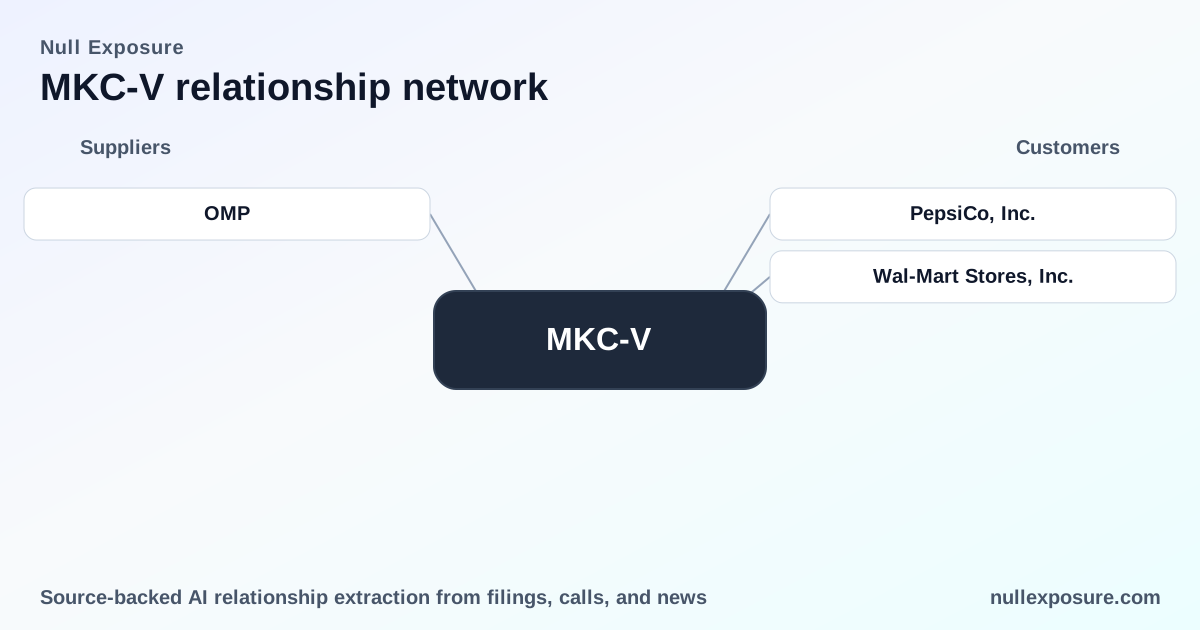
MKC-V Supplier Brief: What investors need to know about McCormick’s OMP relationship
Minute statement thesis: McCormick & Company (ticker context MKC-V for supplier analysis) engages third-party technology and logistics providers to optimize operations and working capital; it monetizes scale through global ingredient sourcing, branded product margins, and supply-chain efficiency that reduces cost of goods sold and working capital needs. The supplier footprint includes high-dollar participants in supply-chain financing and strategic technology partners that drive production and distribution agility. For a consolidated view of vendor dynamics, visit https://nullexposure.com/.
Why this relationship matters to shareholders
McCormick’s supplier strategy is not passive procurement; it is an operational lever. Large supplier payables tied to a supply-chain financing (SCF) program—hundreds of millions on the balance sheet—signal concentrated working-capital exposure and dependence on third-party service providers. That creates both upside (improved margins and inventory turns when partners deliver) and downside (service disruption or contract renegotiation that increases input cost or cash conversion cycle). For a closer look at how supplier signals inform investment decisions, see https://nullexposure.com/.
What the press releases say — every relationship entry in the record
- OMP: A Herald-Mail Media press release on March 10, 2026 reports that OMP is supplying an AI-driven Unison Planning platform to McCormick to enhance supply-chain agility, positioning the vendor as a strategic planning partner rather than a commodity supplier. Source: Herald-Mail Media press release, FY2025 (first seen 2026-03-10).
- OMP: A copy of the same announcement distributed by CJOnline on March 10, 2026 reiterates that OMP’s autonomous operational planning initiative is deployed to improve forecasting and planning cadence for McCormick, underlining cross-publication dissemination. Source: CJOnline press release, FY2025 (first seen 2026-03-10).
- OMP: Monroe News syndicated the release on March 10, 2026, emphasizing that the Unison Planning implementation is positioned as an AI-enabled effort to reduce supply-chain friction across McCormick’s global network, which implies a systems-level integration. Source: Monroe News press release, FY2025 (first seen 2026-03-10).
- OMP: The Southwest Times distribution on March 10, 2026 repeats that OMP is working with McCormick on autonomous operational planning, reinforcing that the engagement is being marketed widely as a strategic supply-chain modernization. Source: SWTIMES press release, FY2025 (first seen 2026-03-10).
- OMP: A State/County Times-syndicated release on March 10, 2026 states that OMP’s Unison Planning platform is intended to enhance supply-chain agility for McCormick, confirming the vendor role across multiple regional press outlets. Source: SC Times/press release, FY2025 (first seen 2026-03-10).
Each of these entries is the same vendor announcement syndicated through multiple local and industry press channels; collectively they demonstrate a public-facing position by McCormick and OMP on a strategic technology engagement.
How the constraints describe McCormick’s supplier posture
The supplier constraint signals extracted from company disclosures provide actionable, company-level insight:
-
Service-provider posture: McCormick discloses reliance on third-party providers for transportation and other services and lists its independent auditor (Ernst & Young LLP). This is consistent with a company that outsources key operational functions and runs multiple supplier relationships under contractual service agreements. The contracting posture is firm-driven—McCormick controls primary logistics strategy while relying on specialist vendors for execution.
-
Material spend concentration: As of November 30, 2025, amounts due to suppliers participating in the SCF and included in trade accounts payable were approximately $332.1 million (prior periods cited at $417.4M and $300.5M), which is a large, persistent working-capital commitment. That scale signals high supplier-dollar concentration and the potential for vendor-level impact on cash flow and margins.
These constraints collectively indicate a procurement model where strategic third-party suppliers (technology and transport) are both operationally critical and financially material. Treat these as company-level signals, not tied to any single vendor unless disclosed explicitly.
Investment implications: risks and value drivers
-
Value driver — operational leverage through tech: The OMP Unison Planning engagement is a positive signal for margin expansion if the platform reduces forecast error and inventory buffers. Improved planning directly lowers COGS risk and working capital, translating to incremental free cash flow.
-
Risk — supplier concentration and working capital exposure: The SCF payables totaling hundreds of millions create a counterparty concentration risk. Any deterioration in supplier financing terms or disruption to key service providers (transport or technology) will have an outsized impact on cash conversion.
-
Contracting posture — vendor dependency: McCormick’s approach is to outsource specialist capabilities while maintaining control over core procurement strategy. That posture accelerates time-to-value but increases lock-in risk with enterprise vendors that integrate deeply into planning and distribution systems.
Operational outlook for operators and procurement teams
Operators should treat the OMP engagement as an opportunity to extract measurable KPIs: forecast error, days inventory outstanding, on-time fill rates, and savings from reduced expedited freight. Procurement should quantify counterparty concentration and stress-test SCF counterparties. The balance sheet shows meaningful payable exposure to SCF participants; operators must keep supplier finance terms under active management to preserve liquidity.
For vendor-risk monitoring and supplier visibility tools that map these exposures, explore https://nullexposure.com/.
Actionable recommendations for investors
- Track implementation metrics from McCormick’s quarterly commentary for signs of improvement in inventory turns and lower SG&A per unit attributable to planning investments.
- Monitor trade payables and SCF disclosures each quarter; a rising payable balance without offsetting productivity gains increases downside risk.
- Engage with management commentary on supplier diversification and contingency plans for transport and IT service continuity.
Bottom line
The public record indicates McCormick is executing a strategic program to digitize planning with OMP while operating a significant SCF-backed supplier base. That combination is a structural lever for margin improvement but creates concentrated counterparty and working-capital risk. Investors should prioritize management commentary on realized savings and continued diversification of supplier finance exposure. For deeper supplier-risk intelligence and ongoing monitoring, visit https://nullexposure.com/.