MKLYR: What investors should know about McKinley Acquisition’s supplier footprint
McKinley Acquisition Corporation (trading symbols MKLY and MKLYR) operates as a classic blank‑check vehicle that monetizes through capital raised in its IPO and the subsequent sponsor economics tied to a business combination; its economic value is driven by trust cash, deal sourcing, and the structural mechanics of unit separation into Class A shares and transferable rights. This profile focuses on the supplier relationships that are operationally critical to that corporate structure and what they imply for counterparties evaluating exposure to MKLYR.
Explore a catalog of supplier relationships and risk signals at NullExposure: https://nullexposure.com/
Market plumbing that matters: the two counterparties in the feed
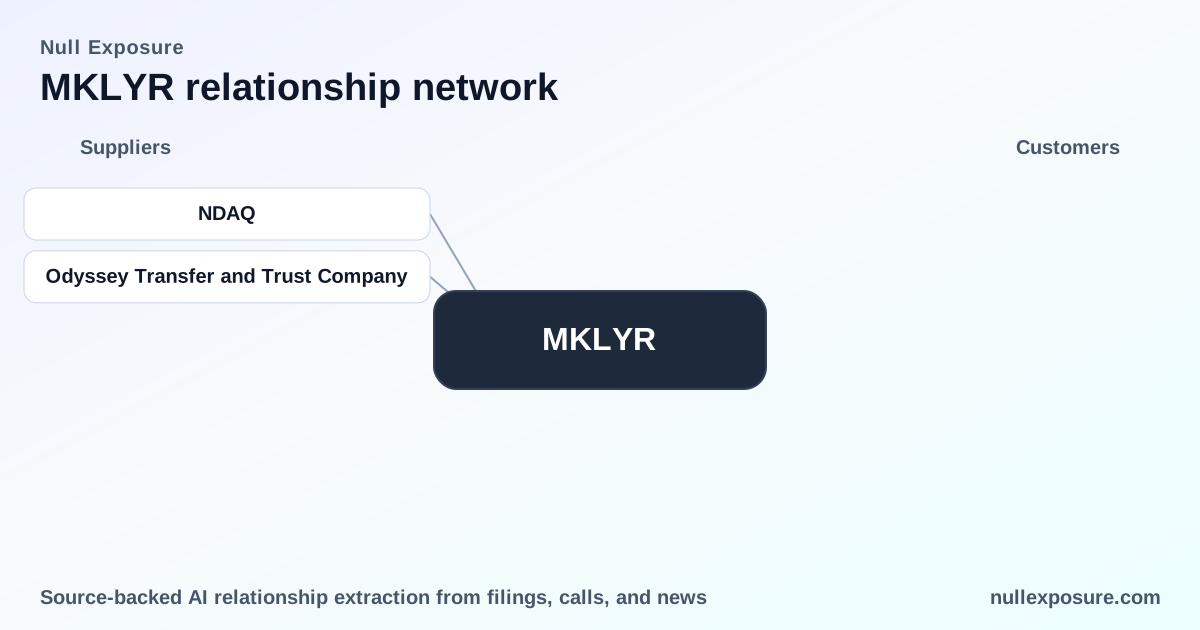
MKLYR’s public feed in our dataset lists two direct supplier/partner relationships that underpin the company’s listing mechanics: Nasdaq, Inc. for market listing and Odyssey Transfer and Trust Company as transfer agent. Both relationships are functional rather than commercial in the product or revenue sense, but they are operationally critical to shareholder mechanics and liquidity.
Nasdaq, Inc. — listing and market access
Nasdaq provides the exchange venue where McKinley’s Class A ordinary shares and rights trade; the company announced that the separated securities will trade on The Nasdaq Global Market under the tickers MKLY and MKLYR. According to a GlobeNewswire press release distributed via The Manila Times on October 1, 2025, the separation of units and commencement of trading under those symbols were communicated as part of the company’s listing mechanics. (Source: GlobeNewswire / The Manila Times, Oct 1, 2025.)
Odyssey Transfer and Trust Company — transfer agent for unit separation
Odyssey Transfer and Trust Company is identified as McKinley’s transfer agent and is the counterparty brokers must contact to separate units into Class A ordinary shares and rights. The same October 1, 2025 release instructs holders to coordinate with Odyssey through their brokers to effect that separation, establishing Odyssey’s role in shareholder recordkeeping and transaction processing. (Source: GlobeNewswire / The Manila Times, Oct 1, 2025.)
Why these relationships are consequential for investors and operators
Both counterparties perform non‑negotiable infrastructure functions for a newly listed blank‑check company. For a SPAC‑style issuer, the exchange and transfer agent are not peripheral vendors; they are the plumbing that enables trading, capital access, shareholder record integrity, and the mechanics necessary for a business combination. From a supplier‑risk perspective:
- Concentration and criticality: There is naturally high concentration here — a single exchange listing and a single transfer agent are the norm — and both functions are critical to liquidity and shareholder operations. Loss of either service would materially disrupt trading and corporate actions.
- Contracting posture: Agreements with exchanges and established transfer agents tend to be standard form, highly regulated, and operationally mature; these are vendor relationships where counterparty substitution is possible but administratively burdensome and time‑sensitive.
- Maturity and stability: Both counterparties are established incumbents in capital markets infrastructure, which reduces execution risk but does not obviate operational dependencies during corporate events like unit separation or de‑SPAC transactions.
These points should be treated as company‑level signals about MKLYR’s operating model rather than attributes of any single relationship excerpt in the feed.
See how these supplier dependencies fit into broader portfolio exposure at NullExposure: https://nullexposure.com/
Practical implications for counterparties and investors
Operators and research teams should translate the above into actionable evaluation criteria:
- Monitor the timing and mechanics of unit separation closely — recordkeeping errors or delayed transfer‑agent processing can create temporary float and market microstructure risks.
- Consider the operational fallback plan: established transfer agents and exchanges are reliable, but administrative drag during a de‑SPAC process can affect liquidity windows for large stakeholders.
- Treat Nasdaq listing status as a liquidity barometer. Exchange tier and trading commencement dates are direct inputs into sell‑side modeling for float and post‑combination free‑float estimates.
Relationship summaries (concise and sourced)
-
Nasdaq, Inc.: The company announced that its Class A ordinary shares and rights will trade on The Nasdaq Global Market under the symbols MKLY and MKLYR, formalizing market access and listing venue. (Source: GlobeNewswire press release, distributed via The Manila Times, Oct 1, 2025.)
-
Odyssey Transfer and Trust Company: Odyssey is the transfer agent responsible for unit separation; the company directed holders to have brokers contact Odyssey to convert units into Class A shares and rights. (Source: GlobeNewswire press release, distributed via The Manila Times, Oct 1, 2025.)
Investment and operational takeaways
- Primary risk is operational rather than commercial: McKinley’s immediate supplier exposure is to market infrastructure rather than to large operating vendors. The key risks are service continuity, timing of corporate actions, and administrative accuracy.
- Counterparty concentration is high but with low counterparty credit risk: Nasdaq and specialized transfer agents are regulated incumbents — counterparty credit risk is modest, but the systemic impact of operational failure is material.
- Maturity profile suits short‑cycle diligence: These relationships indicate a company still in the listing/structuring phase rather than long‑term operational vendor networks, so supplier diligence should focus on event readiness (share separation, proxy and escrow mechanics) rather than multi‑year service contracts.
Next steps for due diligence teams
For firms underwriting, partnering with, or analyzing MKLYR exposure, recommended next steps are straightforward: verify the exchange confirmation and effective trading dates, confirm transfer‑agent operational SLAs for unit separation, and map counterparty outage procedures into your trade execution playbook. For a complete map of supplier linkages and to monitor changes in real time, visit NullExposure.
Assess MKLYR’s supplier footprint and manage operational exposure at https://nullexposure.com/
Closing note
MKLYR’s supplier map is compact and highly focused on capital markets infrastructure: Nasdaq provides market access and Odyssey executes shareholder recordkeeping. For investors and operators, that means the dominant supplier risks are timing, administrative execution, and concentration, not conventional vendor cost leakage or supplier diversification. Track exchange notices and transfer‑agent communications as primary indicators of execution risk, and incorporate those signals into event‑driven valuation and liquidity planning.
Explore the full supplier relationship network and sign up for ongoing monitoring at https://nullexposure.com/.