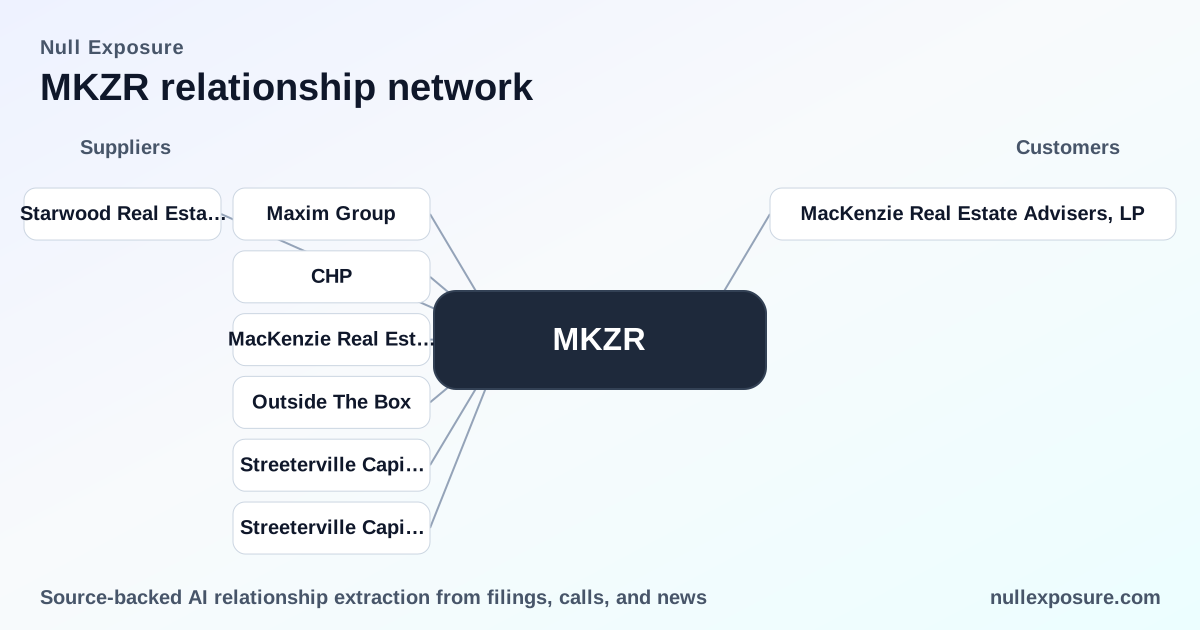
MacKenzie Realty Capital (MKZR): Supplier relationships that determine execution risk and cash flow
MacKenzie Realty Capital operates as an externally managed investment company that acquires non-traded REIT interests and related real estate securities, funds purchases with a mix of cash, short-term notes and at‑the‑market equity offerings, and monetizes through portfolio income plus recurring management and administrative fees paid to affiliated advisers. Investors should evaluate supplier relationships for two reasons: they shape operating continuity (advisers and MSPs run day‑to‑day operations) and they drive cost structure (asset management and administrative reimbursements consume material cash). For ongoing monitoring and deeper supplier intelligence, visit https://nullexposure.com/ for a consolidated view.
How to read MKZR’s supplier signals: contracting, concentration and criticality
MKZR’s operating model exhibits a hybrid contracting posture. The company reports long‑dated real estate leases (3.17–7.75 years) that suggest durable property-level commitments, while the firm’s advisory agreements are structured as short‑term, calendar‑year contracts with automatic one‑year renewals—a setup that preserves managerial flexibility for the board but increases counterparty renewal risk for investors. The adviser relationships are not peripheral: asset management fees reported around $3.45 million in FY2025 place adviser spend firmly in the $1M–$10M band, and administrative reimbursements above $669k emphasize outsized related‑party operational flows.
Operationally, MKZR is externally managed and outsources key functions to affiliated advisers and a third‑party MSP for IT and cybersecurity, which concentrates operational risk into a small number of providers while keeping headcount lean. Governance and contingent liability are also relevant: disclosure of possible “bad‑boy” guaranty payments indicates material contingent liability potential under certain mortgage or loan arrangements.
Mid‑stream actions investors should monitor
- Adviser fee run‑rate and related‑party reimbursements — they are large enough to affect distributable cash.
- ATM activity and equity issuance — dilution risk tied to broker arrangements.
- Short‑term note financings — increases leverage and potential liquidity pressure.
- Counterparty and legal contingent exposures such as guaranties.
For an integrated supplier risk profile and tracking, see https://nullexposure.com/.
The supplier roster — what each relationship actually does for MKZR
Maxim Group
MacKenzie amended its Equity Distribution Agreement with Maxim Group to continue an at‑the‑market program for up to $20 million of common shares, giving MKZR a committed sales channel for incremental equity funding. This is documented in a TradingView news summary posted March 10, 2026. (TradingView, March 10, 2026)
CNL Healthcare Properties, Inc. (CHP)
MKZR used a loan to purchase roughly $1.0 million of CNL Healthcare Properties shares at $4.55 per share, signaling active deployment into non‑traded healthcare REIT positions funded via short‑term financing. The transaction is described in a GlobeNewswire release about new loan funding for non‑traded REIT shares (GlobeNewswire, March 6, 2026).
MacKenzie Real Estate Advisers
MKZR approved an amendment to its Advisory Management Agreement with MacKenzie Real Estate Advisers effective January 1, 2026, underscoring that the company remains externally advised on real estate asset acquisition and disposition and that adviser terms run on annual renewals. This change is reported via TradingView on March 10, 2026, and ties directly to the firm’s adviser governance posture (TradingView, March 10, 2026).
Outside The Box
The company issued 37,362 shares to Outside The Box in exchange for marketing services, reflecting an in‑kind marketing arrangement rather than a cash fee and indicating the use of equity as compensation for certain supplier services. This is noted in MKZR’s FY2026 reporting commentary on operating results (GlobeNewswire, November 18, 2025).
Streeterville Capital, LLC / Streeterville Capital
MKZR entered a Note Purchase Agreement with Streeterville Capital for secured promissory notes (up to $3.27 million in one notice and a separate financing tranche for $1.095 million), receiving initial cash funding of approximately $1.0 million to finance purchases of non‑traded REIT securities and to participate in tender offers. These financings and the related closings are described in both The Globe and Mail press release (June 11, 2025) and subsequent trading reports in early 2026 (The Globe and Mail; TradingView; GlobeNewswire, 2025–2026).
Starwood Real Estate Income Trust, Inc.
MKZR launched a tender offer to acquire up to 150,000 Class S shares of Starwood Real Estate Income Trust at $16.25 per share, representing acquisition strategy focused on buying discounted REIT interests (approximately a 22% discount to an estimated NAV reported as of August 31, 2025). MarketScreener covered the tender offer announcement (MarketScreener, August 2025).
What the constraints tell us about operational posture
- Contracting maturity is mixed. Leases show multi‑year stability, but adviser contracts are annual with automatic renewals, producing a dual profile of fixed property commitments and flexible, reviewable service relationships. (Company disclosure excerpts on lease terms and adviser agreements.)
- Service providers are critical. MKZR is externally managed by MacKenzie affiliates and relies on an MSP for IT and cybersecurity; those service providers run core investment, administration and systems functions, concentrating execution risk. (Administration and advisory agreement excerpts and MSP outsourcing notes.)
- Spending is concentrated. Asset management fees (
$3.45M) and administrative reimbursements ($670k) are material to cash flow and represent predictable recurring outflows to related parties. (Note 8 fee disclosures.) - Contingent liabilities are real. Disclosure of potential “bad‑boy” guaranty payments signals material downside in specific default scenarios and should be a monitoring trigger for risk teams. (Contingent liability excerpt.)
Risk posture and investor action items
- Monitor adviser renewals and fee schedules ahead of year‑end contract windows given the adviser agreements’ annual cadence. Confirm whether fees or scopes change at renewal.
- Track equity issuance via Maxim for dilution and funding cost metrics; ATM usage is the primary near‑term capital source for share issuance.
- Watch short‑term note rollovers with Streeterville Capital for rising leverage or covenant pressure during market dislocation.
- Review contingent liability language in filings for guaranty triggers that could create a material cash drain.
For a full supplier audit checklist tailored to MKZR’s profile, see https://nullexposure.com/.
Conclusion: where the supplier risk concentrates
MKZR’s supplier ecosystem balances operational outsourcing and capital intermediation: advisers and an MSP run the company, Maxim supplies equity liquidity, and Streeterville provides short‑term leverage for opportunistic purchases. The two most important investor levers are monitoring related‑party fee flows and the cadence of short‑term financings, because they directly affect distributable cash and leverage. Maintain active disclosure monitoring around adviser agreement renewals, ATM utilization, and notes issued under Streeterville arrangements; these inputs determine both upside execution and downside liquidity risk. For vendor‑level diligence and to subscribe to continuous supplier monitoring, start at https://nullexposure.com/.