Mesa Laboratories (MLAB) — capital markets suppliers and what investors should know
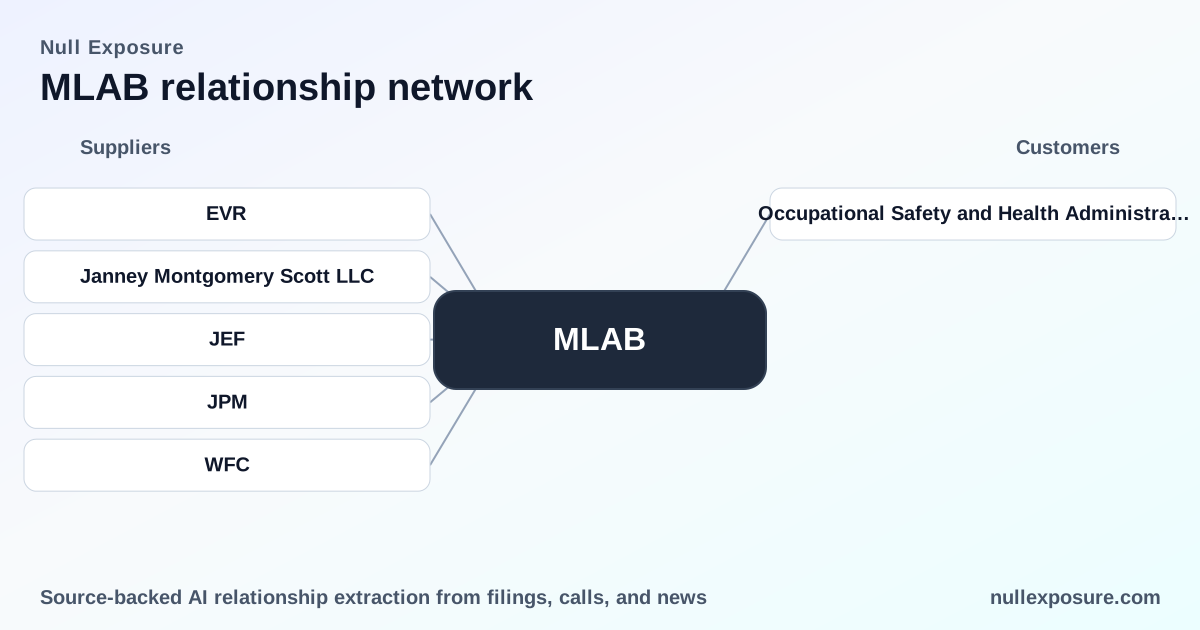
Mesa Laboratories operates as a manufacturer of measurement, sterilization and monitoring equipment sold to healthcare, pharmaceutical and industrial customers and monetizes through product sales, consumables and recurring aftermarket services; when it needs external capital it contracts top-tier investment banks to underwrite equity and debt offerings. For investors, the supplier set documented here is primarily capital-markets facing — investment banks that executed Mesa’s FY2019 public offerings and therefore influence financing cost, timing and covenant structure rather than day-to-day manufacturing operations. For direct access to concise supplier intelligence and relationship mapping, visit https://nullexposure.com/.
Why the FY2019 underwriter list matters to portfolio managers
When a small-cap industrial like Mesa Laboratories chooses underwriters, the decision signals access to capital and the company’s negotiating posture in the market. Using multiple bookrunners and underwriter representatives in a single transaction reduces placement concentration and improves pricing leverage; conversely, reliance on a narrow set of banks can increase execution risk and financing cost in volatile markets. The FY2019 offering that generated the relationships below was structured with several firms sharing book-runner and representative roles, which is meaningful for underwriting capacity and distribution.
- Capital market function, not operational supply: these relationships supply underwriting capacity, distribution and execution rather than production inputs.
- Diversified placement partners: the FY2019 syndicate included both bulge-bracket and middle-market banks, signaling balanced access to institutional and retail channels.
- Execution maturity: selecting established underwriters reduces execution risk and supports better secondary market support.
Explore more supplier relationship intelligence at https://nullexposure.com/.
Relationship inventory — underwriters on Mesa’s FY2019 offerings
Below are each of the supplier relationships captured in the available reporting, with a concise operational summary and source reference.
-
Evercore Group L.L.C.
Evercore served as a book runner on Mesa’s common stock offering in the FY2019 transaction, providing boutique investment-banking execution and institutional placement capability. According to a GlobeNewswire press release announcing the pricing of common stock and convertible senior notes in August 2019, Evercore acted as a book runner on the common stock offering. -
Janney Montgomery Scott LLC
Janney functioned as a lead manager on the common stock offering in FY2019, adding middle-market distribution strength to the syndicate and supporting retail and regional account coverage. The GlobeNewswire August 2019 release lists Janney Montgomery Scott as a lead manager on the common stock offering. -
Jefferies LLC
Jefferies acted as one of the representatives of the underwriters for the FY2019 offerings, coordinating syndicate activity and allocation decisions across institutional channels. This role is recorded in the GlobeNewswire press release detailing the pricing of Mesa’s public offerings in August 2019. -
J.P. Morgan Securities LLC
J.P. Morgan served along with Jefferies as a representative of the underwriters for the offerings, providing bulge‑bracket distribution and trading support for the securities issued in FY2019. The GlobeNewswire announcement of the pricing of the common stock and convertible senior notes in August 2019 names J.P. Morgan Securities as an underwriting representative. -
Wells Fargo Securities, LLC
Wells Fargo functioned as a book runner for the notes offering portion of Mesa’s FY2019 financing, bringing fixed-income placement capability and a broader debt distribution footprint to the transaction. The GlobeNewswire press release from August 2019 identifies Wells Fargo Securities as a book runner on the notes offering.
Each citation above references the GlobeNewswire press release announcing Mesa Laboratories’ pricing of common stock and convertible senior notes dated August 2019 and reflected as FY2019 activity in the supplier records.
What the supplier set implies about Mesa’s contracting posture and risk profile
The supplier records do not contain standalone constraint excerpts tied to individual vendors; as a company-level signal, the absence of constraint data in this feed is itself informative. The supplier relationships captured are capital markets providers engaged on a transactional basis — they are critical to financing outcomes but not critical to product delivery or manufacturing continuity. From that starting point, investors should interpret the operating-model implications as follows:
- Contracting posture: transactional and event-driven. Agreements with underwriters are short-term, deal-specific engagement letters rather than long-term operational contracts; this reduces ongoing vendor lock but increases exposure to market conditions at issuance.
- Concentration: low concentration for financing execution. The syndicate spans boutique, regional and bulge-bracket banks, indicating Mesa did not concentrate underwriting risk in a single counterparty for the FY2019 offering.
- Criticality: high for capital access, low for operations. Underwriters are mission-critical at the moment of financing but do not influence manufacturing supply chains or day-to-day service delivery.
- Maturity: established market access. Engaging recognized firms such as J.P. Morgan and Jefferies signals institutional acceptance and underwriting depth, which supports execution quality and secondary-market liquidity.
These company-level signals should be integrated into investment models as financing-risk inputs rather than operational supplier-risk factors.
Practical implications for investors and operators
- Financing flexibility is strong: the FY2019 syndicate composition demonstrates Mesa’s ability to access both equity and debt channels through diverse underwriters, which supports strategic optionality for capital structure management.
- Execution cost and timing are the primary risks: short-term market volatility at the time of issuance, not vendor performance, drives pricing and covenant terms for these relationships.
- Operational supplier risk is not evidenced here: the available supplier records focus exclusively on capital markets partners; investors concerned about manufacturing or component concentration should seek additional operational supplier disclosures.
For a structured view of supplier relationships and to benchmark Mesa against peers, visit https://nullexposure.com/ for tailored reporting and relationship mapping.
Bottom line and next steps
Mesa Laboratories leverages a diversified group of underwriters for capital raises, balancing boutique execution with bulge‑bracket distribution to manage financing cost and market access. The supplier records reviewed reflect FY2019 public offerings and underline that the primary supplier risk documented is capital-market execution rather than operational procurement.
If you need a deeper vendor-risk assessment that combines capital markets, manufacturing suppliers and service providers, NullExposure provides integrated supplier intelligence and relationship scoring — start your analysis at https://nullexposure.com/.