Mountain Lake Acquisition (MLACR) — supplier relationships and what they mean for investors
Mountain Lake Acquisition Corp. operates as a sponsor-backed special purpose acquisition company (SPAC) that monetizes primarily through completing an initial business combination and capturing transaction-related economics — underwriting fees, sponsor services, and affiliate reimbursements — while using short-term sponsor financing and a capital trust to preserve IPO proceeds. Investors evaluate MLACR not for recurring operating cash flow but for the economics of a single transformational transaction and the strength and structure of its supplier and sponsor relationships that enable that transaction. Read on for a concise supplier map, the operating constraints that drive commercial risk, and a practical investment checklist.
If you want a structured supplier risk view across your portfolio, see the Null Exposure homepage: https://nullexposure.com/.
Two direct supplier relationships to track (plain-English summaries)
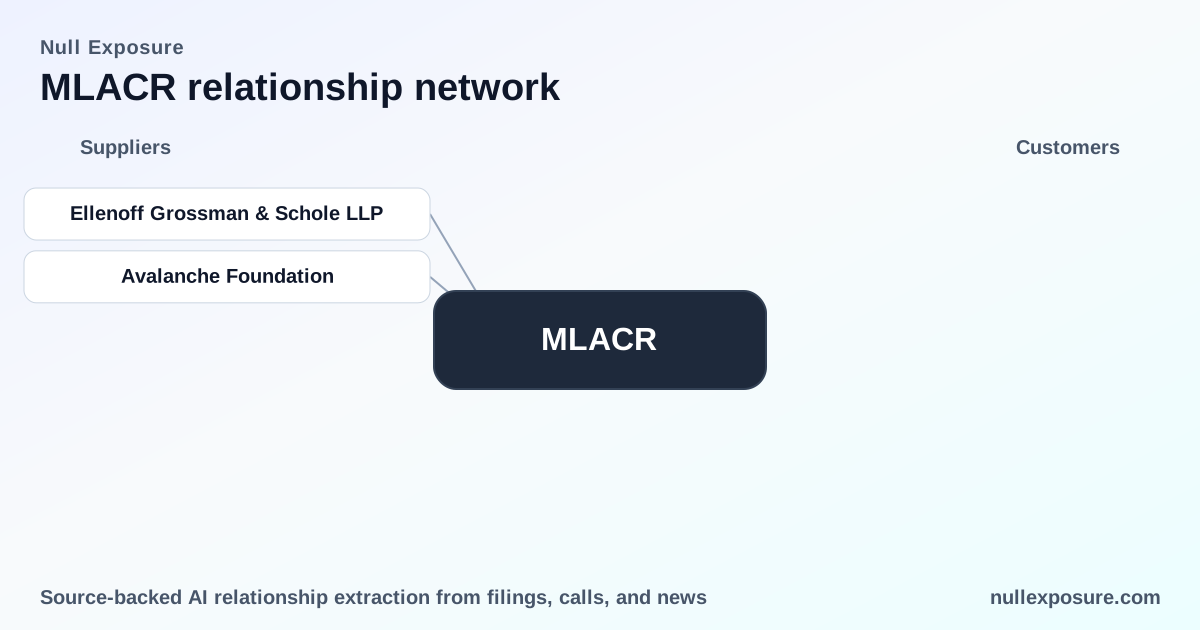
MLACR's publicly surfaced supplier relationships are narrow but strategically relevant. Below are the two relationships found in the record, each summarized with a source pointer.
-
Ellenoff Grossman & Schole LLP — The firm is advising Mountain Lake Acquisition Corp. as legal counsel, led by Douglas Ellenoff and Stuart Neuhauser, supporting the SPAC’s transaction and related legal work. Source: USA Herald news item citing counsel activity (March 10, 2026) — https://usaherald.com/avalanche-treasury-675m-spac-merger-targets-institutional-crypto-surge/.
-
Avalanche Foundation — Sidley represented the Avalanche Foundation on a strategic transaction that formed Avalanche Treasury Co. and involved Mountain Lake Acquisition Corp., structured to provide U.S. investors preferential access to AVAX tokens and priority sales from Avalanche Foundation. Source: Sidley press announcement (October 2025) describing the $675 million digital asset treasury transaction and exclusive arrangements (Oct 2025) — https://www.sidley.com/en/newslanding/newsannouncements/2025/10/sidley-advises-avalanche-foundation-on-strategic-transaction-in-675-million-digital-asset-treasury.
How the supplier map informs the operating model
The two relationships show MLACR as a transaction-focused SPAC that engages legal and strategic counterparties to execute a high-profile digital-asset treasury combination. These relationships are typical for a blank-check vehicle executing a sponsor-driven deal, but the disclosure narrative and constraint signals reveal deeper operating characteristics:
-
Contracting posture: short-term, transaction-oriented. Company disclosures describe a non-interest-bearing promissory note from the sponsor due on the earlier of the IPO closing or year-end, showing reliance on short-term sponsor financing rather than long-term vendor contracts (promissory note dated June 27, 2024; amended Sept 23, 2024). This is a company-level signal of limited ongoing contractual commitments and heightened dependence on single-event execution.
-
Geography: U.S.-centric custody and jurisdiction. The IPO proceeds ($231,150,000 placed in a U.S.-based trust account as of Dec 16, 2024) indicate U.S. custody of capital and regulatory jurisdiction, concentrating legal and operational risk within North America.
-
Role and spend posture: service provider relationships with concentrated, material spend. Disclosures show recurring payments to sponsor affiliates for office and administrative services ($20,000 per month) and a deferred underwriting fee structure totaling roughly $8.05 million in deferred discounts/commissions. These items place supplier spend squarely in the services segment and in spend bands that range from approximately $100k–$1m for ongoing admin services to $1m–$10m for underwriting economics.
-
Relationship stage: active and transaction-ready. Operational disclosures (“we currently utilize office space…”, funds in trust) confirm an active posture: the company is set up, capitalized, and engaged with its service providers in support of a pending or executed business combination.
Collectively, these signals create a profile of a sponsor-reliant SPAC with highly concentrated supplier relationships, short contractual tenors, and critical dependence on completing a single business combination to realize the upside investors expect.
If you want to monitor supplier concentration across similar vehicles, explore Null Exposure for structured alerts: https://nullexposure.com/.
Investment implications — what to watch next
The supplier map and constraints translate into four practical implications for investors evaluating MLACR exposure.
-
Execution risk is the dominant risk. The commercial value of MLACR is tied to a successful combination and the terms of that combination; suppliers are transactional and short-term, so failure to close eliminates much of the expected monetization.
-
Counterparty concentration raises vendor and reputational risk. A narrow set of service providers (legal counsel, sponsor affiliates, underwriters) means any dispute or withdrawal by a single counterparty could materially slow or impair deal completion.
-
Cash custody and regulatory concentration are de-risking features, but limited. U.S.-based trust custody of IPO proceeds reduces custody risk but leaves regulatory and market exposure concentrated in the U.S. market and legal regime.
-
Fee leakage is quantifiable and material. Monthly affiliate charges and multi-million-dollar deferred underwriting fees are explicit cash flows that reduce net transaction proceeds available for target investment; model these line items when valuing the combined entity’s economics.
Use this checklist to prioritize monitoring:
- Track legal and advisory appointment updates (Ellenoff Grossman activity).
- Monitor Avalanche Foundation announcements and Sidley filings for adjustments to preferential token sale mechanics.
- Watch SPAC deadlines and any sponsor-financing amendments that extend or alter short-term notes.
Practical next steps for research and operations teams
For portfolio managers and operators the clear actions are: verify counterparty stability, quantify structural fees into transaction valuation, confirm regulatory and custody positions, and build contingency plans for sponsor financing lapses. Sponsor loans, deferred underwriting fees, and affiliate service charges are not incidental — they are predictable drains on transaction value and must be modeled explicitly.
Final note: MLACR’s supplier profile is compact and highly actionable — legal counsel and strategic counterparties have outsized influence on the outcome. For automated tracking and continuous supplier risk signals for SPACs and sponsor ecosystems, visit Null Exposure to see how this analysis can be operationalized: https://nullexposure.com/.
Conclusion — MLACR is a transaction-first vehicle whose value hinges on execution and the economics embedded in a small set of supplier relationships. Investors must treat supplier fees and sponsor financing as first-order inputs to any valuation or risk assessment.