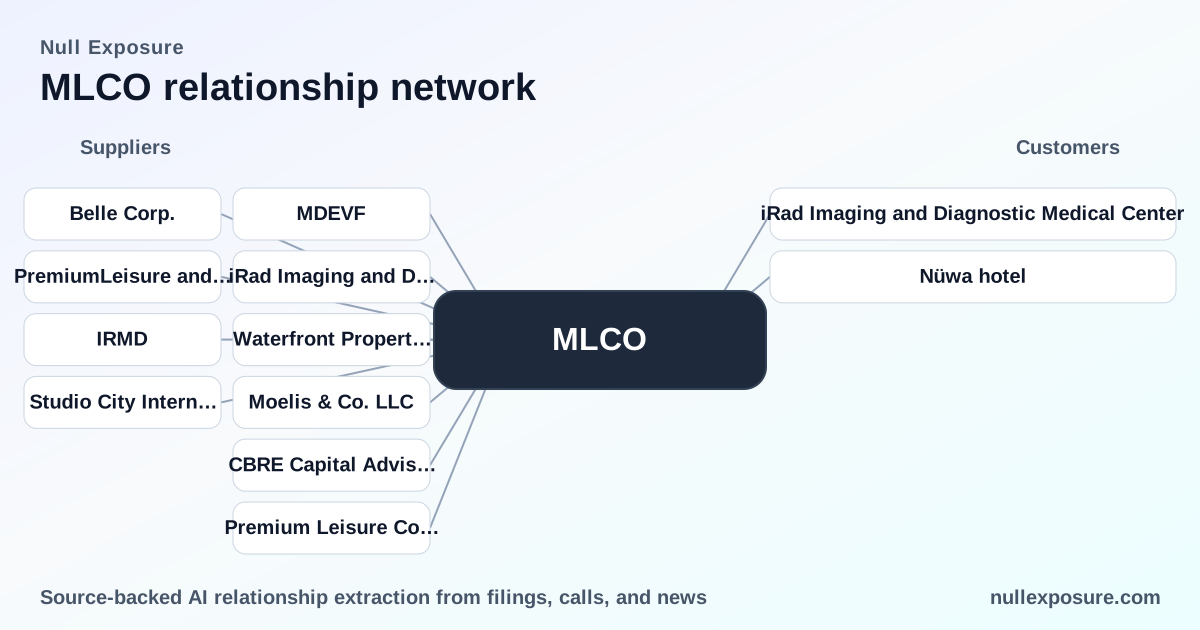
Melco Resorts & Entertainment: Supplier relationships that shape asset strategy and edge cases investors should track
Melco Resorts & Entertainment operates and monetizes high-end integrated resorts by combining gaming revenue, hotel operations, and growing non-gaming services, while extracting value through intercompany licensing and service arrangements. The company’s cash flow is driven by resort EBITDA (TTM revenue ~$5.16bn; EBITDA ~$1.21bn), supplemented by fee arrangements with related parties and third‑party partners for real estate, management and specialist services. Investor attention should center on intra-group trademark fees, operating agreements that govern third‑party assets, and nascent non‑gaming concessions that shift margin mix.
For a detailed supplier mapping and analysis of counterparties, visit https://nullexposure.com/.
What the supplier signals mean for an investor
Public disclosures show a clear operating posture: Melco blends ownership with asset-light arrangements—it operates properties under leases and operating agreements while paying or receiving intercompany fees. Recent disclosures indicate an upward movement in trademark licensing charges to the parent, and expanded non-gaming partnerships (healthcare) that transform revenue composition. Intercompany service and shared‑cost frameworks are material to consolidated margins, and the company has engaged financial advisors for strategic alternatives on specific assets, signaling active portfolio management.
- Contracting posture: A mix of owned assets and operating/lease agreements reduces capital intensity on some projects but concentrates operational risk in contractual counterparties.
- Concentration and criticality: Trademark and shared services arrangements with the listed parent are operationally critical and will influence reported margins.
- Maturity and strategic posture: Use of established financial advisors and asset-level leases suggests a mature approach to portfolio optimization and potential disposals.
- Non-gaming diversification: Partnerships for medical services indicate a strategic push into higher-margin, ancillary services that support guest retention and employee benefits.
For further supplier intelligence and exposure scoring, see https://nullexposure.com/.
Relationship directory — counterparty-by-counterparty, with source notes
Melco International Development Ltd / Melco International (MDEVF)
Melco Resorts pays trademark licensing fees to its Hong Kong‑listed parent; the CFO disclosed the license fee for City of Dreams Macau (excluding the Grand Hyatt) increases to 1.5% of gross revenues from Q1 2026, up from 1% in 2025. An earnings call transcript also confirms Melco International owns and manages trademarks used by Melco Resorts. (GGRAsia, March 2026; Q4 2025 earnings call transcript reported by InsiderMonkey.)
iRad Imaging and Diagnostic Medical Center / iRad (IRMD)
Melco entered a partnership to launch an integrated resort hospital and diagnostic service offering in Macau, and iRad will provide discounted imaging and diagnostic packages to Melco hotel operations and employees. This expands Melco’s non‑gaming service footprint and creates an internal supplier channel for medical services. (ASGAM, Sep 2025; InsiderMonkey, Oct 2025.)
Waterfront Properties (Private) Ltd
Melco is leasing the Sri Lanka resort property from Waterfront Properties (Private) Ltd, which owns the asset that Melco is operating as City of Dreams Sri Lanka. The arrangement reflects an asset‑light route to market in a growth geography. (GGRAsia, March 2026.)
Moelis & Co. LLC
Melco retained Moelis & Co. LLC as a financial advisor to evaluate strategic alternatives for City of Dreams Manila, signaling that the company is actively pursuing potential disposals, joint ventures or capital solutions for that property. (Manila Bulletin report, Aug 2025.)
CBRE Capital Advisors, Inc.
CBRE Capital Advisors, Inc. was also retained as a financial advisor on the City of Dreams Manila strategic review, providing independent capital markets and transaction advisory capability alongside other advisors. (Manila Bulletin report, Aug 2025.)
Premium Leisure Corp.
Premium Leisure Corp. holds the operating license relevant to City of Dreams Manila; Melco operates the resort under arrangements that rely on the license and related agreements with the SM Group entities. This structure creates regulatory and contractual dependencies in the Philippines asset. (Manila Bulletin report, Aug 2025.)
Belle Corp.
Belle Corp. is the property owner tied to City of Dreams Manila; Melco operates on the asset provided by Belle Corp., embedding landlord‑operator relationships into the Manila economics. (Manila Bulletin report, Aug 2025.)
PremiumLeisure and Amusement, Inc.
PremiumLeisure and Amusement, Inc., a wholly owned subsidiary of Premium Leisure Corp., holds the casino license and is the counterparty to Melco’s operating agreement for City of Dreams Manila. The license holder is a direct contractual enabler of gaming operations in that market. (Manila Bulletin report, Aug 2025.)
Studio City International Holdings Limited
Intercompany billing is visible between Studio City International Holdings Limited (SCIHL) and Melco Resorts subsidiaries; disclosures list fees and shared service charges billed across these entities, indicating centralized service provision and cross‑charging that affect consolidated margins and transfer‑pricing exposure. (Company unaudited Q4 2025 release reported by The Manila Times / GlobeNewswire, Feb 2026.)
How these relationships change the investment calculus
These counterparty arrangements lead to several actionable implications for investors:
- Earnings sensitivity to related‑party fees. The announced increase in trademark fees to the parent is a direct margin lever; watch subsequent filings for the P&L impact and any offsetting efficiencies. (GGRAsia, Mar 2026.)
- Asset-level risk tied to operating agreements and licenses. Manila’s economics are materially shaped by license and property arrangements with SM Group entities; resolution of the strategic review will change balance‑sheet and earnings composition. (Manila Bulletin, Aug 2025.)
- Non-gaming revenue strategy is advancing. The iRad partnership and an integrated resort hospital convert guest services into recurring revenue lines and employee benefit programs, which improve customer retention and diversify revenue. (ASGAM, Sep 2025; InsiderMonkey, Oct 2025.)
- Operational concentration through intercompany services. Shared service and intercompany charges with SCIHL are a governance point; transparency on transfer pricing will be crucial for forecasting margins. (Company release via GlobeNewswire, Feb 2026.)
Key takeaway: monitor trademark fee flows, outcomes of the Manila strategic process, and reported intercompany charges in quarterly filings; these items will drive near‑term margin variability and long‑term asset value.
For a supplier‑level stress test and covenant mapping, visit https://nullexposure.com/.
Bottom line and next steps for investors
Melco operates a hybrid model that combines in‑house resort operations with leased and licensed assets plus strategic third‑party partnerships in non‑gaming services. The incremental trademark fee increase, the Manila strategic review, and the launch of medical partnerships are the most consequential supplier‑side developments for near‑term earnings and medium‑term valuation.
Actionable monitoring list:
- Track Q1–Q2 2026 filings for the accounting effect of the increased trademark fee.
- Watch outcomes from Moelis and CBRE’s strategic process around City of Dreams Manila; a sale or JV will change consolidated leverage and cash flow.
- Follow performance metrics for non‑gaming concessions (hospital/diagnostic services) as a leading indicator of margin diversification.
For tailored counterparty exposure reports and supplier risk scoring, see https://nullexposure.com/ — we map contractual links that drive operational and valuation outcomes.