Moolec Science (MLEC): Supplier footprint, corporate plumbing, and what it means for investors
Moolec Science commercializes animal proteins produced in plants through molecular farming and monetizes primarily by supplying those specialty ingredients to food and biotechnology customers and through strategic corporate actions designed to reorganize its capital base. The company combines lab-scale R&D and pilot production with outsourced operational partners and routine transfer-agent services, creating an operating profile that is capital-light on manufacturing capacity but dependent on third-party operational relationships.
For a focused supplier-risk brief and continuous supplier monitoring, visit Null Exposure.
How the relationships on record map to Moolec’s operating posture
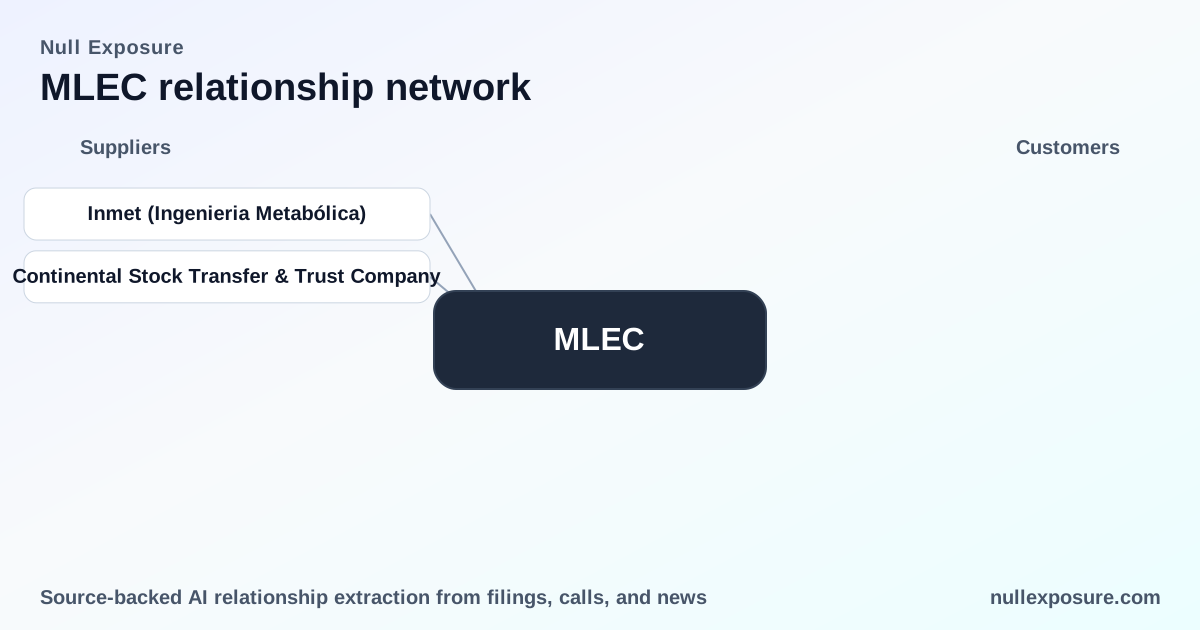
Moolec’s public relationship map is narrow but telling: one operational outsourcing link and one corporate-administration vendor. That split highlights a dual risk profile—operational execution rests partially outside the firm, while corporate governance and investor mechanics (share consolidation) are handled by established service providers. For investors, this implies lower fixed-capital burden but higher reliance on third-party execution for scale and commercial delivery.
The company-level records show no documented supplier constraints, which is itself a signal: public disclosures and news reports do not record binding supplier restrictions or concentrated contractual lock-ins for Moolec across the reviewed period. This absence of supplier constraints should be interpreted as a visibility signal about public filings, not as proof of zero operational dependence.
What the outsourcing relationship implies
Outsourcing part of local operations reduces Moolec’s capital intensity and accelerates time-to-market for pilot production and early commercial runs. It also creates counterparty and continuity risk: if an external operator fails to meet quality or capacity expectations, Moolec’s product delivery and margins will be impacted. Given the company’s negative EBITDA and small market capitalization, the ability to maintain reliable third-party partners is a critical operational dependency.
The relationships on record — straight to the point
Inmet (Ingeniería Metabólica)
A Puntobiz report in FY2022 notes that Moolec (or its related operations) outsources part of local operations to Inmet (Ingeniería Metabólica), a firm integrated into the Bioceres holding structure. This indicates Moolec uses regional third-party technical partners for some operational activities rather than fully internalizing those functions (Puntobiz, FY2022 — https://puntobiz.com.ar/negocios/otra-biotecnologica-rosarina-ya-tiene-casi-listo-su-desembarco-en-wall-street-2022123600).
Continental Stock Transfer & Trust Company
A company press release in FY2026 confirms Continental Stock Transfer & Trust Company served as Moolec’s transfer agent for a share consolidation, performing routine corporate-administration services tied to capital-structure adjustments (AccessWire press release, FY2026 — https://www.accessnewswire.com/newsroom/en/biotechnology/moolec-science-sa-announces-the-implementation-of-a-share-consolidation-of-its-ordina-1122306).
Financial context that frames supplier importance
Moolec is a small-cap biotech listed on NASDAQ with market capitalization around $7.2M and revenue TTM of ~$7.8M, but with negative gross profit and EBITDA (gross profit TTM -$639k; EBITDA -$8.07M). The balance between internal capability and outsourced services therefore matters more than it would for a large, profitable manufacturer. Outsourcing to partners like Inmet preserves capital and reduces fixed-cost leverage at the expense of operational control and supply-chain visibility.
Other structural investor signals:
- Insider ownership is material (≈21%), while institutional ownership is very low (≈0.25%), concentrating control and potentially affecting governance outcomes.
- The FY2026 share-consolidation activity handled by Continental suggests management is actively managing capital structure to address float characteristics and regulatory/listing considerations.
- Volatility is elevated: the 52-week range (high $157.05, low $3.075) and low shares outstanding underscore illiquidity and episodic price moves.
These facts together create a profile where supplier relationships are operationally critical even if small in number. For an investor, that translates into a need to monitor partner performance metrics and any announced changes in outsourced arrangements.
For ongoing supplier monitoring and deeper signals, explore Null Exposure.
Practical takeaways and risk checklist for investors
- Operational concentration: The visible outsourcing relationship with Inmet is a single publicly noted operational partner; investors should treat this as a potential concentration risk until more partners are disclosed.
- Administrative stability: Use of a recognized transfer agent for the FY2026 share consolidation reduces shareholder-operations execution risk on corporate actions.
- Cash and execution sensitivity: Negative EBITDA and negative gross-profit points indicate that supplier performance and cost control directly affect solvency trajectories.
- Disclosure gap: No supplier constraints were recorded in the reviewed materials, which is a company-level signal about limited public supplier-contract visibility; active investors should expect information asymmetry on vendor terms and contingency planning.
Monitor the following items closely:
- Announced long-form contracts or commercial supply agreements with food or ingredient buyers.
- Any expansion or replacement of operational partners beyond Inmet.
- Progress reports on scale-up yield and cost improvement tied to third-party operations.
- Outcomes of the FY2026 share consolidation and any subsequent governance or capital-raising actions.
Where to look next and how to act
For investors evaluating Moolec for either a long or short thesis, the priority actions are: obtain counterparty references or confirmations for outsourced production runs, scrutinize product specs and QC records tied to Inmet and any other contractors, and watch press filings regarding commercial off-take or licensing agreements that would materially change revenue visibility. Given the small market cap and concentrated insider ownership, operational news will move the stock materially.
For timely supplier-risk monitoring and alerts tailored to Moolec and peer firms, visit Null Exposure.
Conclusion: Moolec’s public supplier footprint is small but strategically meaningful. Outsourcing keeps the company capital-light while introducing concentrated operational risk; corporate-administration relationships are standard and reduce execution friction for investor-facing actions. Investors must push for more granular counterparty disclosure and track partner performance as a determinant of Moolec’s ability to convert molecular-farming IP into repeatable revenue.