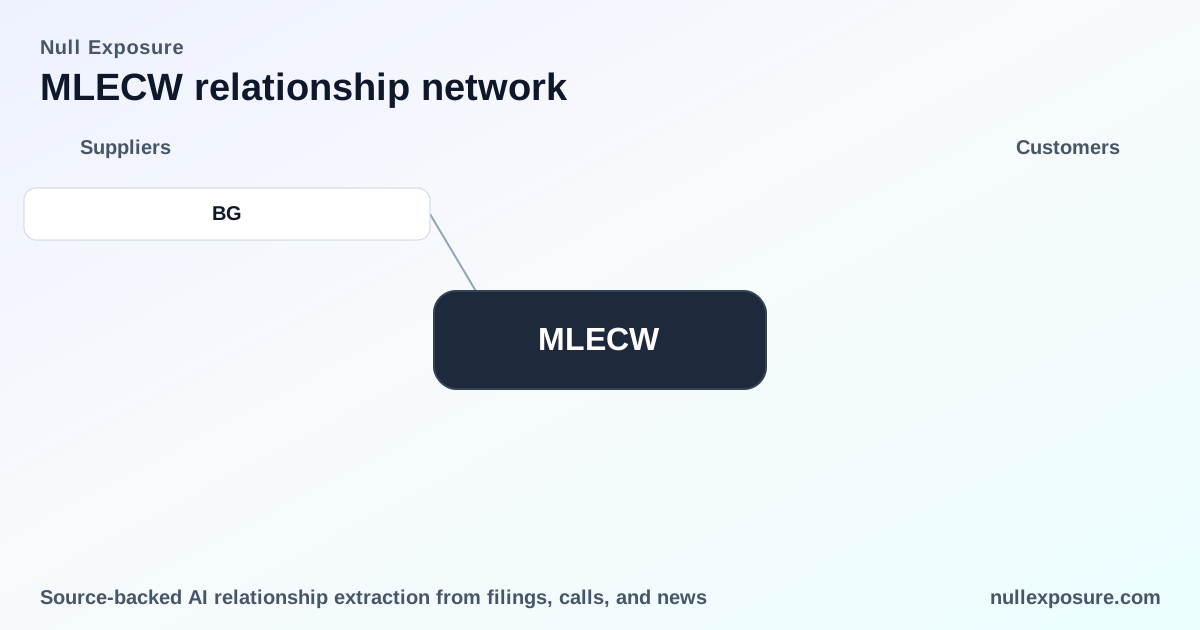
Moolec Science (MLECW) — supplier relationships and what they mean for investors
Moolec Science is a molecular-farming ingredient company that produces animal proteins inside plants and monetizes through ingredient sales, R&D collaborations and commercial partnerships with agricultural and food-industry players. The company advances proprietary plant-expression systems, then converts those capabilities into revenue via product sales and co-development agreements with larger supply-chain partners. Investors should view Moolec as an early-stage ingredient innovator whose commercialization thesis rests on strategic farming and processing partnerships rather than standalone scale today.
If you track industrial supplier risk and partner exposure for alternative-protein plays, this profile is relevant: check more supplier intelligence at https://nullexposure.com/.
One partnership dominates the public record — here’s the short read
Moolec disclosed a signed R&D collaboration with Bunge, focused on developing safflower varieties to improve productivity for specific applications or markets. This is an explicit upstream collaboration designed to improve raw-material yields and application fit, not a finished goods supply contract. According to Moolec’s 2024 Q4 earnings call transcript (published March 7, 2026), the two companies agreed to work together on safflower varietal development.
Why that matters to investors and operators
- Upstream integration: The partnership with Bunge signals Moolec is prioritizing control and optimization of feedstock (safflower), which is a structural lever for lowering unit costs and improving protein yields.
- R&D posture, not procurement insulation: The agreement is R&D in nature, so it increases technical optionality and product-market fit over time but does not immediately secure long-term raw-material supply.
- Counterparty quality: Bunge is a global agribusiness leader; partnering with a major supplier de-risks many execution aspects while creating a potential pathway to scale if varietal improvements yield commercial economics.
For more supplier-level signal context and continuous monitoring, visit https://nullexposure.com/.
Supplier relationships — the single disclosed partner, in plain English
- Bunge — Moolec signed an R&D collaboration agreement to develop safflower varieties aimed at improving productivity for specific applications or markets. This is a development-stage partnership focused on feedstock optimization rather than an off-take or long-term supply contract. According to Moolec’s 2024 Q4 earnings call transcript (filed March 7, 2026), the collaboration is explicitly R&D-focused and centers on safflower varietal improvement.
Operating model and business-model characteristics investors need to weigh
Given the company profile and the public partnership, the following characteristics define Moolec’s current operating model:
- Contracting posture — collaborative and development-led. Moolec uses R&D partnerships with established agricultural partners to secure technical access and validation rather than relying solely on internal scale-up. This reduces capex intensity but extends time-to-revenue solidity.
- Concentration — partner-specific exposure exists. With a single disclosed agribusiness partner in the public record, counterparty concentration is meaningful from a disclosure perspective; additional undisclosed relationships would change the picture but are not captured in this record.
- Criticality — upstream inputs are strategically important. Feedstock (safflower) improvements directly affect production economics and gross margin trajectory; the Bunge relationship targets a critical node in the value chain.
- Maturity — pre-commercial/early commercial. The collaboration’s R&D nature implies ongoing technical validation rather than mature supply contracts; financials corroborate an early-stage company with negative gross profit and EBITDA.
These operating signals align with the financial snapshot: Revenue TTM is approximately $7.8M, gross profit is negative, and EBITDA is negative (~-$8.07M), indicating commercial traction remains constrained and margins are materially subscale.
Risk and upside mapped to supplier relationships
- Upside: Successful varietal development with Bunge can materially reduce feedstock cost per unit and improve yield, accelerating commercial viability. A validated partnership with a global supplier opens distribution and scaling pathways for Moolec’s expressed proteins.
- Risks: The agreement is R&D-stage; there is execution risk in breeding and agronomy, regulatory risk for novel plant-expressed proteins, and concentration risk if additional supplier partners are not secured. The warrant-class listing and small public float further amplify market volatility around newsflow.
Constraints and company-level signals
There are no supplier-specific constraints recorded in the available relationship constraints set. At the company level, observable signals include the warrant instrument structure (ticker class: MLECW), negative gross profit and EBITDA, limited public float (shares/float ~897,820), and small absolute revenue. These factors collectively indicate early commercial scale and high sensitivity to partner outcomes rather than robust supplier-side commitments recorded in public filings.
Investment takeaway and tactical guidance
Moolec is an R&D-driven, upstream-focused alternative-protein supplier play whose pathway to scale depends on successful agricultural partnerships and feedstock economics. The Bunge collaboration is the most consequential disclosed relationship — it reduces some execution risk by involving a top-tier agribusiness, but it remains R&D in orientation and not a guaranteed route to commercial margins. For investors and operators evaluating exposure: prioritize monitoring technical milestones from the Bunge collaboration, subsequent commercial off-take announcements, and any expansion of the partner roster.
Explore further supplier intelligence and ongoing monitoring at https://nullexposure.com/.
If you need a focused supplier-risk briefing or a tracking dashboard for Moolec and its agribusiness partners, visit https://nullexposure.com/ to see available coverage and analyst tools.