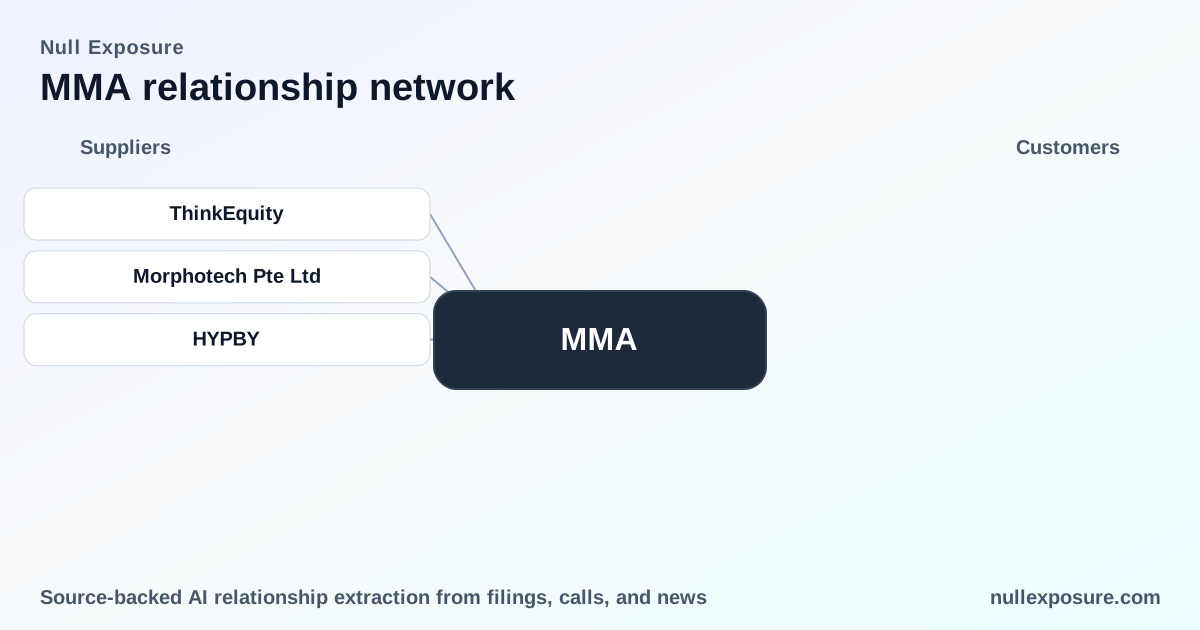
MMA (Mixed Martial Arts Group Limited) — supplier relationships that shape value creation
MMA operates as a platform-focused consolidator and investor in martial-arts-related technology and media assets, monetizing through acquisitions, platform subscriptions and digital services, content and event monetization, and occasional capital markets transactions such as public offerings. Its strategy combines operational roll-ups with selective technology partnerships to accelerate product capability and distribution, while capital markets engagements are used to fund scale initiatives and liquidity events. For investors evaluating supplier risk and strategic leverage, the partnerships and capital-market advisors MMA chooses are direct indicators of execution capacity and pathway to monetization.
Explore deeper supplier intelligence at https://nullexposure.com/.
How MMA runs the business and turns it into revenue
MMA presents itself as an investment-oriented operator that consolidates niche technology and media assets in combat sports and adjacent verticals. Revenues reported are modest — roughly $1.13 million TTM — while operating metrics show negative operating margin and EBITDA, signaling an early-stage roll-up still investing heavily in product, distribution and content. The company advances growth through three levers: (1) M&A to add capability and customers, (2) strategic tech alliances to accelerate platform development, and (3) capital markets transactions to fund scale. That operating model produces a contracting posture that is transactional and alliance-driven rather than long-term vendor lock-in, so supplier relationships are both strategic and replaceable depending on execution.
Supplier relationships you need to know
Below are every supplier/partner relationship surfaced in public filings and press coverage, with direct, plain-English summaries and source notes.
ThinkEquity — capital markets advisor for the offering
ThinkEquity acted as sole book-running manager for MMA’s public offering in FY2024, positioning itself as the primary underwriter and placement agent for that equity raise. According to AccessNewswire and Yahoo Finance releases in March 2026, ThinkEquity led the transaction execution and distribution for the offering, signaling MMA’s reliance on boutique investment-bank expertise for capital raises.
Sources: AccessNewswire release (March 2026); Yahoo Finance coverage (March 2026).
Morphotech Pte Ltd — strategic technology alliance
MMA has a strategic alliance with Morphotech Pte Ltd to integrate Web 2.0 and Web 3.0 technologies across its platforms, which is positioned as a capability accelerator for digital innovation and fan engagement. A company announcement published via SahmCapital in July 2025 describes this partnership as part of MMA’s product roadmap to embed decentralized and next-generation interactive features.
Source: SahmCapital press release (July 15, 2025).
Hype — acquired digital marketing and platform capability
MMA completed a strategic acquisition of Hype, an all-in-one digital marketing platform, to consolidate marketing and distribution capabilities into its operating stack. According to an AccessNewswire announcement in March 2026, the acquisition is intended to enhance MMA’s owned marketing channels and customer acquisition economics as part of its broader consolidation strategy.
Source: AccessNewswire announcement (March 2026).
What these partners reveal about MMA’s operating posture
These supplier and deal relationships collectively map to a distinct operating profile for MMA:
- Contracting posture is transaction- and capability-driven. MMA uses acquisitions (Hype), strategic alliances (Morphotech), and external capital-market advisors (ThinkEquity) as the primary tools to assemble an operating stack quickly rather than developing every capability in-house.
- Supplier criticality is high but replaceable. Technology partners and acquired platforms are important for near-term product and go-to-market expansion, yet the company’s playbook is to consolidate capabilities through M&A, which implies suppliers are strategic but not necessarily long-term single points of failure.
- Concentration and governance signals. MMA reports a small revenue base with negative EBITDA and EPS, high insider ownership (~19%) and minimal institutional ownership (~1.75%), which concentrates control and increases execution dependence on management and connected parties.
- Maturity profile is early-stage and capital dependent. Operating losses and the need for an underwritten offering indicate the business is still building product/market fit and requires continual funding to scale.
For a deeper supplier-risk scorecard and counterparty mapping, visit https://nullexposure.com/ to see how these dynamics compare across peers.
Investment implications: risk and upside in plain terms
- Upside: Acquisitions like Hype and the Morphotech alliance accelerate distribution and product capability without immediate large incremental R&D spend, preserving management bandwidth to focus on monetization and customer growth.
- Execution risk: The company’s negative operating margins and dependence on capital markets imply dilution risk and funding sensitivity; the reliance on boutique underwriters demonstrates willingness to access public capital but also the need for recurring liquidity.
- Governance and concentration: High insider ownership concentrates decision-making, which can speed execution but elevates operational and conflict-of-interest scrutiny for institutional investors.
- Supplier substitution: Because MMA’s playbook emphasizes M&A and alliances, vendors can be replaced or internalized post-acquisition, so counterparty continuity is not guaranteed.
Practical checklist for operators and procurement teams
- Confirm integration plans for acquired platforms (Hype) and technical handover timelines with Morphotech to understand operational dependencies.
- Factor capital-raise cadence into supplier contract length and payment terms — short-term contracts reduce counterparty exposure if further financings change strategy.
- Monitor insider dilution events and any related-party transactions closely; concentration in ownership elevates governance risk.
Bottom line and next steps
MMA is executing a rapid capability build through acquisitions and strategic alliances funded with public-market capital raises. This model creates asymmetric upside if integration succeeds, and concentrated governance plus persistent negative margins creates asymmetric downside if funding or execution falters. Investors and operators should evaluate supplier continuity, integration risk, and the company's capital plan before increasing exposure.
For ongoing supplier intelligence, comparative counterparty analysis, and scenario modeling, visit https://nullexposure.com/. If you need a tailored supplier-risk brief based on MMA’s public relationships, request a deep-dive at https://nullexposure.com/ and get a focused report that aligns with your investment or operational diligence needs.