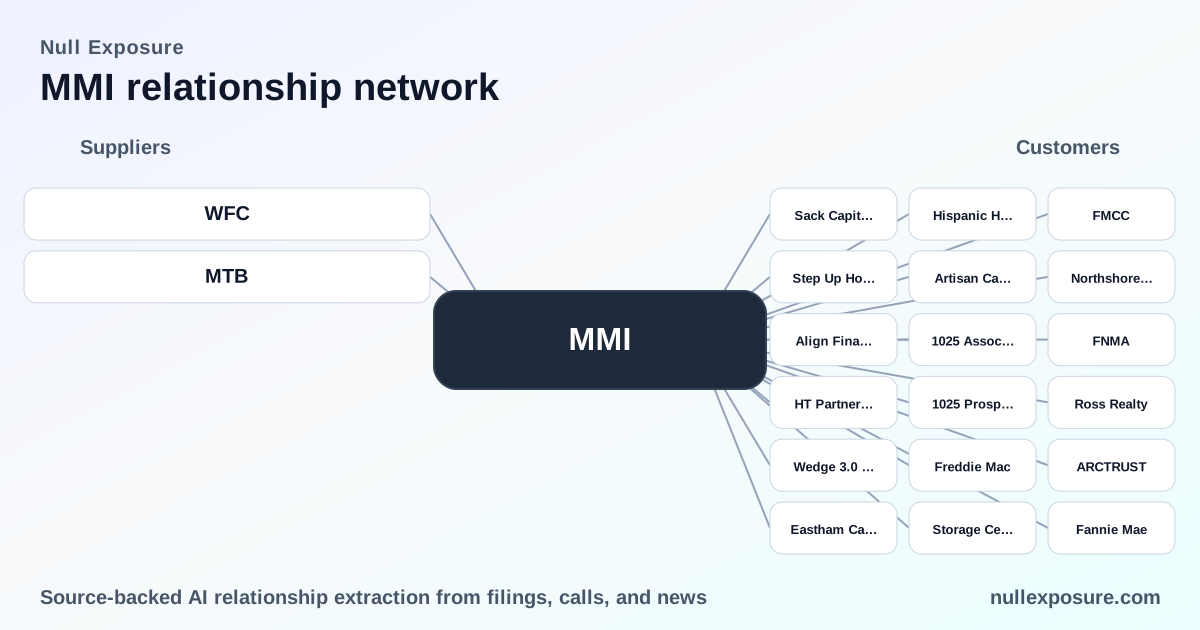
Marcus & Millichap (MMI) — supplier-side relationship map and strategic implications
Marcus & Millichap operates as a specialist commercial real estate brokerage and capital markets intermediary, monetizing through commission-based investment sales and financing placement fees generated by a large network of largely independent brokerage professionals and capital-markets teams. Revenue hinges on transaction volume and placement access; working capital and third-party banking alliances underpin the firm’s ability to execute financing and placement activity at scale. For investors assessing supplier and banking exposure, the company’s short-term credit posture and strategic placement alliances are the material relationships to monitor.
Learn more about supplier landscapes at https://nullexposure.com/.
How to read MMI’s supplier posture in one paragraph
MMI’s operating model relies on a dispersed, commission-based sales force and a small set of banking partners that provide liquidity and placement channels. That combination produces high revenue leverage to deal flow, limited fixed labor overhead, and dependency on partner banks for capital-market distribution and contingent credit capacity. The firm’s counterparty mix therefore skews toward many independent counterparts for origination and a few concentrated institutional partners for capital and liquidity.
Banking and capital partners that matter today
Wells Fargo Bank — standby credit capacity
Marcus & Millichap maintains a $10 million senior secured revolving credit facility that was undrawn as of December 31, 2025, according to the company’s FY2026 filing summarized by TradingView. The facility gives MMI short-duration committed liquidity and a sublimit for standby letters of credit that has been used, supporting contingent financing needs. (Source: TradingView reporting on MMI FY2026 10‑K, March 10, 2026.)
M&T Bank — strategic placement alliance for agency execution
MMCC and IPA Capital Markets executed over 1,600 transactions totaling nearly $12 billion in volume, including a $2.3 billion portion placed with Fannie Mae and Freddie Mac primarily through a strategic alliance with M&T Bank, as disclosed on the company’s 2025 Q4 earnings call and reflected in subsequent press coverage. That alliance is an active distribution channel for agency placements and a meaningful conduit for mortgage-capital execution. (Source: MMI 2025 Q4 earnings call, March 7, 2026; also reported in InsiderMonkey, March 10, 2026.)
What the constraints and contract signals reveal about operating risk
The textual constraints extracted from filings and disclosures illuminate the company-level posture rather than being tied verbatim to a single named counterparty unless specified.
- Contracting posture — short-term committed liquidity. Filings note a revolving credit facility that matured in mid-2025 under prior language, reflecting a pattern of short-dated credit arrangements rather than long-term secured financing; this signals management’s preference for flexible, shorter-duration borrowing capacity to match transactional working capital needs.
- Counterparty mix — highly distributed originator base. The firm reports over 1,700 investment sales and financing professionals who are primarily exclusive commission-based independent contractors, indicating low fixed staff overhead but also reliance on a decentralized network for deal origination and client access.
- Relationship stage — active counterparties and facilities. The company’s ability to borrow, repay and reborrow under the Credit Facility until maturity (and the continued use of placement alliances) documents active, operational relationships with its bank partners.
- Spend and contingent exposure — mid-range commitments and letter-of-credit usage. Commitments aggregated roughly $16.8 million as of Dec 31, 2024 (with $6.0 million paid subsequent to year end), and the credit facility included a $3.0 million sublimit for standby letters of credit with about $1.05 million utilized at year end — indicating contingent obligations in the low tens of millions rather than negligible exposure.
Together these constraints suggest a company structured for transaction flexibility: high channel breadth (many originators) and concentrated distribution + liquidity partners (banks), with contingent credit exposure at a modest absolute scale.
What investors should take away — risks and thesis drivers
- Revenue sensitivity to capital-markets flows is the primary thesis driver. Placement fees and commissions scale with transactional volume; the M&T Bank alliance that routed $2.3 billion of agency placements is a tangible example of distribution that converts deal flow into fees. (Source: MMI 2025 Q4 earnings call.)
- Liquidity and operational continuity depend on short-term bank facilities. The existence of a $10 million senior secured revolver — undrawn as of 12/31/2025 — is a working-capital backstop, but the short-duration nature of such facilities exposes MMI to periodic refinancing or renewal risk. (Source: MMI FY2026 10‑K via TradingView.)
- Workforce model reduces fixed-cost leverage but increases execution variability. The predominance of commission-based independent contractors keeps operating leverage low in downturns, but deal throughput is subject to agent activity and market cycles. (Company disclosure on independent contractors.)
- Counterparty concentration is meaningful on the distribution side. The strategic alliance with M&T Bank for agency placements is a constructive asset but creates concentrated reliance for a portion of agency channel capacity.
Practical next steps for diligence
- Review the latest credit agreement schedule, maturity profile and sublimit utilization in the company’s most recent 10‑K and 10‑Q to confirm current revolver terms and covenant thresholds.
- Track quarterly disclosures and earnings commentary on placement volumes and the health of the M&T relationship; a decline in agency placements would show up quickly in fee revenue.
- Monitor contingent commitments and letter‑of‑credit usage to measure off‑balance-sheet exposure relative to cash and net working capital.
For a deeper look at supplier exposures across the commercial real estate services sector, visit https://nullexposure.com/ for analyst-grade mapping and relationship signals.
Final assessment
Marcus & Millichap presents a capital-markets-dependent business model that converts broad origination reach into fee income via a small set of execution partners. Key risks are concentrated distribution reliance and short-term bank financing refresh cycles, while strengths are low fixed labor costs and established agency placement capability. Investors should weigh deal-flow momentum and bank‑facility renewal capability when evaluating the next earnings cycle.
If you want structured supplier-relationship intelligence or to model counterparties for MMI and its peers, explore our platform at https://nullexposure.com/ for tailored research and reporting.