MMK: State Street’s Prime Money Market ETF and what it means for counterparties
MMK is the ticker for the State Street Prime Money Market ETF, an actively managed cash vehicle that monetizes through management fees on assets under management and the operational scale of State Street’s institutional cash franchise. The product converts short-term high-quality debt exposure into an ETF wrapper, generating fee income while routing investor cash through State Street’s cash-management operations and trading infrastructure.
If you want a concise supplier-risk briefing or to benchmark MMK alongside other cash products, start here: https://nullexposure.com/
Why MMK matters to investors and operators
State Street launched MMK to offer ETF-based access to short-term, high-quality debt instruments under an actively managed mandate. That structure captures traditional money-market use cases—cash parking, liquidity management, and yield enhancement—while delivering the distribution and operational benefits of the ETF model. The product’s economics are driven by scale (AUM-dependent fees), transaction execution, and the ability to source and manage high-quality short-duration paper at competitive spreads.
State Street’s cash-management team underpins the product with deep scale: the team manages a substantial cash franchise that supports MMK’s execution and inventory management. That scale underwrites both cost competitiveness and distribution reach, making MMK a supplier of short-duration cash exposure to institutional and retail channels.
Explore how MMK compares to other supplier relationships and instruments at https://nullexposure.com/
Who supplies services to MMK (all relationships found)
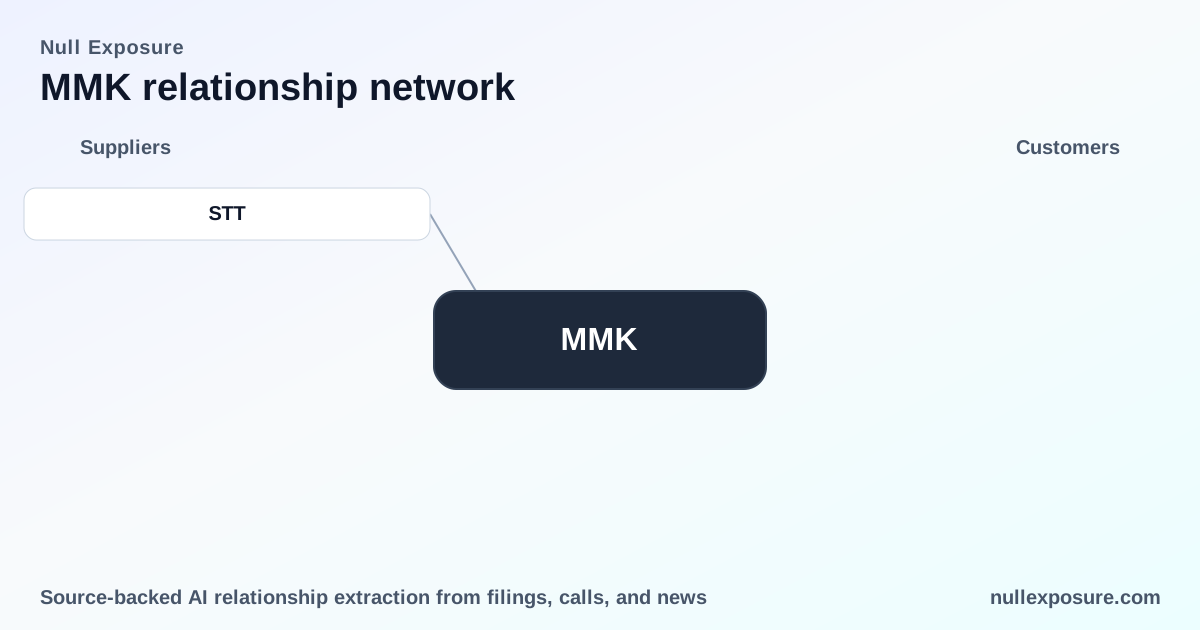
State Street Investment Management (STT)
State Street Investment Management is the sponsor and operating manager for MMK; the firm launched the actively managed State Street Prime Money Market ETF to provide low-cost prime cash exposure using its cash team and trading capabilities. According to a Sahm Capital news report published on February 18, 2026, State Street’s cash team supports the product with US$599.55 billion in assets under management, underscoring the institutional scale behind the ETF (https://www.sahmcapital.com/news/content/what-state-street-stts-new-prime-money-market-etf-and-mariner-deal-mean-for-shareholders-2026-02-18).
(That listing represents the full set of supplier relationships surfaced in the available results.)
What the operating model looks like in practice
MMK’s operating model combines an ETF wrapper with institutional cash management. Key characteristics that shape supplier relationships and execution priorities include:
- Contracting posture: State Street operates MMK through established fund governance and third-party service agreements typical of large ETF sponsors—custody, transfer agency, and trading relationships are centralized under the State Street platform rather than fragmented vendor-by-vendor contracting.
- Concentration: The product is tightly integrated with State Street’s cash team; that internal concentration concentrates operational know-how and underwriting capacity within a single corporate franchise, which is an advantage for execution but increases single-supplier exposure for functions that are not outsourced.
- Criticality: MMK is critical as a cash-management channel for investors seeking an ETF vehicle for prime short-duration paper; counterparties and market-makers will treat it as a liquidity conduit rather than a credit originator, so its supplier relationships prioritize settlement, custody, and market access.
- Maturity: The ETF wrapper is a mature distribution vehicle, while a prime money-market strategy remains sensitive to credit cycles and regulatory oversight; MMK benefits from industry-standard maturity in product distribution combined with the active-management complexity of prime cash.
These company-level signals define how counterparties should assess operational dependence and counterparty risk before committing capital or service capacity.
Strategic implications for counterparties and partners
State Street’s scale and institutional positioning create both opportunity and obligation for suppliers and operators that engage with MMK:
- Opportunity: Access to a large, fee-bearing cash product that can generate steady transaction volumes for market-makers, custodians, and trading counterparties. State Street’s distribution network increases the probability of meaningful, recurring flow.
- Obligation: Providers must meet high operational and compliance standards—settlement speed, custody robustness, and regulatory reporting are baseline requirements when supplying services to a flagship product from a major custodian.
Key takeaway: suppliers that can integrate with State Street’s operational tempo and custody standards will capture the most durable flows from MMK.
Risks that investors and operators should track
- Liquidity and redemption pressure: Prime money-market strategies are inherently sensitive to short-term liquidity stresses; ETF wrapper mechanics reduce some friction but do not eliminate the need for liquid inventories and market-making capacity.
- Fee compression: MMK’s value proposition centers on low cost and scale; margins are thin and directly correlated to AUM growth and trading efficiency.
- Concentration risk: Operational and managerial concentration with State Street’s cash team concentrates counterparty exposure; failures or degradation in that team’s capabilities would have outsized effects on performance and operations.
- Regulatory sensitivity: Prime cash instruments face targeted regulatory scrutiny during stress periods; counterparties should expect enhanced reporting, stress-test cooperation, and compliance-related operational demands.
Bold operational readiness—technology, settlement guarantees, and capital to warehouse paper—remains a precondition for profitable supplier relationships.
For a quick supplier-readiness checklist and to compare MMK to other market offerings, visit https://nullexposure.com/
The relationship summary in plain terms
- State Street Investment Management provides the management and operational backbone for MMK, leveraging its sizeable cash-management arm to deliver an actively managed prime money market ETF to investors (Sahm Capital, February 18, 2026: https://www.sahmcapital.com/news/content/what-state-street-stts-new-prime-money-market-etf-and-mariner-deal-mean-for-shareholders-2026-02-18).
Bottom line: where investors and suppliers should focus
MMK is a scale-dependent ETF that monetizes through management fees, trade execution, and the distribution muscle of a major custodian. For suppliers and counterparties, the product offers predictable volumes if you can meet the operational and compliance bar set by State Street. For investors, MMK delivers ETF-level accessibility to prime cash while inheriting the liquidity and regulatory dynamics of money-market instruments. Evaluate counterparties on their settlement resiliency, inventory capacity, and alignment with State Street’s operational cadence before forming long-term supplier relationships.
If you need a structured supplier-risk memo or competitive benchmarking for MMK and related cash products, we provide targeted analysis and engagement playbooks at https://nullexposure.com/