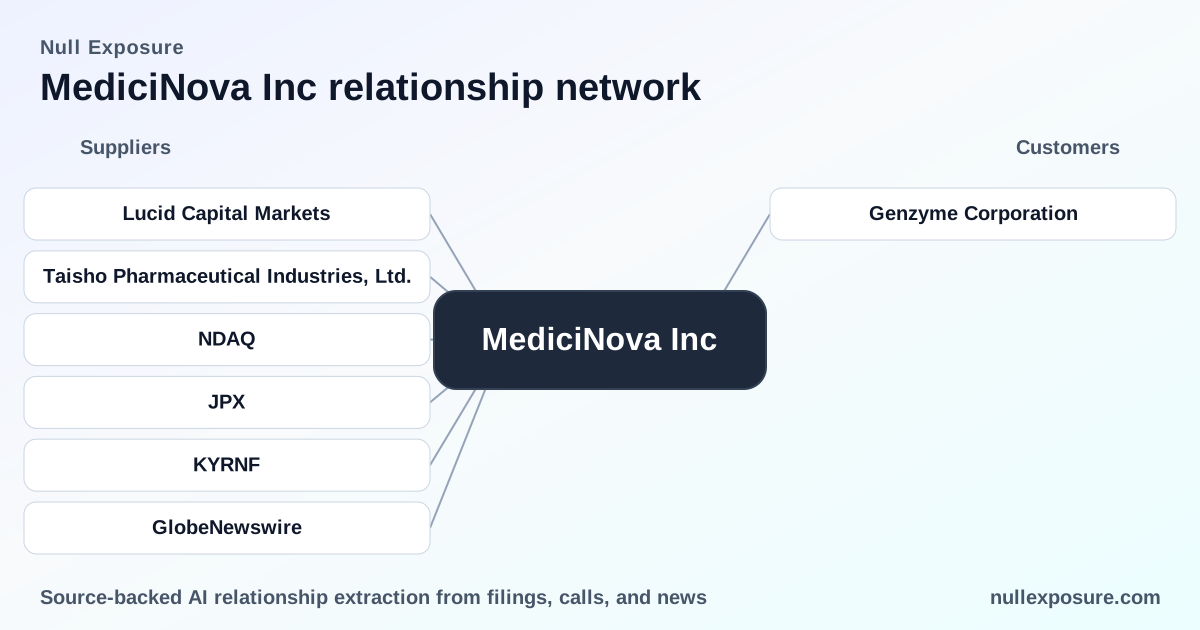
MediciNova (MNOV) — supplier relationships and what they mean for investors
MediciNova assembles value by licensing and developing small-molecule candidates (notably MN‑166 / ibudilast), then monetizing through a mix of licensing, supply collaborations, and public market financings; revenue upside depends on milestone-triggered payments and successful clinical advancement while cost and execution risk are concentrated in third‑party manufacturing and service relationships. For investors evaluating supplier counterparties, the recent disclosures underscore an operating model that is licensing-centric, reliant on external manufacturers and service providers, and actively financed through at‑the‑market equity programs. Learn more at https://nullexposure.com/.
How the headlines map to counterparties
Below are the counterparties and public‑market touchpoints surfaced in recent news and the plain‑English significance of each relationship.
Lucid Capital Markets
MediciNova executed an Equity Distribution Agreement with Lucid Capital Markets to sell up to $50 million of common stock through an at‑the‑market offering, creating a ready mechanism to raise capital by placing shares over time. This is reported in TradingView referencing the FY2025 announcement on March 10, 2026. (TradingView, FY2025)
Taisho Pharmaceutical Industries, Ltd.
A drug supply collaboration with Taisho Pharmaceutical—an entity associated with Teva Pharmaceuticals ownership—was expanded to include development of higher‑dosage ibudilast capsules, indicating upstream product supply and formulation work has been outsourced to a large contract manufacturer/developer. The expansion was reported on March 10, 2026. (ADVFN / br.advfn.com, FY2026)
NASDAQ Global Market
MediciNova’s clinical progress, including completion of patient enrollment in the Phase 2 OXTOX study, was announced in materials tied to its listing on the NASDAQ Global Market, reinforcing the company’s public‑market profile and the financing pathway through equity markets. The notice appeared March 10, 2026. (Quiver Quantitative / press release, FY2025)
Tokyo Stock Exchange
The same enrollment announcement reiterates MediciNova’s dual listing status on the Tokyo Stock Exchange (Standard Market), confirming a cross‑listed public structure that broadens investor access and liquidity. This was included in the March 10, 2026 distribution. (Quiver Quantitative / press release, FY2025)
Kyorin Pharmaceutical
MediciNova licensed MN‑166 (ibudilast) from Kyorin Pharmaceutical in October 2004, a foundational intellectual property arrangement that underpins the company’s lead program and royalty/licensing economics. This historical licensing relationship is referenced in the FY2026 reporting. (ADVFN / br.advfn.com, FY2026)
GlobeNewswire distribution
The press release describing clinical progress was distributed through GlobeNewswire; the distribution included a disclaimer that the release summary was automated, which investors should note when tracing primary source text. This appears in the March 10, 2026 release. (Quiver Quantitative / GlobeNewswire distribution, FY2025)
Operating model signals investors should prioritize
MediciNova’s contract profile and disclosure set reveal clear company‑level characteristics that shape counterparty risk and commercial upside.
- Contracting posture: licensing‑first. The company’s historical and current activity centers on licensing intellectual property and out‑licensing development rights, which creates milestone‑driven potential revenue rather than immediate product sales.
- Dependency on third parties for manufacture and services. Filings explicitly state reliance on third‑party manufacturers, CROs and clinical service providers to run trials and produce drug supply; these relationships are operationally critical and can generate delays and cost overruns if disrupted.
- Materiality of licensing agreements. Management states that termination of license agreements could have a materially adverse effect on the business, signaling high concentration risk around a limited number of licensed assets.
- Role diversity across counterparties. The company functions as licensee (explicit with Kyorin), licensor, service consumer, and reliant distributor, indicating a mix of upstream IP dependence and downstream commercialization outsourcing.
- Spend and milestone scale. Disclosures show potential milestone obligations in the mid‑tens of millions (e.g., aggregate milestone payments cited at $26.5 million), positioning counterparties and suppliers in a material but not blockbuster spend band consistent with late‑stage development programs.
These are company‑level signals drawn from regulatory and press excerpts rather than assertions about any single counterparty (except Kyorin, which is explicitly cited in disclosure).
Learn more about assessing supplier concentration and contract structure at https://nullexposure.com/.
Investment implications for operators and procurement leads
The combination of an ATM equity facility, active supply collaborations, and a licensing origin story drives a distinct investor playbook.
- Balance sheet flexibility is explicit. The Lucid ATM provides near‑term capital optionality and reduces liquidity shock risk for clinical operations, but it also dilutes existing equity when used; operational partners should anticipate ongoing fundraising as a feature of the cash‑management strategy.
- Supply chain is strategically important. The expansion with Taisho into higher‑strength capsules demonstrates the company’s approach to de‑risking drug product supply by partnering with established pharmaceutical manufacturers rather than building internal production capacity.
- IP is the core asset. The long‑standing license from Kyorin is foundational; loss or impairment of that license would be materially adverse, so counterparties that depend on long‑dated royalty or milestone streams should evaluate license security and patent maintenance arrangements.
- Operational maturity is mixed. The company relies heavily on external CROs and service providers, which is typical for a small biopharma but elevates execution risk relative to vertically integrated peers.
Key takeaway: MediciNova’s supplier network is central to execution; investors should price in supplier concentration, milestone‑dependent payments, and recurring equity financing as part of the capital plan.
Practical next steps for relationship evaluation
For investors and procurement/partner teams assessing MNOV counterparties, prioritize these actions:
- Validate license terms and termination controls for the Kyorin agreement and any sublicenses.
- Review manufacturing agreements and supply continuity clauses with Taisho and other CMOs, including capacity, quality metrics, and contingency plans.
- Monitor ATM utilization and the schedule of potential milestone payments to understand dilution risk and cash runway.
For deeper analysis and model inputs, visit https://nullexposure.com/ to access the full supplier relationship mapping and contract‑level signals.
Final read
MediciNova operates as a licensing‑led clinical developer that outsources manufacturing and services while using equity markets to fund advancement. Counterparty relationships—from the Kyorin license that seeds the program to the Taisho supply expansion and the Lucid ATM financing—are the levers that determine clinical progress and value realization. Investors and operators should treat manufacturing and licensing continuity as primary risk vectors and integrate contract durability checks into any valuation or partner due diligence.