Monopar Therapeutics (MNPR): How supplier and capital‑markets relationships shape development runway
Monopar Therapeutics is a clinical‑stage oncology company that builds value by in‑licensing drug candidates, developing them through early clinical trials, and monetizing through milestone‑linked licensing economics, strategic supply contracts for specialized biologics/radiochemistry inputs, and periodic capital raises. Revenue is currently nonexistent; value derives from clinical progress, milestone payments tied to partnered licenses, and access to financing that underwrites trials and manufacturing. For investors and operators, the critical signals are who supplies essential materials (and on what terms), who holds commercialization rights, and who underwrites near‑term dilution. Visit the Null Exposure homepage for further supplier due diligence tools: https://nullexposure.com/
Underwriters and the immediate capital context: what the recent placement implies
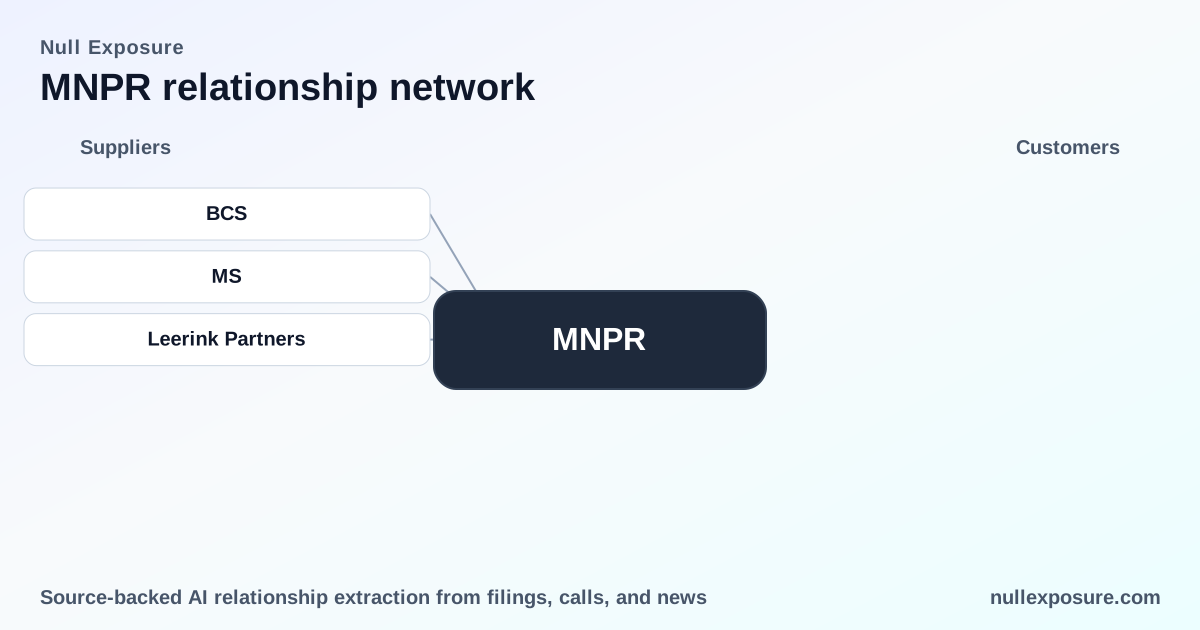
Monopar executed a registered offering to raise up to $100 million, and three investment banks—Morgan Stanley, Leerink Partners and Barclays—acted as lead book‑runners. The placement directly impacts the company’s near‑term liquidity and the potential dilution pathway for existing shareholders. A QuiverQuant news release on March 10, 2026, reported the pricing of the $100 million registered offering and named the three firms as lead book‑running managers.
Barclays
Barclays is one of the lead book‑running managers on the $100 million registered offering, positioning it as a principal channel for investor distribution and potential follow‑on market support. A QuiverQuant news article dated March 10, 2026 covered the transaction and named Barclays alongside Morgan Stanley and Leerink Partners.
Morgan Stanley
Morgan Stanley served as a lead book‑running manager for Monopar’s registered offering, giving it an active role in syndication and execution for the company’s primary equity raise. This involvement is documented in the March 10, 2026 QuiverQuant announcement.
Leerink Partners
Leerink Partners joined Morgan Stanley and Barclays as a co‑bookrunner on the offering, indicating boutique and sector‑specific distribution capability for biotech institutional demand. The participation was reported in the same March 10, 2026 QuiverQuant release.
Supplier, licensee and licensing footprint that drive cost and upside
Monopar’s operating model is license‑centric and supply‑dependent, which shapes both upside via milestones and downside via cash obligations and supply chain concentration.
- The company is actively a licensee: On October 23, 2024, Monopar executed an exclusive worldwide license with Alexion for ALXN1840, transferring development and commercialization responsibility to Monopar; the deal included equity and cash upfront consideration, per company filings in late 2024 and early 2025. According to Monopar’s disclosure, the agreement included issuing 387,329 shares (9.9% of outstanding shares at the time) and a $4.0 million upfront cash obligation (with $1.0 million paid at signing and $3.0 million paid in January 2025).
- The company uses third‑party humanization technology: Monopar took a non‑exclusive license to XOMA’s humanization technology to humanize MNPR‑101, with structured milestone payments rather than large immediate cash fees; filings state milestone payments to XOMA could total up to $14.925 million, paid on clinical/regulatory milestones.
- The company is buyer of specialty radiochemistry supply: In June 2024 Monopar entered a long‑term, non‑exclusive master supply agreement with NorthStar for actinium‑225 (Ac‑225), a critical therapeutic radioisotope for the company’s radiopharmaceutical programs.
Key contract economics and maturity signals: filings and disclosures indicate a mix of upfront equity, modest cash up front, milestone‑based contingent payments, and long‑term supply commitments that are already active. The firm’s contractual posture is oriented toward non‑exclusive technology licenses and long‑term supply agreements, which reduces single‑vendor exclusivity risk but ties cash obligations to regulatory and commercial success. Company filings from October 2024 through January 2025 document these items and the milestone bands cited above.
(For deeper supplier mapping, see supplier intelligence at Null Exposure: https://nullexposure.com/)
Why these relationships matter for valuation and risk
Monopar’s relationships create a clear risk–reward profile: as a pre‑revenue developer, cash needs and access to specialized inputs are the gating factors for clinical progress and value realization.
- Concentration and criticality: Ac‑225 supply from NorthStar is operationally critical for radiotherapeutic trials; long‑term master supply reduces short‑term procurement risk but creates dependency on third‑party production capacity.
- Cost structure and contingent liabilities: Licensing economics shift near‑term cash requirements to milestone triggers. The Alexion deal included equity and $4.0 million cash upfront; the XOMA license defers cash into contingent milestones (up to $14.925 million), while other license obligations aggregate to up to $94.0 million for regulatory and sales milestones according to company disclosures.
- Financing pathway and dilution: The $100 million registered offering with Morgan Stanley, Leerink Partners and Barclays provides immediate runway while setting a clear dilution vehicle for future milestones or manufacturing scale. The presence of major book‑runners improves execution reliability and likely access to institutional demand; QuiverQuant reported the offering pricing on March 10, 2026.
Risks condensed for quick review:
- Supply risk: reliance on third parties for Ac‑225 and clinical batches of labeled MNPR‑101 products.
- Milestone cash exposure: cumulative contingent payments into double‑digit millions for regulatory/commercial events.
- Financing dilution: active registered offering pathway that sponsors institutional placement.
If you want a structured risk matrix that ties each counterparty to operational milestones and cash triggers, discover our methodology at Null Exposure: https://nullexposure.com/
Relationship-by-relationship (complete list from disclosed results)
- Barclays: Lead book‑running manager on Monopar’s $100 million registered offering, responsible for syndication and market execution. Reported by QuiverQuant on March 10, 2026.
- Morgan Stanley: Lead book‑running manager on the same offering, providing primary distribution and underwriting support. Reported by QuiverQuant on March 10, 2026.
- Leerink Partners: Co‑lead book‑running manager, contributing sector distribution to the placement. Reported by QuiverQuant on March 10, 2026.
Operational takeaways and recommended next steps
For investors and corporate operators, the actionable conclusions are direct: monitor Ac‑225 supply continuity, track milestone triggers and payment schedules in licensing agreements, and follow the book‑runners’ syndication outcomes for clues on institutional appetite and pricing pressure. Operators should ensure contingency sourcing plans for critical isotopes and align milestone calendars with financing windows.
Three specific actions:
- Request updated supplier capacity confirmations from NorthStar and proof of supply timelines for clinical batches.
- Map milestone payment schedules (Alexion, XOMA and others) against projected cash runway and scenario‑based dilution.
- Watch book‑runner allocation and closing details for the registered offering to infer institutional demand and pricing execution.
For hands‑on supplier diligence and to benchmark counterparty risk across biotech suppliers, visit Null Exposure: https://nullexposure.com/
Monopar’s asset value is concentrated in clinical progress plus the contractual framework that governs who supplies essential inputs and who benefits from downstream commercialization. Investors should value the company as a licensing and development platform whose path to value is contingent on a small number of specialized suppliers and the successful execution of both clinical milestones and financing events.