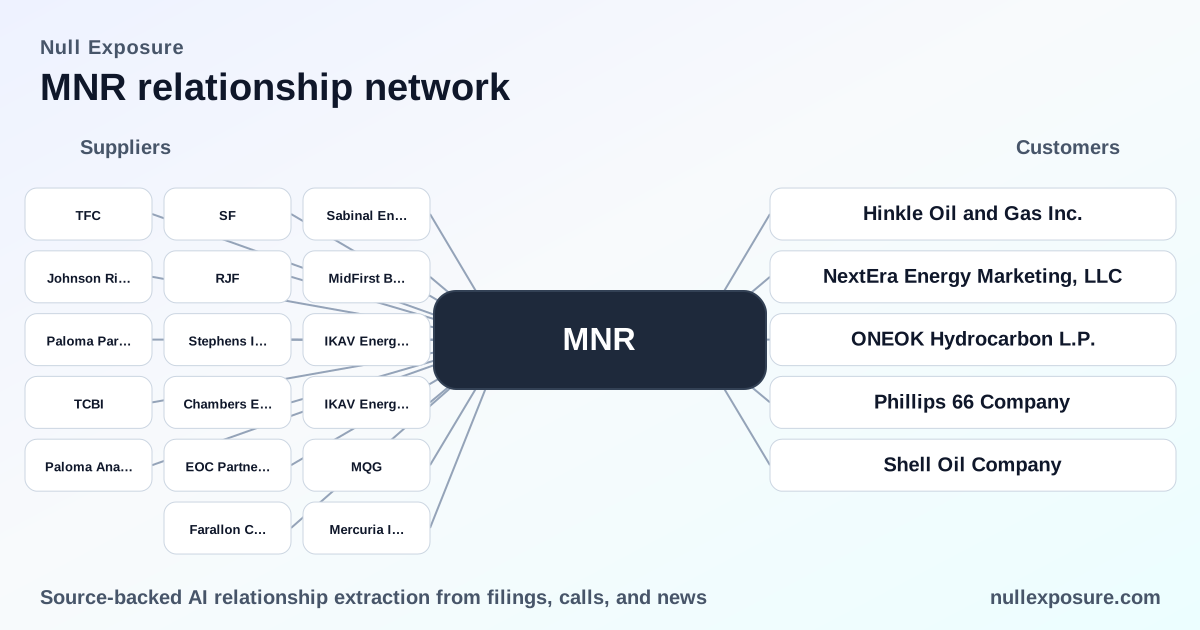
Mach Natural Resources (MNR): supplier relationships that shape operations and balance sheet risk
Mach Natural Resources LP is an upstream oil and gas E&P operator that monetizes by acquiring producing oil and gas assets, operating them to generate hydrocarbon production and selling cash flow into commodity markets and midstream outlets. The company finances growth through a mix of secured term debt and revolving facilities, pays a material management fee under a Master Services Agreement, and uses hedges and transportation contracts to stabilize cash flow. For investors evaluating supplier and counterparty risk, the combination of large-scale acquisitions funded with syndicated loans and significant payments under an operating MSA are the principal structural drivers to monitor. For a concise overview of Mach’s public intelligence and relationship mapping, visit https://nullexposure.com/.
Operational and capital strategies are inseparable for Mach: asset acquisition expands production and EBITDA, while debt maturities and servicing obligations create concentrated counterparty exposure that directly affects liquidity and execution.
How Mach’s supplier map drives cash flow and risk
Mach runs a hybrid operating model: it owns some gathering/processing assets and contracts out other midstream and operating services under a Master Services Agreement (MSA) and discrete firm transportation contracts. The practical implications for investors are clear:
- Contracting posture is weighted to medium- and long-term agreements. Evidence shows operating leases and MSAs with multi-year terms extending through 2029 and automatic renewal provisions, which lock in service spend and operational dependency.
- Counterparty set is institutionally focused. Mach transacts with commercial and investment banks, alternative asset managers and energy operators — a profile consistent with large-enterprise counterparties that bring credit capabilities but create concentration risk.
- A secured term loan is a critical balance‑sheet constraint. The Term Loan Credit Agreement is secured by substantially all assets and carried large outstanding borrowings as of year-end 2024, creating near-term mandatory principal payments that are material to liquidity.
- Spend concentration is significant. Payments under the MSA were over $112 million in 2024, signaling a high reliance on a single service provider for management and operational functions; other line-item spend bands (leases, firm transportation) are meaningful but smaller by comparison.
These company-level signals matter for procurement and counterparty diligence: long-term contracting, sizable single-provider spend, and concentrated secured financing are the dominant structural features shaping supplier diligence.
Relationship-by-relationship: who Mach contracts, borrows from, and acquired assets from
Below are every counterparty captured in our review with a direct, plain-English note and the source context.
-
Sabinal Energy, LLC — Mach closed the acquisition of certain oil and gas assets from Sabinal, which formed part of the company’s FY2025 asset expansion. According to Rigzone and Chemanalyst reporting, the transaction closed in 2025 and was described as included in Mach’s recent asset purchases (Rigzone, Sep 18, 2025; Chemanalyst, FY2025).
-
IKAV Energy Inc. — Mach completed an acquisition of entities owning oil and gas assets managed by IKAV as part of a combined roughly $1.3 billion set of transactions announced in 2025, expanding Mach’s acreage and production base (IncomeInvestors, FY2025; Chemanalyst, FY2025).
-
MidFirst Bank — Mach entered a $75 million revolving credit facility led by MidFirst Bank, providing short-term liquidity capacity to support operations and acquisitions during FY2024 (ConnectMoney, FY2024).
-
Macquarie Group (MQG) — Macquarie participated as a lender in an $825 million term loan syndicate that funded an acquisition, positioning Macquarie among the institutional lenders underwriting Mach’s growth capital in FY2024 (ConnectMoney, FY2024).
-
Mercuria Investments US, Inc. — Mercuria was a lender participant in the $825 million term loan arranged to finance Mach’s purchase from Paloma and other sellers, providing commodity/energy-focused capital support (ConnectMoney, FY2024).
-
Chambers Energy Management — Chambers led the seller group for the assets financed by Mach’s term loan and was referenced as a transaction counterparty in the financing for the Paloma purchase in FY2024 (ConnectMoney, FY2024).
-
EOC Partners — EOC Partners was part of the seller/transaction group tied to the financing of Mach’s purchase, naming EOC as a source counterparty in the FY2024 transaction narrative (ConnectMoney, FY2024).
-
Farallon Capital Management LLC — Funds managed by Farallon participated in the lender group for the $825 million term loan, representing alternative asset capital in Mach’s credit mix for the FY2024 deal (ConnectMoney, FY2024).
-
Texas Capital Bank (TCBI) — Texas Capital Bank acted as administrative agent on the term loan that financed the Paloma assets, giving it an administrative and operational oversight role in the repayment mechanics (ConnectMoney, FY2024).
-
Paloma Partners IV, LLC — Mach closed an $815 million acquisition of Anadarko Basin assets from Paloma Partners IV, a transaction backed by EnCap Investments and disclosed as completed in FY2024, materially increasing Mach’s Oklahoma footprint (ConnectMoney, FY2024).
-
Paloma Anadarko Basin Assets — The specific asset package acquired for $815 million closed in December and became a central growth element for Mach’s production profile in FY2025 reporting (IncomeInvestors, FY2025).
-
Stifel, Nicolaus & Company, Incorporated — Served as a joint book-running manager on a public offering related to Mach’s capital activities, assisting with equity issuance and investor distribution in FY2024 (OK Energy Today, Sep 2024).
-
Raymond James & Associates, Inc. (RJF) — Acted as a joint book-running manager alongside Stifel and Truist for Mach’s offering, providing placement and underwriting services during the FY2024 capital raise (OK Energy Today, Sep 2024).
-
Truist Securities, Inc. (TFC) — Participated as a joint book-running manager, contributing to Mach’s capital markets execution and distribution strategy in FY2024 (OK Energy Today, Sep 2024).
-
Johnson Rice & Company L.L.C. — Served as a co-manager on Mach’s equity offering, supporting the transaction syndicate for the FY2024 offering (OK Energy Today, Sep 2024).
-
Stephens Inc. — Functioned as a co-manager on the same offering, completing the syndicate of regional and national underwriters during FY2024 (OK Energy Today, Sep 2024).
Each relationship entry above is drawn directly from the public reporting cited.
What to watch operationally and on the balance sheet
-
Debt amortization is an immediate liquidity vector. The Term Loan Credit Agreement was originally $825 million with roughly $763.1 million outstanding as of Dec 31, 2024 and material mandatory repayments scheduled in 2025 and 2026; this makes refinancing or replacement options a near-term strategic priority (company disclosures, FY2024). That debt is secured by substantially all assets, raising counterparty priority for lenders.
-
Service concentration is large and cash‑flow relevant. Payments to the manager under the MSA were $112.9 million in 2024, a major operating cash outflow that is contractually recurring and affects distributable cash flow.
-
Commercial counterparties skew toward large institutions. Hedging, lending and underwriting partners are large banks and asset managers; this is helpful for market access but increases the impact of a small number of counterparties on liquidity and repricing risk.
-
Contract tenure and operating commitments reduce flexibility. Long-term leases and firm transportation obligations create fixed-cost baselines that limit short-term operating leverage.
If you are modeling Mach’s forward cash flow, stress-test refinancing outcomes for the term loan, and model the MSA fee as a fixed, high-priority operating expense.
For a complete supplier and counterparty map tied to Mach’s public reporting, see the firm’s relationship analysis at https://nullexposure.com/. If you want ongoing alerts when these supplier dynamics change, explore coverage and monitoring at https://nullexposure.com/.
Investment implications and action points
-
Positive: Acquisitions materially expanded production and EBITDA, supporting higher revenue per share and allowing scale economies across operations; participating institutional lenders demonstrate market access for sizable financings.
-
Negative: Near-term secured debt maturities and large, recurring MSA payments concentrate refinancing and operational risk, compressing free cash flow if commodity prices or production underperform.
-
Actionable next steps for investors:
- Monitor term loan refinancing activity and covenant language closely; bank syndicate behavior will determine short-term solvency optics.
- Reconcile MSA cost trajectory and post-acquisition integration synergies to understand whether the large service payments translate to operating leverage.
- Track counterparty concentration on hedges and transportation contracts; replacement timing for counterparties that hold priority exposures is critical.
To review Mach’s relationship map and get alerts on changes to lenders, sellers, and service providers, visit https://nullexposure.com/.