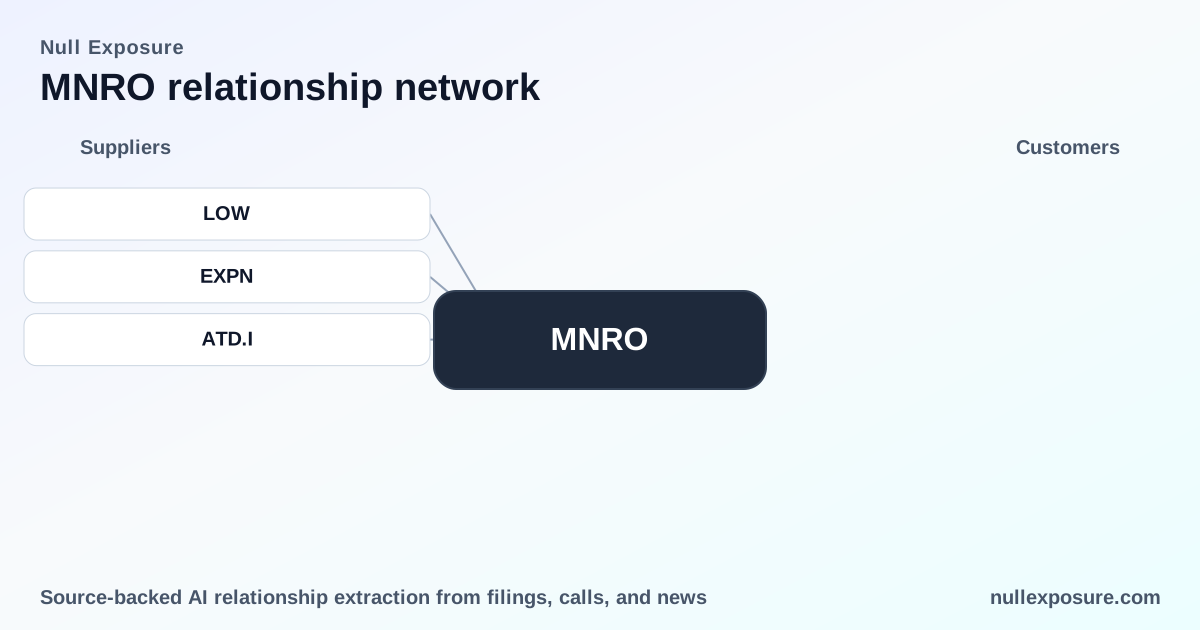
Monro (MNRO) — Supplier relationships, sourcing posture, and concentration risks investors should price
Monro, Inc. operates a national network of automotive service and tire centers and monetizes through retail service revenue and parts sales, centrally procuring inventory and outsourcing certain services via distribution agreements and vendor programs. The company's margin and working capital profile are driven by centralized buying, large distributor contracts for tires, and a supplier financing program that advances hundreds of millions of dollars of payables. This note reviews every supplier relationship surfaced in the latest public records and draws out the operating constraints that matter for procurement risk and supplier continuity. For a deeper signal-driven view of supplier exposure, visit https://nullexposure.com/.
What investors need to know up front
Monro runs a centralized purchasing model with an automatic replenishment system that controls inventory for company-operated stores in near-real time, and it funnels large tire purchases through formal distribution agreements. That structure delivers scale benefits but also creates high vendor concentration and pronounced counterparty risk, because a handful of suppliers account for the overwhelming majority of stocking purchases. For more on supplier concentration and procurement maturity, see https://nullexposure.com/.
The relationships in plain English
Lowe's
Katy, a senior executive referenced on Monro's 2026 Q1 earnings call, has prior senior experience at Lowe's, indicating Monro’s leadership team has retail channel expertise relevant to nationwide store operations. According to Monro’s Q1 2026 earnings call transcript, the executive’s background includes a senior role at Lowe's (2026 Q1 earnings call).
Experian
Monro is offering affected customers complimentary access to Experian IdentityWorks for 12 months as part of its breach response, demonstrating an active vendor relationship for consumer identity protection services. A data-breach notice reported on ClaimDepot in March 2026 describes Monro’s use of Experian IdentityWorks for affected individuals (ClaimDepot, March 2026).
American Tire Distributors (ATD)
Monro maintains an active distribution agreement with ATD under which ATD supplies and sells tires to Monro’s company-owned retail stores, and those stores are contractually required to source at least 90% of certain tire categories through ATD. The company disclosed the distribution arrangement and the purchase requirement in its public filings and Q1 2026 commentary (Monro 2026 Q1 earnings call and related filings).
The operational constraints that shape risk and optionality
The following constraints are company-level signals about Monro’s supplier posture and should factor into any valuation of vendor concentration or supplier disruption risk:
-
Contracting posture — mixed-term exposure. Monro operates with both long-term distribution agreements and short-term payment programs: the company discloses distribution agreements with fixed initial terms that include automatic renewals (initial term running through January 1, 2030, according to an agreement excerpt), while supplier payment programs may provide advance payments and typically reflect payment terms up to 360 days. These arrangements create both long-dated reliance on specific distributors and short-term working capital obligations to financial counterparties.
-
Concentration and criticality — extremely high. Monro reports that its ten largest vendors accounted for roughly 97% of total stocking purchases, with the single largest supplier representing about 47% of stocking purchases in 2025. This is a critical concentration signal: a disruption to a top vendor would materially affect inventory availability and sales.
-
Purchasing control and maturity — centralized and prescriptive. The company operates an automatic replenishment system that centralizes parts selection and purchase for company-operated stores on a near real-time basis, reflecting mature procurement processes that reduce store-level buying variance but increase dependency on centralized vendors and logistics.
-
Role definitions — buyer and distributor relationships are explicit. Monro acts as a centralized buyer for parts and supplies, and it uses distributors (national vendors) to ship most parts directly to stores. Where named, the distribution relationship with ATD is active and prescriptive, with binding purchase minimums for specific tire categories.
-
Spend scale and funding mechanics — large payable financing. Monro reported outstanding supplier obligations eligible for advance payment under its program at approximately $245.5 million as of March 29, 2025, included within Accounts Payable. This indicates material use of supplier financing and reliance on third‑party capital to fund payables.
For a vendor-by-vendor exposure view and a quantified supplier concentration dashboard, visit https://nullexposure.com/.
How these constraints translate into investment considerations
-
Concentration risk is a principal valuation lever. With the top vendor accounting for nearly half of stocking purchases, any counterparty deterioration or negotiation that widens credit terms will compress inventory flow and likely depress same-store sales until alternate sourcing is stood up.
-
Contract tenure reduces short-term optionality on core tires. Contractual sourcing requirements tied to distribution agreements — specifically the ATD 90% purchase threshold on certain tires — lock Monro into long-term purchase flows and limit tactical re-sourcing without incurring breakage or contractual penalties.
-
Working capital programs shift counterparty exposure to financiers. The supplier advance program removes some immediate cash strain but substitutes dependency on funding partners and creates concentrated payable reductions that are eligible for third-party advances, making Monro sensitive to the cost and availability of short-term financing.
-
Operational maturity reduces supplier churn but increases single‑point fragility. The automatic replenishment system creates efficient inventory turns and consistent store fills, improving gross margin stability; however, it amplifies the impact of a vendor outage because replenishment logic assumes reliable supply.
What investors should watch next
- Contract renewals and renegotiation timelines, particularly the expiration cycle tied to the distribution agreement initial term through 2030 and its renewal mechanics; changes here will materially affect procurement flexibility.
- Supplier financing availability and pricing, given the $100m+ spend band and $245.5 million in eligible obligations that reflect ongoing use of advance payment programs.
- Execution on alternate sourcing and inventory buffers if any of the largest vendors soften service levels or increase prices.
For a concise supplier risk scorecard that maps these exposure vectors to financial impact scenarios, check https://nullexposure.com/.
Bottom line
Monro combines mature centralized procurement with high vendor concentration and significant working capital-financing dependency. Those characteristics deliver operational efficiency but also create material supplier and financing risk that should be explicitly modeled in scenarios for revenue continuity and margin pressure. Investors evaluating MNRO should prioritize contract expiration schedules, the durability of the ATD distribution relationship, and the stability of supplier financing arrangements when building out downside cases.