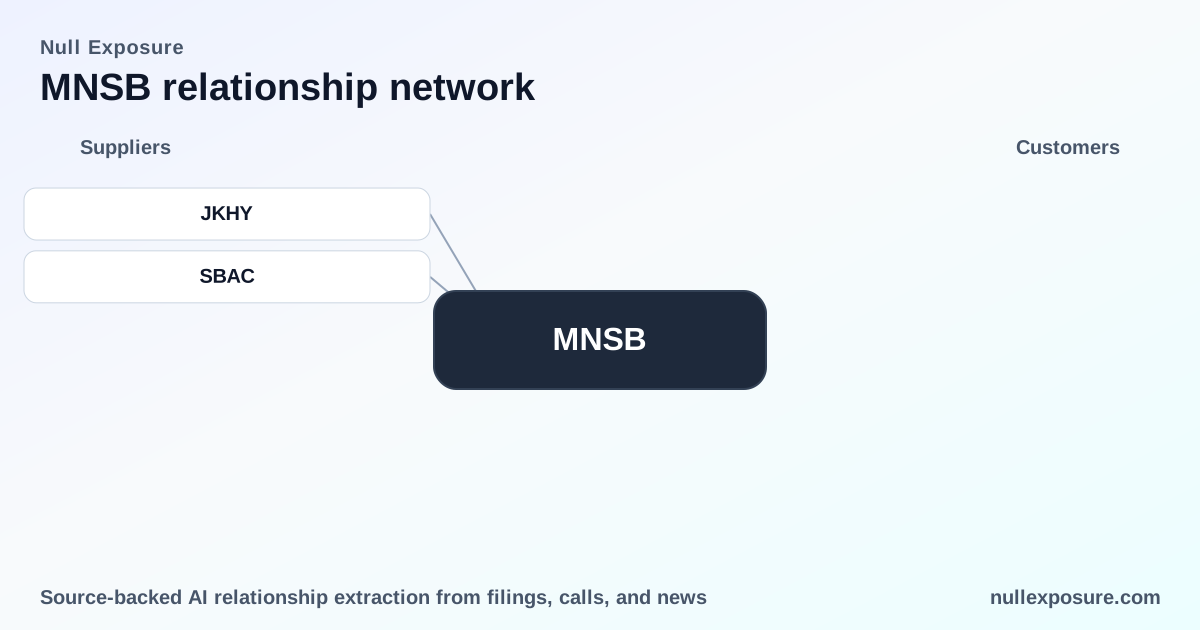
MainStreet Bancshares (MNSB) — Supplier posture and what it means for investors
MainStreet Bancshares operates as a community bank that monetizes through net interest income on its loan portfolio, fee income from banking services and participation in government-backed lending programs. Its operating model depends on outsourced infrastructure and third-party service relationships for core processing and lending channels, which convert into predictable operating leverage when contracts are stable and into execution risk when they are not. Investors should value MNSB both as a lending business and as a buyer of critical vendor services — continuity and contract terms with those vendors are a primary driver of operational risk and capital efficiency. For a concise vendor map and deeper relationship signals, visit https://nullexposure.com/.
Why third parties determine operational runway
MainStreet discloses that it outsources many operational functions and “relies on vendors to provide part of the services we deliver to customers.” The company also flags that a failure of third‑party systems or termination of a critical license could interrupt operations and attract regulatory scrutiny, noting that an inability to replace ineffective providers could damage reputation and results. This is not a peripheral disclosure — the language indicates vendor relationships are mission‑critical to daily processing and customer delivery.
The practical implications are straightforward:
- Contracting posture: MainStreet pursues an outsourcer model for core processing and ancillary services rather than vertically integrating those functions.
- Concentration risk: The firm’s operations are sufficiently dependent on external platforms that a single provider disruption would be material.
- Criticality: Company filings classify the threat of vendor failure as a critical operational risk that can meaningfully affect results.
- Maturity and segmentation: Third parties supply core infrastructure (data processing, network access, core application processing) and services (statement production, armored car services, software amortization), indicating a mixed vendor base spanning mature processors and specialized service providers.
These company‑level signals mean investors need to evaluate contract durability, service‑level commitments, and contingency funding alongside traditional balance‑sheet metrics. For more background and tracked supplier links, see https://nullexposure.com/.
The explicit disclosure that matters
The filing language is blunt: “The failure of these systems, or the termination of a third‑party software license or service agreement on which any of these systems is based, could interrupt our operations.” That is a direct admission that vendor continuity is integral to MainStreet’s ability to serve customers and sustain earnings.
Supplier relationships you must monitor
Below are every supplier relationship surfaced in our review, with plain‑English takeaways and source references.
Jack Henry (JKHY)
MainStreet uses Jack Henry as its core processor and identifies Jack Henry as the largest provider of remote deposit for banks serviced by that core, implying a deep operational integration with Jack Henry’s processing stack and remote deposit capture capabilities. According to coverage of MainStreet Bancshares’ FY2026 earnings call in The Globe and Mail / Motley Fool (March 10, 2026), Jack Henry remains the bank’s principal core processor.
SBA (U.S. Small Business Administration)
MainStreet partners with the SBA to offer 7(a) and 504 lending solutions, which expands the bank’s small‑business lending footprint and provides access to government‑backed credit channels that support fee income and loan growth. A SahmCapital news piece covering MainStreet’s community banking initiatives reported this SBA relationship on February 20, 2026.
What those relationships imply for business economics
The Jack Henry relationship signals that a single established core processor underpins transaction flow and deposit services, which is efficient for scaling payment and deposit operations but concentrates execution risk. The SBA relationship demonstrates MainStreet’s strategy to participate in government‑backed lending programs to diversify loan products and capture fee income tied to guaranteed programs.
Investors should parse three commercial dynamics:
- Operational leverage — outsourcing to Jack Henry reduces fixed IT overhead and accelerates product deployment, enhancing returns on equity when stable.
- Execution risk — heavy dependency on a core processor elevates the importance of contract terms, change‑control provisions, and migration cost estimates.
- Regulatory and credit channel diversification — SBA programs broaden lending distribution and can improve asset quality through government guarantees, but also require specialized origination and servicing capabilities that are frequently vendor‑assisted.
For a holistic supplier risk view and vendor drought modeling, check the main site: https://nullexposure.com/.
Monitoring checklist for investors and operators
To track whether MainStreet’s vendor posture supports its strategy, focus on the following indicators:
- Contract tenure and renewal cadence with core processors and key vendors. Short renewal windows or opt‑outs increase migration and re‑procurement risk.
- Service‑level and disaster‑recovery commitments from processors; documented failover tests and RTO/RPO numbers.
- Concentration metrics: percentage of transaction volume and deposit processing handled by the largest provider versus smaller vendors.
- Contingency readiness: written substitution plans, migration budgets and regulatory notifications on vendor changes.
- Compliance and oversight: internal audit coverage, third‑party risk assessments, and regulator correspondence referencing vendor failures.
- Performance of SBA lending channels: origination volume, default rates on guaranteed loans, and servicing arrangements.
These items are immediate inputs to stress scenarios and valuation adjustments for franchise stability.
Final assessment and action items
MainStreet’s business model benefits from leveraging third‑party infrastructure to scale community banking services with limited fixed IT spend, while simultaneously creating concentrated operational and vendor dependency risks that investors must price. The company’s own filings call vendor failure a critical threat; therefore, diligence on vendor contracts and service continuity is a first‑order item for credit analysts and equity investors alike.
If you want a vendor‑centric risk profile or a consolidated map of supplier relationships for MNSB, visit https://nullexposure.com/ for the vendor dashboards and regulatory linkage analysis.
For investors assessing MainStreet, the actionable priorities are clear: monitor core‑processor stability and contract terms, validate SBA channel economics, and require transparent contingency plans from management. For portfolio teams building event scenarios, vendor disruption should be modeled as an operational shock with both revenue and regulatory cost impacts. Learn more and access the supplier intelligence hub at https://nullexposure.com/.