Monster Beverage (MNST) — supply chain relationships and what they mean for investors
Monster Beverage builds its business by selling branded energy drinks while outsourcing a large portion of production and leaning on strategic distribution and enterprise software partners to scale. The company monetizes through finished‑goods sales to distributors and customers, recognizes revenue at the point control of product transfers, and reduces fixed manufacturing cost and capital intensity by contracting third‑party bottlers and co‑packers. For investors, the mix of contracted supply cover (both short and multi‑year), concentration of critical inputs, and dependence on outsourcers and distribution partners are the principal operational levers that determine margin durability and execution risk. Learn more about supplier exposures and monitoring at https://nullexposure.com/.
How Monster’s operating model shapes supplier risk
Monster runs a lean manufacturing posture: the company outsources the bulk of finished‑goods production to third‑party bottlers and contract packers and maintains a blend of short‑term purchase commitments and multi‑year supply agreements to protect input availability. This contracting posture lowers fixed costs and capex intensity while transferring execution risk to partners — a trade investors must price into margins and downside scenarios.
- Contract maturity profile: The company discloses purchase commitments that are “generally satisfied within one year,” while also holding purchase agreements covering packaging and ingredients for one to four years based on anticipated volumes. That combination delivers tactical flexibility but leaves exposed near‑term commodity and availability swings; at the same time, multi‑year arrangements provide partial forward cover for key inputs (company filing, Dec 31, 2024).
- Concentration and criticality: Monster acknowledges that certain products depend on components or co‑packing services from a limited number of sources; supply disruption for those components would materially affect revenues for affected SKUs if alternatives are not available on commercially reasonable terms (company filing, FY2024 disclosure).
- Service provider role of distributors: Bottlers and distributors sometimes act as co‑packers and take possession of finished goods, making them operationally critical partners in both manufacturing and go‑to‑market functions (company filing, FY2024 statements).
- Named supplier signal: AFF is identified as the primary flavor supplier for Monster Energy drinks and is responsible for developing and manufacturing primary flavors at specific facilities in California and Athy, Ireland (company filing, FY2024).
These characteristics create a supplier profile that balances flexibility with concentration risk; investors should treat Monster as a branded, asset‑light beverage company where margin predictability rests on contracting discipline and partner execution.
The explicit relationships you need in your model
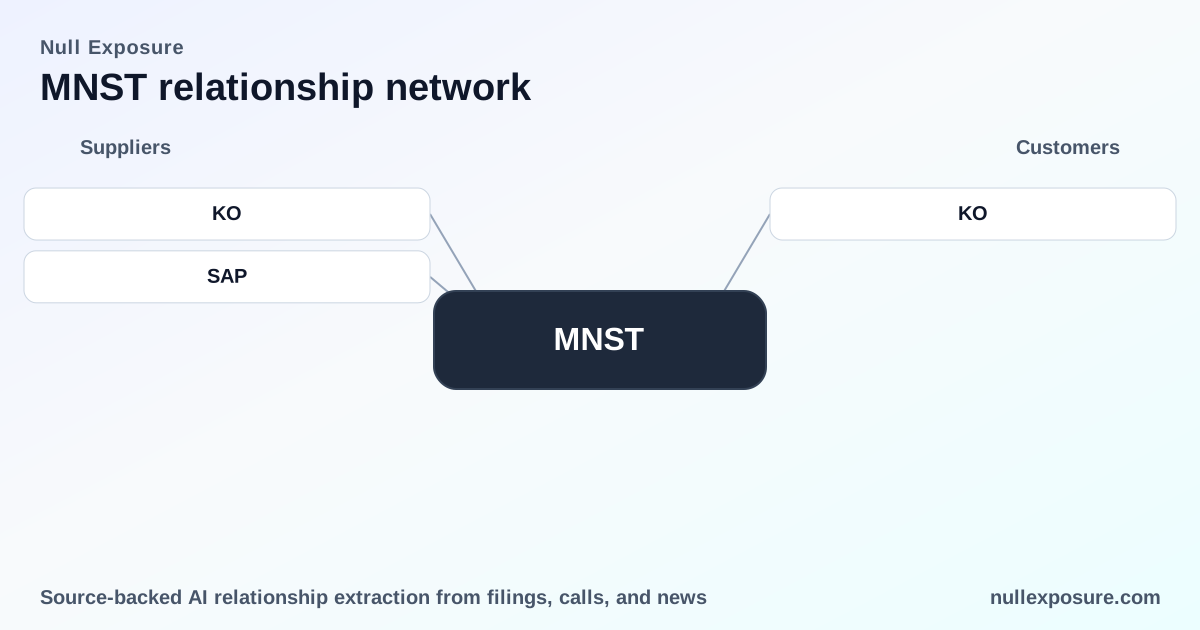
Coca‑Cola (KO): distribution partner that scales reach
Monster uses Coca‑Cola’s distribution network to expand its products beyond the U.S.; this distribution alliance, in place since 2015 for international expansion, materially increases Monster’s global shelf presence and reduces Monster’s own distribution capital requirements. According to a TradingView note dated March 10, 2026, the companies have leveraged Coca‑Cola’s distribution footprint to push Monster products outside the U.S. (TradingView, March 10, 2026).
SAP: ERP modernization to improve operational control
Monster disclosed an enterprise resource planning upgrade to implement SAP S/4HANA with a planned go‑live on January 1, 2028, aimed at improving operational efficiency, scalability and overall business management. The plan was discussed in the company’s FY2026 earnings call transcript and reporting captured by InsiderMonkey in March 2026 (InsiderMonkey, FY2026 earnings call transcript).
AFF and bottlers/co‑packers: flavor supply and outsourced manufacturing (company filing)
AFF is identified by Monster as the primary flavor supplier for Monster Energy, developing and manufacturing key flavor formulations at facilities in California and Athy, Ireland; third‑party bottlers and contract packers produce the majority of the finished goods and sometimes act as co‑packers for distribution partners (company filing, FY2024–FY2025 disclosures).
What the relationship map means for valuation and risk
Monster’s supplier mix and partner strategy have immediate implications for revenue volatility, margin sustainability, and capital allocation.
- Revenue recognition and distribution economics: Monster recognizes most revenue when control of finished goods transfers to customers; when bottlers and distributors act as co‑packers, operational control and logistics become central to cash conversion and working capital management (company filing, FY2024). Investors should model potential margin compression from higher co‑packer charges or freight cost pass‑throughs.
- Procurement and working capital signal: Purchase commitments aggregated to approximately $415.9 million at Dec 31, 2024, indicating meaningful near‑term contracted spend and forward coverage for raw materials; this level of commitments is a clear working‑capital factor to include in cash‑flow scenarios (company filing, Dec 31, 2024).
- Concentration risk as a downside amplifier: The explicit admission that certain products rely on a limited set of sources is a structural downside risk. A supply disruption at a key flavor or packaging supplier could meaningfully reduce revenue for the affected SKUs unless Monster can source replacements quickly and economically (company filing, FY2024).
- Technology program risk and upside: The SAP S/4HANA implementation is a multi‑year systems project that will improve scalability and data quality when complete, but execution risk during rollout can temporarily distract operations or create reporting noise; investors should model both possible cost reductions and short‑term implementation costs (InsiderMonkey, FY2026).
If you want deeper mapping of supplier concentrations and contract tenors to stress test revenue and margin scenarios, visit https://nullexposure.com/ for tailored exposure reports.
Actionable takeaways for investors and operators
- Prioritize monitoring of key suppliers (AFF, primary packaging providers and major co‑packers) and track any signals of service disruption or capacity constraints; these relationships are critical to SKU availability (company filing, FY2024).
- Stress test gross margin under scenarios where short‑term purchase commitments roll at higher commodity prices and where one or two concentrated suppliers reduce capacity; the documented mix of short‑ and multi‑year contracts informs realistic shock propagation timelines (company filing, Dec 31, 2024).
- Treat the Coca‑Cola distribution relationship as strategic for international growth, and model upside from expanding shelf presence alongside downside if distribution terms evolve (TradingView, March 10, 2026).
- Build implementation contingencies around the SAP rollout to avoid one‑off operating disruptions; model both cost savings and transitional expense in 2026–2028 (InsiderMonkey, FY2026 earnings call transcript).
For a hands‑on supplier exposure brief tailored to MNST and comparable beverage brands, see the coverage tools at https://nullexposure.com/.
Monster’s operating model — outsourcing production, selectively locking in inputs, and leveraging distribution partners — produces a capital‑efficient business with concentration and execution risk that are measurable and manageable when actively monitored. Investors who price the company should quantify the effects of input commitments, co‑packer dependence, and the ongoing ERP implementation on margins and cash flow.