Montauk Renewables (MNTK) — Supplier relationships, contractual posture, and what investors should price
Montauk Renewables operates and monetizes renewable natural gas (RNG) and renewable electricity production by locking output to long-term fuel supply agreements and property leases; the company secures feedstock through multi-decade contracts and sells energy under long-duration offtake terms that convert asset production into predictable cash flow. For investors and operators, the core thesis is simple: Montauk’s revenue profile is deliberately contracted and concentrated — durable cash flows in exchange for counterparty and supplier concentration risk.
Explore supplier intelligence and relationship mapping at the NullExposure homepage: https://nullexposure.com/.
The public record: what recent press releases disclose about named partners
Montauk’s most recent press distribution lists external contacts and the channel used to distribute investor communications. This section summarizes every named relationship pulled from public notices so investors can track communications, PR channels, and listed third parties.
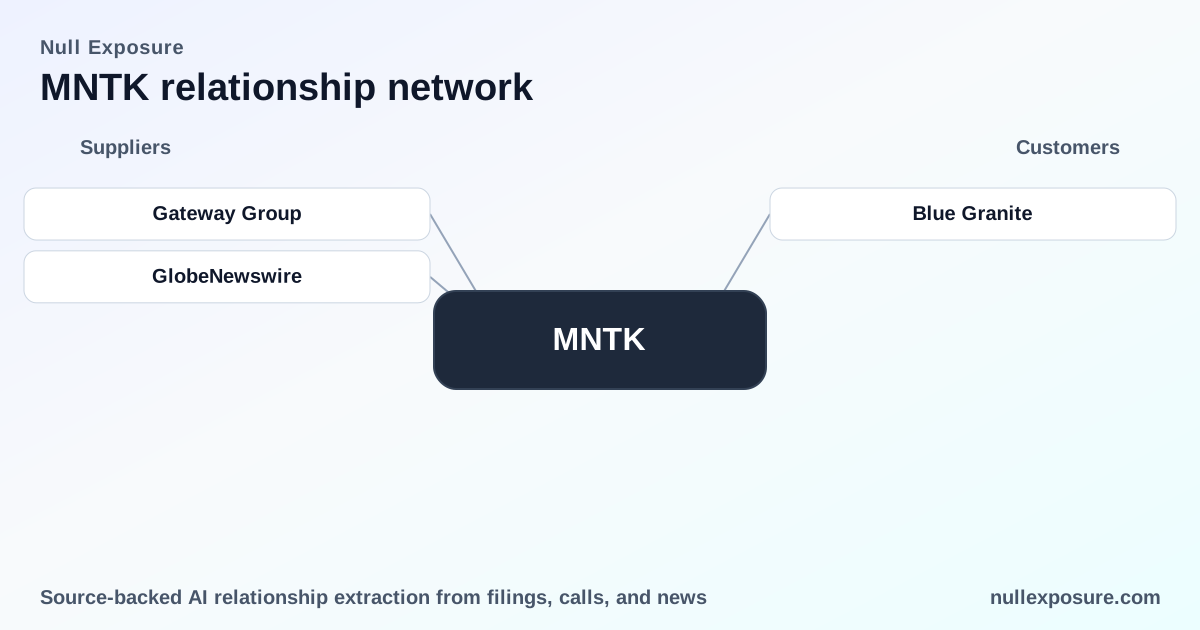
Gateway Group — investor relations contact listed for the Q3 2025 results call
QuiverQuant’s distribution of Montauk’s conference call announcement identifies Gateway Group and names Georg Venturatos as the investor relations contact for the Q3 2025 financial results call; this positions Gateway Group as Montauk’s external IR or communications contact for that event. See the QuiverQuant news item distributed March 10, 2026: https://www.quiverquant.com/news/Montauk+Renewables,+Inc.+to+Host+Third+Quarter+2025+Financial+Results+Conference+Call+and+Webcast+on+November+6.
GlobeNewswire — distribution channel for the press release
The same QuiverQuant posting explains the press release content originated via GlobeNewswire and includes a disclaimer that the text is an AI-generated summary of the GlobeNewswire release, indicating GlobeNewswire served as the distribution platform for Montauk’s investor communication. See the QuiverQuant news item distributed March 10, 2026: https://www.quiverquant.com/news/Montauk+Renewables,+Inc.+to+Host+Third+Quarter+2025+Financial+Results+Conference+Call+and+Webcast+on+November+6.
What the company-level constraints reveal about operating model and supplier risk
Montauk’s public disclosures surface multiple, linked constraints that define how the business contracts and where operational leverage sits. These are company-level signals investors should incorporate into valuation and counterparty diligence.
-
Long-term contracting is the default posture. Montauk reports that approximately 92% of its 2024 renewable electricity production and 69% of its 2024 RNG production are monetized under fuel supply agreements with expirations greater than 15 years from December 31, 2024. The company also states it typically secures biogas feedstock via long-term fuel supply agreements and property lease agreements. This demonstrates an intentional strategy to convert physical production into long-dated contracted revenue, reducing short-term merchant exposure while increasing dependency on counterparties over many years.
-
Supplier relationships are material to operations. Management explicitly warns that failure to maintain third‑party provider relationships, or to secure adequate replacements, could adversely affect the ability to deliver products and solutions and harm results of operations. That language signals materiality: suppliers and contractors are not peripheral — they are integral to delivering contracted output and cash flow.
-
Dual operational roles create multi-vector dependencies. Montauk discloses reliance on third parties both as manufacturers (components and products must meet design specs) and as service providers (technology, infrastructure, and software hosting are outsourced). This combination elevates both supply‑chain risk for physical components and operational risk for hosted systems and external service delivery.
Together, these constraints describe a company that trades commodity risk for counterparty and supplier concentration risk: stable, long-dated revenues on the upside; concentrated external dependencies and replacement risk on the downside.
Explore deeper supplier profiles and relationship intelligence at NullExposure: https://nullexposure.com/.
Risk implications investors and procurement teams should price in
From a valuation and operational resilience perspective, the constraint set produces four clear risk lenses:
-
Counterparty credit and replacement risk. Long-dated offtakes are only as secure as counterparties and the enforceability of contracts; monitor counterparty balance sheets and collateral/credit support provisions.
-
Concentration and rollover risk. While >15-year agreements lock revenue, they also concentrate replacement exposure around fewer counterparties and future maturity cliffs.
-
Supply-chain and manufacturing execution risk. Reliance on third-party manufactured components creates single-point failure modes for operations and maintenance cycles.
-
Service-provider technology risk. Outsourced hosting and platform dependencies make continuity plans, SLAs, and vendor redundancy essential.
These are not hypothetical cautions — Montauk’s own disclosures flag them as material. Underwrite scenarios that stress counterparty default, protracted supply interruptions, and technology outages when modelling downside outcomes.
Practical due-diligence checklist for operators and investors
For investors performing counterparty diligence or operators negotiating supplier contracts with Montauk, prioritize these actions:
- Require transparency on counterparty credit (financials, guarantees, escrow arrangements).
- Map who supplies critical components and which subcontractors perform key construction and O&M functions.
- Insist on contractual redundancy and defined replacement paths for feedstock and critical services.
- Include performance warranties, liquidated damages, and step-in rights where feasible.
- Monitor contract expirations and clustering to anticipate future re-contracting risk.
Final read: what to take to the boardroom
Montauk’s commercial model converts renewable output into contractualized revenue via long-term fuel supply and lease agreements; this is a strength for cash-flow stability and a structural source of concentration risk. Investors should value the predictability but actively quantify counterparty, supplier, and technology dependencies. Public notices show Montauk uses established PR channels and external IR support — operational and communications relationships investors should track alongside commercial counterparties.
For a structured supplier-risk assessment and to compare Montauk’s partner map with peers, visit NullExposure for full relationship intelligence: https://nullexposure.com/.