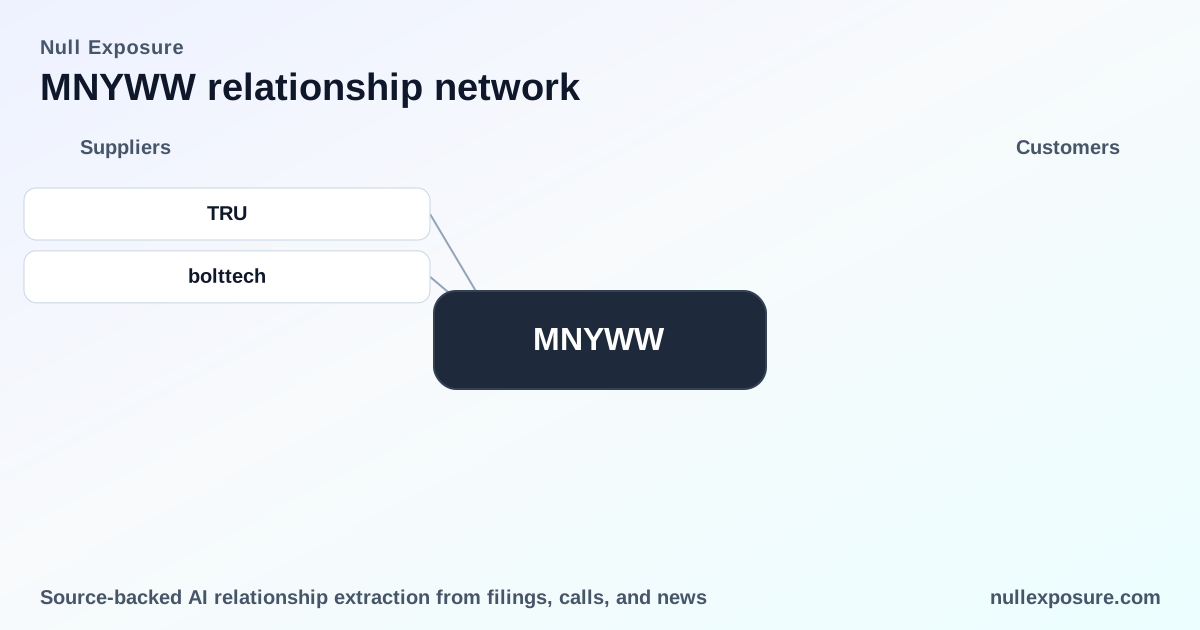
MoneyHero (MNYWW) — Supplier relationships that steer monetization and product distribution
MoneyHero operates a consumer-facing personal finance comparison platform headquartered in Singapore and monetizes primarily through partner commissions, lead-generation fees and product integration agreements with financial-services providers. The warrants ticker MNYWW represents investor exposure to that franchise; operating economics are driven by traffic conversion, product mix (insurance, lending, wealth) and the depth of integrations with third-party data providers and insurers. For investors assessing supplier risk, the company’s commercial partners directly affect revenue per user and product economics—so treat partner architecture as a principal value driver.
For a broader view of supplier exposures and to track counterparty signatures, visit https://nullexposure.com/.
How MoneyHero runs the business and turns traffic into revenue
MoneyHero aggregates consumer choices across insurance, loans, credit cards and savings products and routes customers to providers that pay referral fees or take commercial placements. The platform’s gross profit of $17.3M on $69.2M of trailing revenue confirms that the company executes a scale referral model, but operating loss and negative EBITDA indicate that conversion economics and marketing investment remain material headwinds. The company’s public figures show flat top-line growth (quarterly revenue growth YOY ~0.9%) and a negative profit margin (-34.5%), positioning the firm as revenue-generative but not yet cash-flow positive.
Key commercial characteristics that investors should internalize:
- High dependency on partner flow: product providers and data partners feed the inventory that converts traffic to revenue. Partner economics control take rates and lifetime values.
- Concentration sensitivity: low reported institutional and insider ownership (both listed as 0%) suggests shareholder base and disclosure patterns that can amplify governance and financing risks.
- Early monetization in product verticals: partnerships expanding into insurance and wealth indicate the company is shifting from pure comparison to deeper product journeys, which increases revenue per user if execution holds.
Explore supplier exposures and partner-level risk signals at https://nullexposure.com/ to augment your diligence.
Supplier relationships that matter today
The publicly surfaced supplier relationships for the MNYWW supplier scope show two notable partners revealed in FY2025 commentary. Both relationships are commercially material because they expand monetizable customer journeys beyond simple comparison listings.
TransUnion — credit-data partnership embedded in product-tiering
MoneyHero launched the Credit Hero Club in cooperation with TransUnion to enhance user engagement and monetize through personalized recommendations and credit-product matching based on bureau insights. According to a Q1 2025 earnings-call transcript summary published by FutuNN in March 2026, the integration is designed to increase conversion and allow more targeted product offers from lending partners (see https://news.futunn.com/en/post/58001149/moneyhero-limited-mny-q1-2025-earnings-call-transcript-summary).
Why it matters: embedding a major credit bureau raises both conversion potential and regulatory/compliance demands; TransUnion is a strategic data supplier that increases product relevance and monetization per user.
bolttech — insurance distribution and end-to-end journeys in Hong Kong
MoneyHero deepened a strategic partnership with bolttech to provide end-to-end car insurance purchase journeys in Hong Kong, extending the company’s ability to host full transaction flows rather than simple referrals. The Q1 2025 earnings-call transcript summary (FutuNN, March 2026) highlights expanded product offerings in both wealth and insurance, with bolttech cited as a key partner for insurance distribution (see https://news.futunn.com/en/post/58001149/moneyhero-limited-mny-q1-2025-earnings-call-transcript-summary).
Why it matters: moving to an end-to-end insurance purchase increases revenue per transaction and control over customer experience, but it also elevates operational complexity and integration risk.
Operational posture and company-level constraints
There are no explicit third-party constraint excerpts provided for individual supplier relationships; therefore, constraints should be interpreted as company-level signals drawn from the corporate profile and financials.
- Contracting posture: The evidence of strategic co-branded products and end-to-end journeys indicates active, revenue-sharing partnerships rather than one-off referral arrangements. This posture improves monetization upside but increases dependency on partner SLAs and integration quality.
- Concentration: Only a few named partners surfaced in public FY2025 materials, implying concentration risk at the commercial level; a handful of deep partners control meaningful conversion pathways.
- Criticality: Partners like TransUnion are mission-critical because credit-data is foundational to lending product matching; bolttech is critical for insurance distribution in important regional markets.
- Maturity: The relationships are in a growth and deepening phase in FY2025 — commercially advanced but operationally immature relative to fully integrated insurance or banking platforms, given the company’s continuing negative EBITDA and the transition toward transaction-based journeys.
These company-level constraints signal that investors should evaluate partner contract terms, termination provisions, and data-sharing agreements as part of any material diligence.
What this means for valuation, risk and upside
MoneyHero’s partner-driven model offers a clear path to uplift revenue per user through deeper product journeys, but the mixture of negative profitability (-34.5% profit margin), negative EBITDA, and modest revenue growth implies that partnerships must scale quickly and efficiently to justify any multiple expansion. Key risk vectors:
- Partner concentration: reliance on a small set of suppliers increases counterparty risk and negotiating leverage held by partners.
- Operational integration: moving from referrals to end-to-end transactions raises execution risk and operational capital requirements.
- Regulatory and data controls: bureau integrations create compliance obligations that raise cost of goods sold and legal exposure.
Investors should prioritize diligence on contract economics (commissions vs. revenue share), termination clauses, and historical conversion lifts from partner integrations.
If you want a partner-risk scorecard or a deeper exposure map for MNYWW supplier relationships, get detailed supplier intelligence at https://nullexposure.com/.
Bottom line and recommended actions
MoneyHero has progressed from product listing to deeper, revenue-bearing partnerships with players like TransUnion and bolttech; these relationships materially influence both upside and downside. For investor due diligence:
- Demand visibility into partner contract terms and demonstrated conversion uplift.
- Model scenarios where partner economics improve conversion by 10–30% to test valuation sensitivity.
- Monitor operating cash flow and EBITDA trajectory as partnerships scale to end-to-end product flows.
For ongoing tracking of supplier dependencies and counterparty risk frameworks for MNYWW, visit https://nullexposure.com/ and incorporate partner-level clauses into your investment memo.