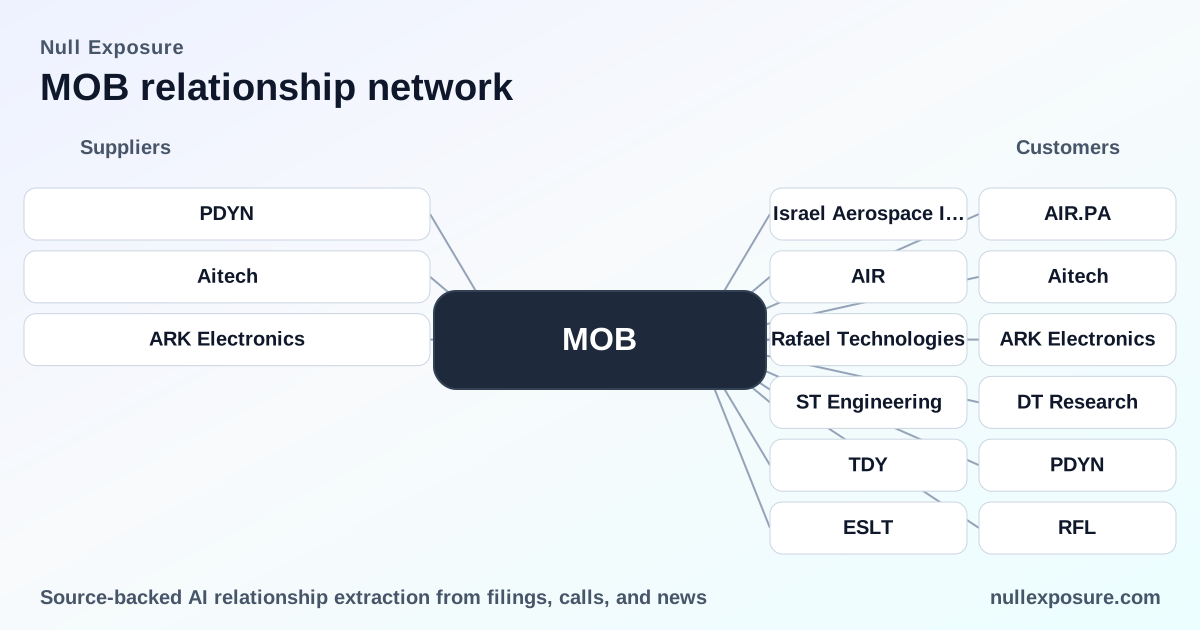
Mobilicom (MOB): Partner-led growth in secured autonomy for drones and robotics
Mobilicom monetizes by bundling its OS3 cybersecurity software and SkyHopper radio platforms with partner hardware and systems integrators, selling integrated compute-network-security solutions to defense, public-safety, and commercial drone/robotics customers. Revenue is driven through product sales, software licensing and recurring services delivered alongside strategic OEM and U.S. supply-chain partners — an operating model that converts engineering IP into higher-margin integrated offerings rather than standalone commodity hardware. For an investor or operator evaluating supplier relationships, the priority is how these partnerships convert into addressable revenue growth, U.S. market access, and scope for recurring software economics. Learn more about supplier-risk analysis and partner intelligence at https://nullexposure.com/.
How Mobilicom’s commercial strategy reads to investors
Mobilicom is a small-cap, R&D-heavy vendor that packages software-defined radios, cybersecurity (OS3) and system integration into branded compute-network-security stacks targeted at the UAS/robotics market. The company’s reported TTM revenue of approximately $2.8M against negative EPS and margins indicates early commercial scale: Mobilicom is monetizing innovation but remains pre-profitability, so partner-driven distribution and U.S. defense endorsements materially affect valuation and growth trajectories.
Key financial signals:
- Market capitalization roughly $65.8M with negative EPS and operating margins, showing technology investment outpacing current revenue.
- High valuation multiples relative to revenue (Price/Sales ~23x; EV/Revenue ~21x), reflecting investor expectations for rapid scaling if partnerships convert to sustained sales.
- Low institutional ownership (≈2.4%) and meaningful insider stake (≈15%), indicating concentrated ownership and potential sensitivity to execution and messaging.
Partnerships and product integrations that matter now
Mobilicom’s strategy is execution through integration partners: it licenses OS3 and bundles SkyHopper radios into partner compute stacks and UAS platforms. The recent announcements represent critical channels into the U.S. defense and commercial markets and are the primary near-term levers for revenue expansion.
Palladyne AI Corp.
Mobilicom and Palladyne agreed to bundle Palladyne’s neuro-symbolic AI software with Mobilicom’s OS3 cybersecurity solution, creating a combined AI-plus-security offering for embodied systems. This positions Mobilicom to capture higher-value software-integrated sales where AI processing and cybersecurity are sold as complementary capabilities. According to a Yahoo Finance press release dated March 10, 2026, each party will offer the bundled solution to their respective customers.
Aitech
Mobilicom announced a joint product, the Compute PRO-AT, combining Mobilicom’s OS3 cybersecurity software with Aitech’s NVIDIA-based AI compute systems, marketed as a Secured Autonomy™ compute solution to reduce cyber risk in UAS deployments. This is a strategic OEM integration that places Mobilicom on certified compute platforms used by defense and enterprise customers. The announcement was detailed in Mobilicom’s corporate update on November 13, 2025 on GlobeNewswire.
ARK Electronics
Mobilicom partnered with ARK Electronics to deliver a cybersecure platform that pairs Mobilicom’s SkyHopper PRO radios and OS3 cybersecurity with ARK’s U.S.-made Jetson PAB Carrier (NVIDIA-powered), both BlueUAS-listed for defense procurement. This partnership gives Mobilicom a fully U.S.-sourced hardware/software stack, improving eligibility for U.S. government programs, as described in Mobilicom’s November 13, 2025 GlobeNewswire release.
What these relationships imply for supplier risk and upside
These three integrations share a clear commercial thesis: Mobilicom converts technology IP into addressable, defense-eligible systems through partnerships with compute and hardware OEMs. For investors and procurement teams evaluating supplier relationships, several operating-model characteristics follow.
- Contracting posture: Mobilicom operates as a licensed-software and integration supplier that typically sells bundled solutions through OEM partners and system integrators rather than as a primary prime contractor. That posture reduces direct program-management burden but increases dependence on partner execution and sales channels.
- Concentration: Company revenue is modest today, so each major OEM or channel partner represents outsized importance to near-term growth; the ARK and Aitech integrations are particularly critical for U.S. expansion because they combine BlueUAS listings and U.S.-made components.
- Criticality: Mobilicom’s value lies in cybersecurity and communications for autonomous platforms; for programs that prioritize resilience and secure comms, Mobilicom’s stack is a differentiator and therefore strategically critical to an integrator’s offering.
- Maturity: Mobilicom is early commercial — productized, with partners delivering integrated SKUs, but financials show ongoing investment and negative margins. That profile implies execution and order-book growth will determine whether current partnerships translate into repeatable, recurring revenue.
For procurement and risk teams, the logical questions are: who holds prime liability on contracts that include Mobilicom technology; how are support and lifecycle obligations shared; and how dependent are delivery schedules on partner component supply-chains?
Learn how to model supplier concentration and contractual exposure in your vendor portfolio at https://nullexposure.com/.
Risks that investors should prioritize
- Execution risk: Mobilicom’s small revenue base means any partner sales shortfall creates outsized pressure on financial performance.
- Dependency on partner certifications and U.S. supply-chain credentials: ARK’s U.S.-made carrier and BlueUAS listings materially affect addressability in defense markets; loss or delay of these approvals would constrict channels.
- Valuation sensitivity: With high Price/Sales and EV/Revenue multiples, market expectations are already priced for growth; disappointment in partner conversions would compress the premium quickly.
Practical takeaways for investors and operators
- Partnerships are the primary channel for Mobilicom to scale; Aitech and ARK are tactical entries into compute-led and U.S.-compliant markets, while Palladyne brings complementary AI capabilities that enhance the value of Mobilicom’s OS3.
- Monitor order intake and partner-level revenue attribution — the cadence of OEM-integrated shipments is the clearest short-term signal of sustainable growth.
- For procurement teams, clarify support, compliance, and liability splits in any contract that embeds Mobilicom’s software or radios to avoid downstream program risk.
If you’re assessing supplier concentration or want a deeper partner-risk scorecard for MOB, start with a supplier intelligence engagement at https://nullexposure.com/.
Closing assessment
Mobilicom’s current trajectory is textbook for a specialist embedded-systems supplier: strong IP, strategic OEM partnerships, and an emphasis on U.S. market access through certified hardware alliances. The upside is meaningful if partner integrations turn into recurring, defense-eligible sales; the downside is execution risk inherent in a small, pre-profit company priced for growth. For investors and operators, the near-term focus should be concrete sales conversion from the Aitech, ARK and Palladyne collaborations and the contractual clarity around support and compliance for defense programs.