MOBBW (Mobilicom Limited Warrants): Supplier relationships, operational signals, and investment implications
Mobilicom Limited operates as a provider of mission-critical communications solutions for drones, robotics, defense, mining, and security customers. The company monetizes through hardware sales, embedded software licensing (including its OS3 cybersecurity stack), and partnership-driven solution bundles; MOBBW is the listed warrants instrument tied to Mobilicom equity exposure. For investors and operators assessing supplier relationships, the primary analytical question is how those partnerships expand addressable markets and embed Mobilicom’s stack into downstream mission flows—thereby converting product sales into recurring, higher-margin services. For an active review of supplier positioning and supplier-driven risk, visit https://nullexposure.com/.
Quick financial snapshot and what it implies for supplier risk
Mobilicom’s reported figures show a Market Capitalization of $688.9 million with Revenue TTM of $2.83 million and Gross Profit TTM of $1.63 million, while operating and net margins are negative. The company exhibits high volatility (beta ~2.1) and a very wide bid between retail float (6.86 million shares) and total shares outstanding (321.94 million), consistent with a warrant structure and thin underlying float for common shares.
- Implication for supplier relationships: Mobilicom must rely on strategic partnerships to scale revenue rapidly and improve margin leverage; supplier and integration agreements are therefore commercially critical to achieving profitable unit economics.
- Warrant-specific consideration: MOBBW holders have leveraged exposure to equity upside but limited direct claims on cash flows; supplier-driven revenue acceleration is the practical path to warrant value realization.
Why supplier relationships matter for MOBBW investors and operators
Supplier and partner ties translate into two concrete drivers of value for Mobilicom: (1) distribution and integration reach—partners bundle Mobilicom technology into larger solutions sold to defense and enterprise customers; and (2) technology complements—partners that supply AI, autonomy, or cybersecurity capabilities increase Mobilicom’s product stickiness and open recurring revenue channels. Given Mobilicom’s current scale, a single meaningful partnership can materially change growth trajectory and investor sentiment.
Visit https://nullexposure.com/ for deeper supplier mapping and exposure analytics.
How partnerships move the needle
- Partnerships that embed Mobilicom’s OS3 and communications middleware directly into operator workflows increase switching costs and create predictable upgrade cycles.
- Bundling agreements that cross-sell third-party AI or autonomy stacks with Mobilicom hardware convert one-off hardware sales into integrated system contracts—improving potential gross margins and creating program-level revenues.
Supplier relationships on record
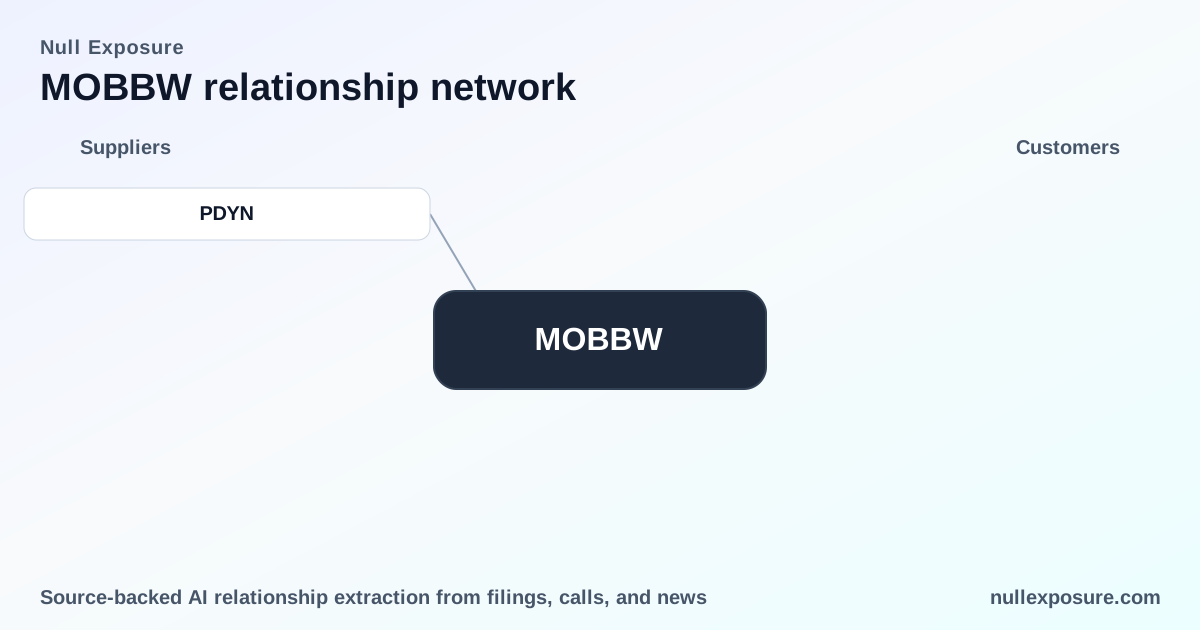
The universe of supplier relationships returned for MOBBW contains one documented partner in the available results.
Palladyne AI Corp. — Mobilicom will bundle PalladyneAI’s embodied neuro-symbolic artificial intelligence software with Mobilicom’s OS3 cybersecurity software to deliver integrated, cybersecure autonomy offerings. This is a product-level partnership designed to combine Palladyne’s autonomy stack with Mobilicom’s operational security and compliance features. According to a news report published on Futunn on 10 March 2026, the companies will offer mutually bundled solutions to target autonomy deployments in contested and safety-critical environments. (Source: Futunn news, 2026-03-10.)
This single recorded relationship indicates Mobilicom’s strategy of packaging third-party autonomy and AI capabilities alongside its own communications and cybersecurity stack to create end-to-end solutions for customers in defense and industrial robotics.
Operational constraints and company-level signals investors should read as facts
The constraints data returned for MOBBW is empty; no explicit contractual limitations or supplier-specific redactions were included in the source set. Absent explicit constraints, the following company-level operational signals are present and relevant:
- Contracting posture: Mobilicom’s commercial posture is partner-driven and solution-centric rather than purely OEM hardware sales. Partnerships are structured to produce bundled offerings that sell to operator customers and systems integrators.
- Concentration risk: With few publicly recorded supplier relationships in this crop of results, Mobilicom’s growth depends on selectively deep partnerships instead of a broad vendor base, implying single-partner outcomes can be material.
- Criticality of suppliers: Partners that contribute autonomy or cybersecurity technology are functionally critical because they materially increase Mobilicom’s product value and accelerate adoption by defense and regulated industries.
- Maturity and scale: Financials indicate early revenue scale and negative operating metrics; Mobilicom is at a stage where partnerships are more important for go-to-market acceleration than for incremental cost reduction.
These signals are company-level and do not assert contractual specifics for any named partner.
What this means for investors and operators — risk and opportunity
- Opportunity: The Palladyne AI partnership is a blueprint for scaling: combining third-party AI with Mobilicom’s OS3 creates a differentiated product bundle that targets high-fee, mission-critical procurement cycles. For warrant holders, successful deployment and customer wins from such bundles are the direct vector for meaningful equity appreciation.
- Risk: Concentrated dependency on a small number of deep partners raises execution risk. If a partner relationship fails to convert into program wins, revenue growth will remain constrained and the warrant’s leverage to positive equity moves will be muted. Additionally, a small free float and warrant mechanics increase market sensitivity to news flow about partner contracts.
- Operational focus: Mobilicom must translate partnership announcements into binding systems-of-record customer contracts and demonstrate repeatable procurement uptake across defense and industrial verticals.
Tactical takeaways for due diligence
- Request evidence of signed framework agreements and early order commitments that reference bundled deliveries and service-level obligations. Public announcements without contract backstops do not move revenue recognition.
- Verify technical integration roadmaps and field trials that show the combined stack operating under OS3 security constraints in target environments; these are the triggers that convert prospective customers into program buyers.
- Assess dependency concentration: quantify how much of the prospective revenue pipeline relies on any single partner and stress-test scenarios where partner performance lags.
For a detailed supplier exposure map and to track partnership progress against program milestones, consult https://nullexposure.com/.
Final takeaway and next steps
Mobilicom’s supplier strategy is intentionally concentrated and partner-centric; partnerships like the one with Palladyne AI are the primary mechanism for converting product capability into commercial scale. MOBBW traders and operators should value partnership announcements by their contractual depth and program-stage evidence rather than headline collaboration alone.
If you want a structured monitoring plan for supplier-driven catalysts and a running log of Mobilicom partnership milestones, start here: https://nullexposure.com/.
Bold, trackable partnerships will determine whether Mobilicom moves from proof points to platform economics—MOBBW’s value depends on that transition.