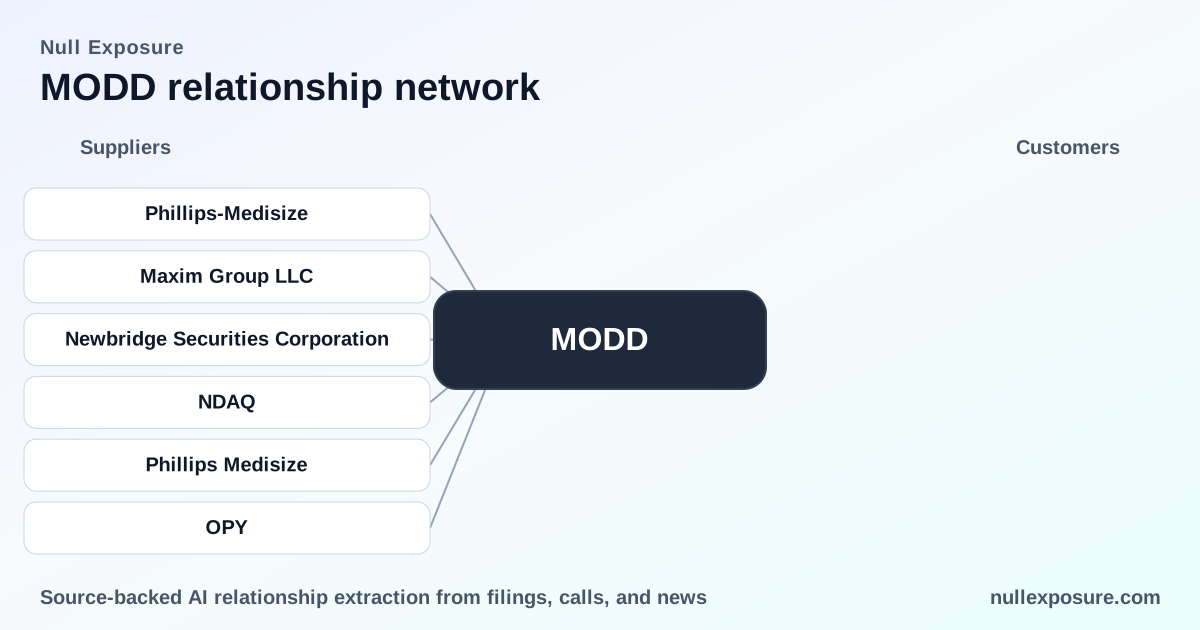
Modular Medical (MODD) — supplier relationships, capital partners and operational constraints investors should price in
Modular Medical designs and develops a next‑generation insulin pump system and monetizes through product sales of pumps and disposables plus licensing arrangements; today it is a development-stage company with no product revenue and a capital‑markets funding model to finance R&D and scale manufacturing. The company outsources critical production capabilities to tier‑one contract manufacturers and uses placement agents and bookrunners for frequent equity raises, creating a business model that is manufacturing‑dependent, capital‑intensive, and concentrated around a small set of external partners. For an operator or investor assessing supplier exposure, these linkages define where execution and dilution risk concentrate; explore further at https://nullexposure.com/.
How the relationship map shapes the investment thesis
Modular Medical’s commercial prospects rest on two operational pillars: manufacturing scale for lower unit cost and capital markets access to cover development and pre‑revenue cash burn. Company filings and press coverage make the posture clear:
- The firm is in active development with zero reported revenue and negative EBITDA, so external manufacturing and financing relationships are functionally critical to delivery and runway.
- Contracting posture is a mix of licensed technology obligations and outsourced manufacturing — the company has a license fee obligation (
$400k remaining over three years) and substantial purchase orders for machinery and equipment ($1.5M outstanding as of March 31, 2025). - Spend concentration is moderate but meaningful: discrete license fees put vendor spend in the $100k–$1M band, while capital equipment commitments sit in the $1M–$10M band, signaling a step‑up in fixed investment as the company scales.
These signals describe a supplier ecosystem that is relatively immature but active, where vendor performance and capital availability determine the company’s ability to transition from development to commercial scale.
Supplier and financing relationships you must evaluate
Phillips‑Medisize / Phillips Medisize — contract manufacturer partner
Modular Medical has contracted Phillips‑Medisize (a Molex company) to provide design, development and high‑volume manufacturing capabilities, positioning a tier‑one medical‑device partner to manage production scale‑up and lower unit costs. According to Medical Design & Outsourcing (March 2026) and TradingView’s coverage of the company’s FY2025 filings, Phillips‑Medisize is the cornerstone manufacturing partner for bringing the MODD1/Pivot transition into higher volumes.
Maxim Group LLC — placement agent for recent equity
Maxim Group LLC acted as the sole placement agent on a $12.0 million public offering priced in FY2026, indicating that Modular Medical uses boutique capital markets intermediaries to access near‑term equity funding. AccessNewswire reported the placement agent role in March 2026.
Newbridge Securities Corporation — bookrunner on prior financing
Newbridge Securities Corporation served as sole bookrunner on a $4.68 million public offering in FY2025, demonstrating a pattern of repeated equity raises with small underwriting syndicates to fund operations. This role was noted in company announcements covered by AccessNewswire and FinancialContent in late 2025.
Nasdaq — listing venue and earlier IPO context
Modular Medical planned its Nasdaq listing under the symbol MODD during its public offering process in FY2022, a milestone that provided access to public capital markets and the visibility necessary for subsequent secondary offerings. Renaissance Capital covered the IPO terms in the FY2022 period.
Oppenheimer & Co. — IPO bookrunner (historical)
Oppenheimer & Co. acted as the sole bookrunner on the company’s IPO transaction in FY2022, linking Modular Medical to a traditional investment‑bank route for its initial public listing as reported by Renaissance Capital. That underwriting relationship was an early signal of institutional distribution capability.
(Note: both Phillips‑Medisize entries and the multiple Newbridge mentions reflect repeated reporting of the same counterparty roles across different filings and press releases; each citation covers the relevant filing or press date.)
What the constraints say about operational risk and supplier criticality
Company‑level disclosures give a clear picture of contracting terms and exposure:
- Licensing commitments: Modular Medical carries an explicit licensing obligation (approx. $400k remaining over three years) tied to a device integration agreement with a connected‑care provider, which creates a mid‑size contractual liability that reduces available free cash flow. This is a company‑level signal, not tied to a named vendor in the excerpt.
- Manufacturing posture: The company intends to manufacture core pump components in‑house while sourcing infusion sets from third parties and has documented plans to scale production through a contract manufacturer — a hybrid manufacturing model that concentrates operational risk on a small number of external producers.
- Service‑provider usage: Multiple issuances of equity to service providers (consulting, market research) indicate active reliance on external services for commercialization and validation, consistent with a development‑stage go‑to‑market approach.
- Spend profile: Documented obligations place vendor spend in the $100k–$1M and $1M–$10M bands for license fees and capital equipment respectively, signaling meaningful near‑term cash commitments that will be critical as manufacturing ramps.
Taken together, these constraints define a supplier matrix that is critical (manufacturing and licensing), concentrated (few tier‑one partners), and early‑stage (active development, increasing R&D and manufacturing bring‑up costs).
Investment implications and actionable due diligence
- Operational due diligence: Prioritize audit of the Phillips‑Medisize manufacturing agreement, capacity commitments, quality‑systems integration and timelines for the MODD1→Pivot transition. Manufacturing performance will directly affect cost curves and launch timing.
- Contract review: Model the $400k licensing obligation and $1.5M equipment purchase orders into runway projections; these are committed cash outflows that reduce the company’s flexibility between raises.
- Capital markets readiness: Expect additional equity financings; review the track record and terms of prior underwritings by Newbridge, Maxim and the IPO syndicate (Oppenheimer) to anticipate dilution and placement execution risk. For investor tools and monitoring, see https://nullexposure.com/.
- Counterparty concentration risk: The supplier map shows a small set of counterparties handling manufacturing, licensing and financing — a single operational failure or a funding disruption would have outsized impact on timeline and valuation.
Bottom line and next steps
Modular Medical’s path to commercialization is manufacturing‑dependent and financing‑driven. For investors and operators, the critical checklist is clear: validate Phillips‑Medisize’s manufacturing capacity and timelines, incorporate license and equipment commitments into cash‑runway models, and monitor capital‑markets activity from Maxim and Newbridge for dilution risk. For streamlined counterparty analysis and to track these relationships over time, visit https://nullexposure.com/.
If you are building a vendor diligence plan or preparing a board‑level supplier risk briefing, begin with the manufacturing contract review and a three‑scenario cash‑runway model tied to financing cadence. For tailored exposure monitoring and alerts, explore offerings at https://nullexposure.com/ — get ahead of supplier concentration before it becomes a valuation event.