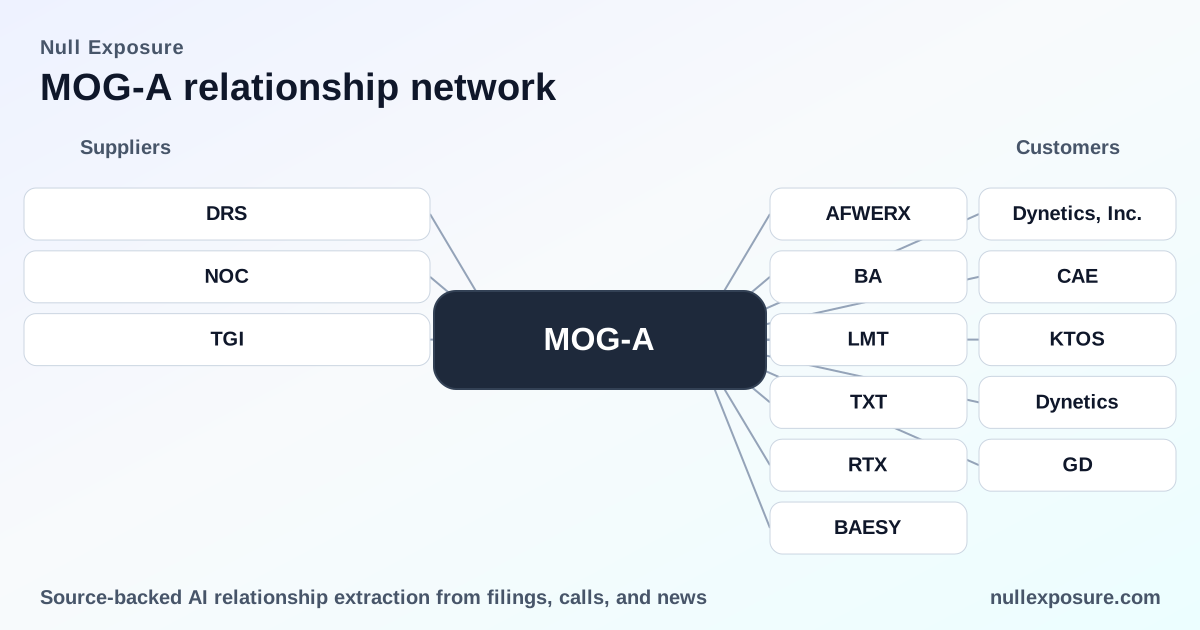
Moog Inc (MOG-A): Supplier relationships that shape aftermarket and defense integration value
Moog Inc designs and manufactures precision motion and fluid controls and monetizes through OEM sales, systems integration for aerospace and defense platforms, and recurring aftermarket services and MRO contracts. Revenue mixes across new platform OEM work and higher-margin aftermarket support underpin free cash flow conversion, while systems-integration contracts in defense create sticky, multi-year revenue streams. Investors should value Moog as a capital‑intensive engineering supplier with a sizable aftermarket moat and selective defense integration exposure that enhances contract durability.
If you want consolidated supplier relationship intelligence and supplier-risk scoring for due diligence, visit the NullExposure homepage: https://nullexposure.com/
Why supplier relationships matter for Moog’s investment case
Moog’s business combines product sales with integration and service contracts. When Moog is named integrator on defense or aftermarket programs, the company captures both component revenue and recurring service margins, raising lifetime customer value. At the same time, Moog operates in markets where platform certification, long product life cycles, and technical interchangeability raise switching costs for customers and partners.
Financial context sharpens that view: Market capitalization near $9.65bn, trailing revenue around $4.05bn and operating margin about 10.9% signal a healthy industrial franchise capable of funding R&D and service networks. Forward P/E compresses relative to trailing (38.0 trailing vs 15.3 forward), which indicates consensus expectations for earnings growth or margin re-rating as embedded contracts and aftermarket scale season. For primary sourcing posture, company disclosures highlight broad supplier diversity: loss of any single supplier is considered immaterial to long‑term operations, which lowers single-vendor concentration risk as a counterweight to program-level dependencies.
Visit https://nullexposure.com/ for supplier relationship dashboards and historical tracking.
Operating model signals and constraints that matter to investors
Think of Moog’s supplier posture and contract profile like a two-layer risk structure:
- Program-level criticality: Defense systems where Moog integrates multiple subsystems create concentrated technical exposure per program but also confer high switching costs for prime contractors and end customers.
- Corporate-level resilience: Company filings note a broad supplier base and state that loss of any single supplier would not be materially disruptive to long‑term operations, which signals low supplier concentration at the enterprise level and a contracting posture that favors multiple sourcing and inventory flexibility.
- Maturity and predictability: Aftermarket and MRO agreements (multi-year terms) convert project revenue into predictable recurring streams; this increases revenue visibility and drives higher lifetime margins.
- Contracting posture: Moog wins integration work that bundles hardware and lifecycle support, positioning it as more than a commodity parts vendor—it is a solutions contractor that captures spare-parts and service economics.
These constraints together present a company that is operationally diversified at the supplier level but strategically concentrated at the program level where it acts as an integrator and aftermarket provider.
What the recent relationship signals mean for growth and risk
The relationships captured in recent reporting fall into two strategic buckets: defense systems integration and aftermarket/MRO partnerships. Defense integrations elevate Moog’s strategic importance on platforms and create multi‑partner engineering dependencies; aftermarket partnerships broaden recurring revenue exposure and expand Moog’s addressable service market in Asia Pacific and elsewhere. Both types of relationships strengthen Moog’s revenue durability and provide optionality on margin expansion through services.
If you track partner exposure as part of counterparty risk or growth planning, see full Moog supplier coverage at https://nullexposure.com/.
Relationship run‑through: what investors need to know
Leonardo DRS — integration on C‑UAS weapon systems
Moog is listed as the supplier responsible for scope of supply and integration work on a counter‑UAS weapon system that also integrates Leonardo DRS’ Multi‑Mission Hemispheric Radars (MHR) and associated C2 systems, indicating Moog’s role as a systems integrator in multi‑prime defense programs. According to a defence‑industry.eu report dated March 10, 2026, Moog’s integration scope is common to the M‑SHORAD family of systems and ties Moog into a wider defense systems ecosystem. Source: defence‑industry.eu article (March 10, 2026) — https://defence-industry.eu/bae-systems-successful-test-of-ampv-c-uas-prototype-video/
Northrop Grumman — co‑integration alongside heavy weapons
Moog’s integration role on the same C‑UAS system also interfaces with Northrop Grumman’s XM914 30mm cannon, which places Moog within the hardware and integration chain of large‑caliber weapon and sensor suites. The same defence‑industry.eu piece (March 10, 2026) describes these common components across M‑SHORAD and C‑UAS systems, confirming Moog’s supplier role in complex defense assemblies that involve major primes. Source: defence‑industry.eu article (March 10, 2026) — https://defence-industry.eu/bae-systems-successful-test-of-ampv-c-uas-prototype-video/
Triumph Group, Inc. — four‑year MRO program expansion in Asia Pacific
Moog signed a four‑year agreement to include Triumph Group’s landing gear and lower deck cargo door actuation control systems for Boeing 787 into Moog’s Aftermarket Total Support (MTS) program for an Asia Pacific operator. This contract demonstrates Moog’s strategy to grow aftermarket service penetration through program-level MRO partnerships, converting component suppliers into recurring service revenue sources. The arrangement was reported by WorldBusinessOutlook (first seen March 10, 2026). Source: WorldBusinessOutlook article (March 10, 2026) — https://worldbusinessoutlook.com/moog-inc-and-triumph-join-hands-on-mro-agreement/
Investment implications and risk checklist
- Upside drivers: Integration roles on defense platforms and expanded aftermarket MRO contracts are high‑quality revenue drivers that lift lifetime customer value and margins. Moog’s recurring aftermarket exposure is a core earnings multiple support.
- Risk factors: Program-level concentration creates single‑platform dependency risk; a single program delay can compress near‑term revenues even though corporate supplier concentration is low. Contract performance, certification timelines, and prime‑contractor dynamics are key operational risks.
- Valuation context: With trailing operating margin ~10.9% and forward P/E notably lower than trailing P/E, the market is discounting near‑term earnings normalization and pricing in growth potential from services and integration work.
Final view and next steps
For investors evaluating partner counterparty risk, program exposure, or aftermarket runway, Moog is a supplier/integrator whose value is driven by system-level integration work and extension of aftermarket services. The company’s supplier diversity reduces single‑vendor procurement risk at the corporate level, while program roles with Leonardo DRS and Northrop Grumman strengthen strategic ties into defense primes and the Triumph MRO relationship boosts recurring revenue in Asia Pacific.
For deeper supplier maps, contract histories, and time‑series exposure analytics, explore the NullExposure platform: https://nullexposure.com/
If you want tailored supplier risk reports or program‑level exposure summaries for investment due diligence, NullExposure can deliver customized analyses — start at https://nullexposure.com/