Molina Healthcare (MOH): Supplier relationships, covenant relief, and what operators and investors should know
Molina Healthcare runs managed care for low-income populations through Medicaid, Medicare and state marketplace programs and monetizes primarily through capitated premiums and risk-bearing contracts with state and federal programs. The business converts membership into recurring revenue streams and reinvests margin into network management and care coordination; financial flexibility and vendor continuity are therefore central to operational stability and earnings conversion. For a deeper look at supplier exposure and covenant-driven liquidity actions, visit https://nullexposure.com/.
Why the Truist amendment matters to an investor in plain English
Molina amended its credit agreement with lenders including Truist Bank to temporarily ease a quarterly minimum interest coverage ratio from 3.00x to a stepped schedule of 1.75x–2.75x covering Q1 2026 through Q3 2027, giving the company near-term covenant breathing room. According to a press release carried by The Globe and Mail on March 10, 2026, this amendment provides additional financial flexibility as Molina executes its Medicare strategy and absorbs near-term earnings variability (https://www.theglobeandmail.com/investing/markets/stocks/MOH-N/pressreleases/92119/molina-healthcare-announces-impairment-charge-amid-medicare-shift/).
- Investment implication: covenant relief reduces the immediate risk of a technical default and lowers the probability of emergency asset sales or abrupt cost cutting.
- Operational implication: lenders have line-of-sight to the company’s plan through a negotiated schedule, which gives management runway to execute but also signals lender oversight for the intermediate term.
All supplier and counterparty relationships recorded in the review
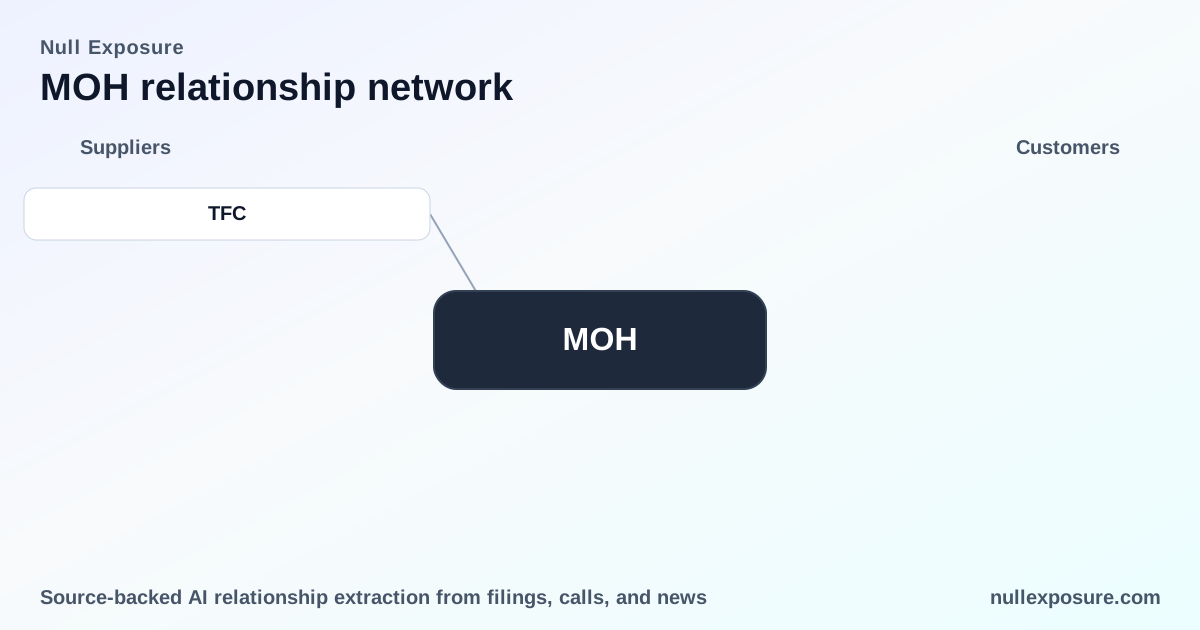
Truist Bank — Molina adjusted its lending terms with Truist as part of a broader amendment to its credit agreement, temporarily lowering the quarterly interest coverage covenant to a stepped schedule for reporting periods between Q1 2026 and Q3 2027 to increase financial flexibility. This action reflects lender engagement over liquidity and covenant metrics (press release reported by The Globe and Mail, March 10, 2026: https://www.theglobeandmail.com/investing/markets/stocks/MOH-N/pressreleases/92119/molina-healthcare-announces-impairment-charge-amid-medicare-shift/).
What the supplier/contract signals tell us about Molina's operating model
Molina’s publicly disclosed constraints around third-party contracting indicate a vendor-centric operating posture for implementation, operations, and IT/cybersecurity support. The filing language states: "The Company contracts with third-party service providers to support aspects of the Program implementation, operations, and review of information technology operations and cybersecurity technologies." That language is a company-level signal of reliance on external vendors for critical infrastructure and program delivery.
From these constraints we draw several structured conclusions about Molina’s business model characteristics:
- Contracting posture: Molina employs active third-party contracts for operational delivery and IT/cybersecurity review, implying regular vendor management and oversight processes rather than insourcing those functions.
- Concentration and criticality: While the constraints do not name specific vendors besides financial lenders, reliance on external IT and cybersecurity suppliers is inherently critical to membership servicing and regulatory compliance; vendor failure or degradation would have outsized operational impact.
- Maturity and stage: The relationship stage is recorded as active, indicating ongoing contracts rather than one-off projects. Active, contract-based relationships suggest established governance but also recurring vendor-renewal decisions and potential cost pressure.
- Negotiating leverage: Molina’s scale as a multi-state managed care operator provides negotiating leverage, but recent covenant concessions to lenders underscore that financial flexibility can influence procurement posture and the timing of vendor investments.
Financial context that frames supplier risk
Molina’s operating scale and valuation metrics contextualize supplier importance:
- Market capitalization roughly $7.54B with trailing revenue of $43.56B and EBITDA around $902M (latest TTM).
- Forward-looking valuation metrics — forward P/E ~11.7 and EV/EBITDA ~3.46 — imply market expectations that profitability will improve if management navigates reimbursement and Medicare shifts successfully.
- Analyst consensus places a target around $150.65, reflecting divergence among buy/hold ratings.
These figures matter because vendor continuity (especially IT/cybersecurity and care management partners) directly affects revenue realization and regulatory compliance, which in turn drives margin recovery and valuation multiple expansion.
Risk checklist for investors and operators
- Covenant watch: The Truist amendment reduces immediate default risk but indicates lender monitoring; track covenant reversion dates (Q3 2027) and quarterly coverage trends.
- Vendor concentration: Confirm the number and criticality of IT and care-management suppliers; single-vendor dependencies are a material operational risk.
- Cybersecurity and compliance: Outsourced cybersecurity reviews create a dependency; demand evidence of penetration testing, SOC reports, and remediation cadence in vendor contracts.
- Refinancing path: Assess access to credit markets and counterparty appetite post-amendment; lender terms set the tone for future financing costs.
- Operational telemetry: Verify that vendor SLAs align with membership and claims-processing timetables; missed SLAs translate quickly into higher medical loss ratios.
For a comparative supplier-risk framework and tailored counterparty monitoring tools, visit https://nullexposure.com/ to see how these signals are tracked across healthcare suppliers.
Bottom line — what to do next
Molina’s lender amendment with Truist reduces an immediate refinancing cliff and gives management runway, but it also highlights how financial covenants intersect with supplier strategy. For investors, the question is whether margin recovery and membership retention will outpace the operational risks inherent in outsourced IT and cybersecurity services. For operators and procurement teams, the priorities are ensuring vendor redundancy, strong SLAs, and visibility into vendor remediation and governance.
If you are evaluating MOH supplier relationships or building a counterparty risk playbook, take the next step and review the detailed relationship logs and covenant timelines at https://nullexposure.com/.