Movano (MOVE) supplier intelligence: what investors and operators should price in
Movano builds and commercializes a smart wearable continuous glucose monitor and related algorithms, monetizing through device sales, algorithm licensing/royalties tied to shipped units, and recurring services supported by third‑party compute and financing arrangements. Supplier relationships—spanning capital providers, cloud/compute vendors, contract manufacturers and accounting firms—directly shape Movano’s runway, product delivery cadence, and regulatory posture. For a deeper read on supplier exposure and counterparty risk, visit https://nullexposure.com/.
Why supplier relationships matter for MOVE right now
Movano is an early‑stage medical device company with $500k in trailing revenue and negative gross profit, so supplier terms have outsized impact on cash flow and go‑to‑market speed. Long‑term leases, usage‑based royalties, and large compute leases or equity facilities change the company’s capital structure, operating leverage and concentration risk in ways investors need to model into scenarios rather than treat as peripheral overhead.
- Capital relationships affect dilution and runway.
- Compute and strategic partnerships can materially accelerate product development and analytics capabilities while concentrating operational risk around a vendor.
- Third‑party manufacturing and distribution are core to whether Movano can scale, given its outsized dependence on outsourcers for device production and algorithm integration.
Explore supplier-level signals and contractual transparency at https://nullexposure.com/ to benchmark counterparties across peers.
The supplier map — every relationship disclosed in recent coverage
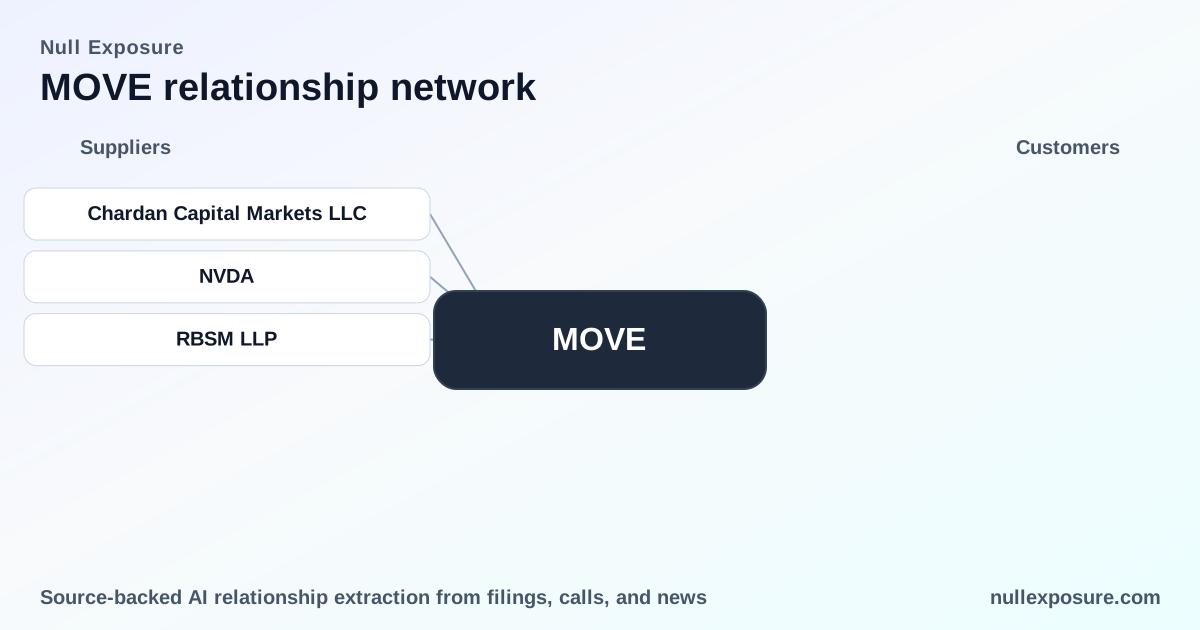
Chardan Capital Markets LLC
Movano entered an equity financing arrangement with Chardan, including a $1.0 billion equity facility plus an additional $3.0 million private placement, providing a substantial financing channel that converts to equity rather than debt. This is reported in market coverage of Movano’s strategic moves (Pulse2, March 2026).
Source: Pulse2 coverage of the Chardan equity facility and private placement (reported March 2026).
NVIDIA / Nvidia H200 GPU deployment
Multiple market reports tie Movano to a strategic deployment of NVIDIA H200 GPUs to support secure, enterprise AI workloads tied to a combined unit with Corvex, and those disclosures corresponded with a sharp rally in the stock as the market priced enhanced compute capability into the story. StocksToTrade and Benzinga both described the GPU lease announcement as a catalyst for a multi‑day surge in MOVE shares (January 2026 reporting).
Source: StocksToTrade coverage (Jan 24–25, 2026) and Benzinga market note on the NVIDIA H200 deployment.
RBSM LLP (new independent registered public accounting firm)
Movano engaged RBSM LLP as its independent registered public accounting firm for fiscal year 2025 and interim periods as part of a compliance plan following Nasdaq notice activity; the engagement was disclosed in the company’s PR release in August 2025. This change signals a governance and reporting remediation pathway that investors should monitor for timing and audit findings.
Source: PR Newswire release announcing RBSM LLP engagement (Aug 13, 2025).
Contractual and operating constraints that drive supplier risk
Movano’s public filings and press coverage surface a set of company‑level signals that define supplier exposure:
- Long‑term contracting posture. The company has an extended lease commitment that runs through December 31, 2027 with an option to extend three years, indicating a willingness to lock into multi‑year obligations for facilities and possibly other infrastructure. This is a company‑level signal about maturity and fixed‑cost commitments rather than a product supplier fact.
- Usage‑based royalty model for product algorithms. Movano is required to pay usage‑based royalties tied to the number of Evie Rings shipped and the number of vendor‑developed algorithms embedded in devices; that royalty structure aligns vendor economics to unit growth but also creates variable margin pressure as volume scales.
- Materiality: currently immaterial royalties. The royalty amounts for 2023 and 2024 were disclosed as not significant, which suggests current sales volumes keep usage‑based fees modest, but the royalty cap and structure matter as devices scale.
- Dependence on third‑party manufacturing and services. Filings explicitly state reliance on contract manufacturers and consultants for integrated circuit development and product supply, so outsourcing is central to execution and creates concentration and quality risk.
- Spend band and contingent exposure. The maximum identified royalty commitment is approximately $6.1 million, a mid‑single‑digit million cap that frames vendor exposure in the near term (spend band $1M–$10M).
- Active contractual stage. Multiple lease amendments through 2024 indicate active, ongoing supplier/provider relationships rather than dormant contracts.
These constraints together show a company that is outsourcing core development and production, trading some fixed costs for variable royalties, and accepting multi‑year infrastructure commitments that affect near‑term liquidity profiles.
Investment implications — how to price these supplier signals
- Dilution vs. runway: Chardan’s equity facility is liquidity but also a dilution lever. Equity facilities of the scale reported materially increase financial flexibility but shift risk to shareholders through issuance; model scenarios with varying draw‑downs and pricing to estimate dilution impact.
- Strategic compute lifts product defensibility but centralizes vendor risk. The NVIDIA H200 deployment accelerates AI capabilities for analytics and algorithm delivery, which is a positive for product differentiation; however, dependency on a single OEM for high‑performance compute creates concentration risk that should be stress‑tested in vendor disruption scenarios.
- Operational execution remains the gating factor. With manufacturing and algorithm royalties outsourced, the company’s ability to secure quality manufacturing, control costs, and protect IP in vendor code is the primary operational risk to revenue trajectories.
- Governance and reporting remediation matters to valuation. The auditor change to RBSM LLP after Nasdaq deficiency notice is a governance signal that investors should treat as a near‑term reputational and compliance risk until filings are current and audited.
For operator teams, translate these points into supplier scorecards and contingency playbooks; for investors, incorporate supplier concentration into downside scenarios. More on supplier scoring and counterparty intelligence is available at https://nullexposure.com/.
Actionable next steps for investors and operators
- Require transparent schedules on royalty caps, revenue thresholds, and escalation mechanics to model margin inflection points as unit volumes grow.
- Insist on dual‑source manufacturing plans and documented transition timelines to reduce single‑vendor production risk.
- Monitor audit timetables and SEC/Nasdaq filings to validate remediation progress and to quantify near‑term reporting risk.
Final read and where to go next
Movano’s supplier relationships are material to both its execution and valuation: equity facilities and compute partnerships extend capability and runway, while royalty models and heavy outsourcing concentrate operational risk. Investors should price both the upside from accelerated AI/compute deployment and the downside from manufacturing or reporting setbacks.
For a systematic supplier risk assessment and benchmarking across the healthcare device sector, visit https://nullexposure.com/ and consider integrating supplier‑level scenario analyses into your valuation models.